Rocketing fuel prices triggered by the Iran war have led to a growing interest in electric vehicles, as charging costs get cheaper.
Prices at the pump have soared to £1.50 a litre as Iran continues its stranglehold on tankers passing through the Strait of Hormuz, following US and Israeli-led military strikes on the country.
At the same time, energy companies have slashed electricity tariffs for overnight EV-charging at home to as low as 3.5p/Kwh.
As a result, a growing number of drivers are now looking to switch to electric vehicles.
Online car marketplace, Autotrader, said there has been a 28 per cent increase in new car EV leads and five per cent for used EVs since the Iran war began on February 28.
Despite growing calls, Labour is refusing to scrap its planned fuel duty hike which would add another £3 to the cost of a fill-up from this September.
The RAC said the average price of a litre of diesel at UK forecourts hit 185.23p, up by 30 per cent or 43p, since the war started on February 28.
Average petrol prices have reached 154.45p per litre, a rise of 16 per cent or 22p, over the same period.
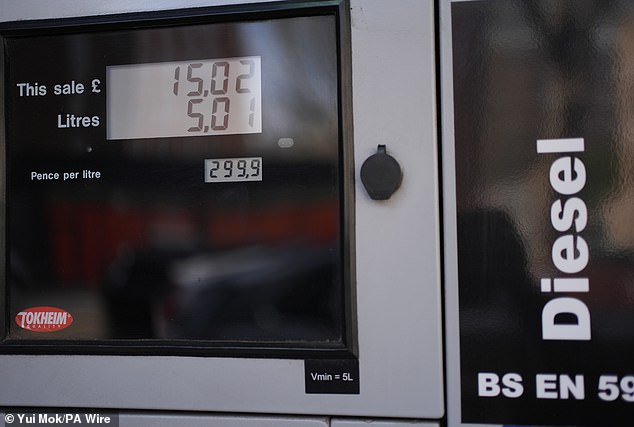
Fuel prices are shown on the pump at 299.9p per litre of diesel at the Gulf Chelsea Cloisters service station in central London on Wednesday
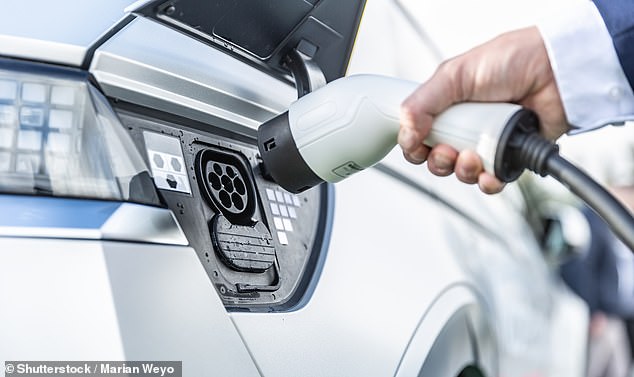
A growing number of drivers are now looking to switch to electric vehicles as fuel prices continue to rise
One fuel station in Chelsea, west London, was seen selling diesel for 299.9p per litre, with the equivalent rate for petrol set at 288.9p.
Meanwhile Octopus Energy has cut its most popular EV tariff, which allows up to six hours charging overnight, from 12p/kWh to 8p/kWh.
Fraser Brown, an analyst from the automotive consultancy MotorVise, told The Times: ‘It seems like a no-brainer, especially when the costs of charging are falling.’
Brown, who also runs the second-hand EV car dealership Browns of Richmond, in North Yorkshire, said that since the start of the Iran war, queues had formed outside his dealership every Saturday.
He said the economics are winning people over, with it costing about £3.50 to charge an EV overnight as opposed to more than £100 to fill an average family car.
As the Middle East conflict continues, UK drivers have been urged to consider cutting out ‘non-essential journeys’ because fuel prices are rising as the cost of oil soars.
AA president Edmund King, who issued the advice, also suggested motorists should change their driving style to be more fuel efficient and therefore save money.
Data compiled from pump price comparison website PetrolPrices.com previously showed a litre of diesel costing up to 217.0p at some forecourts in rural Scotland.
The UK’s most expensive petrol was being sold for 199.9p per litre at Avenue Garage in Northwich, Cheshire.
The most expensive motorway service area for diesel was said to be Euro Garages’ Rivington Services on the M61 in Bolton, Greater Manchester, where the price reached 200.9p per litre.
Welcome Break’s Woodall Services on the M1 in Sheffield had the highest price for petrol, at 189.9p per litre.
The RAC Foundation estimated that rises in pump prices since the conflict began led to motorists paying an additional £544million for petrol and diesel – £409million for diesel and £135million for petrol.
The figures are based on average daily pump price rises and last year’s fuel consumption rate.
Richard Smith, managing director of the Road Haulage Association, said rocketing pump prices were hurting businesses and delivery firms as well as private motorists.
He said: ‘Rising fuel prices continue to be a huge challenge for HGV, coach and van businesses who already typically operate on thin margins.
‘The knock-on effect will be felt through the supply chain and by households as costs are passed on.
‘We’re clear – scrap the fuel duty hike. This isn’t an industry concern; it’s a national one.’