Daily Mail journalists select and curate the products that feature on our site. If you make a purchase via links on this page we will earn commission – learn more
It’s often considered the ‘cleanest country in the world’ – where even chewing gum is outlawed to crack down on littering; so it’s no wonder that Singapore has some of the tidiest homes and spaces out there.
From small apartments to public buildings, social media is awash with locals sharing their very impressive tech, which includes robot window cleaners, a rubbish bin that automatically seals the trash bag for you, and a special machine that cleans your fruit and veg.
Elsewhere tourists visiting the East Asian country have been overwhelmed with the nation-wide commitment to discipline, with some cafes touting self-cleaning tables while airports have robots that do the tidying up.
‘Singapore’s clean reputation is something the government consciously sought to promote,’ public policy academic Donald Low told the BBC – after the country separated from Malaysia in 1965.
‘Originally, that cleanliness had at least two connotations: the first was physical, or environmental, cleanliness; the second was a clean government and society that didn’t tolerate corruption.
‘As a newly independent city-state that was keen to attract foreign investments, Lee Kuan Yew (the prime minister at the time) believed, correctly, that these things would differentiate Singapore from the rest of South-East Asia.’
And today, it seems to be a key part of the country’s culture.
Taking to TikTok earlier this year, Singaporean influencer Cherie demonstrated her using a handy ‘winbot’ from company ECOVACS – which she uses to clean her windows without tiring her arms out.
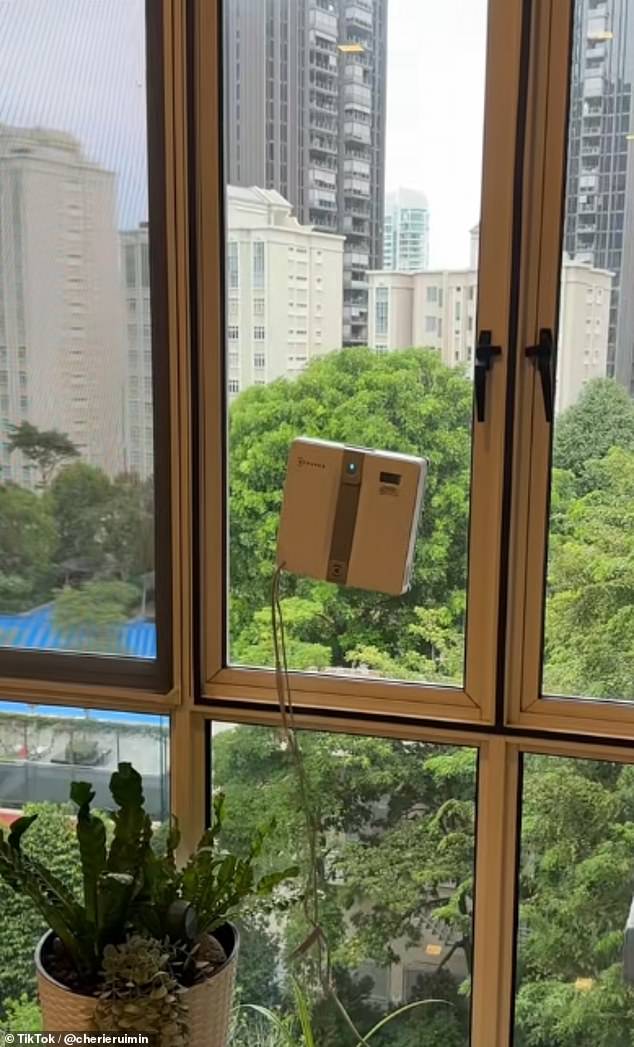
Taking to TikTok earlier this year, Singaporean influencer Cherie demonstrated her using a handy ‘winbot’ from company ECOVACS – which she uses to clean her windows without tiring her arms out
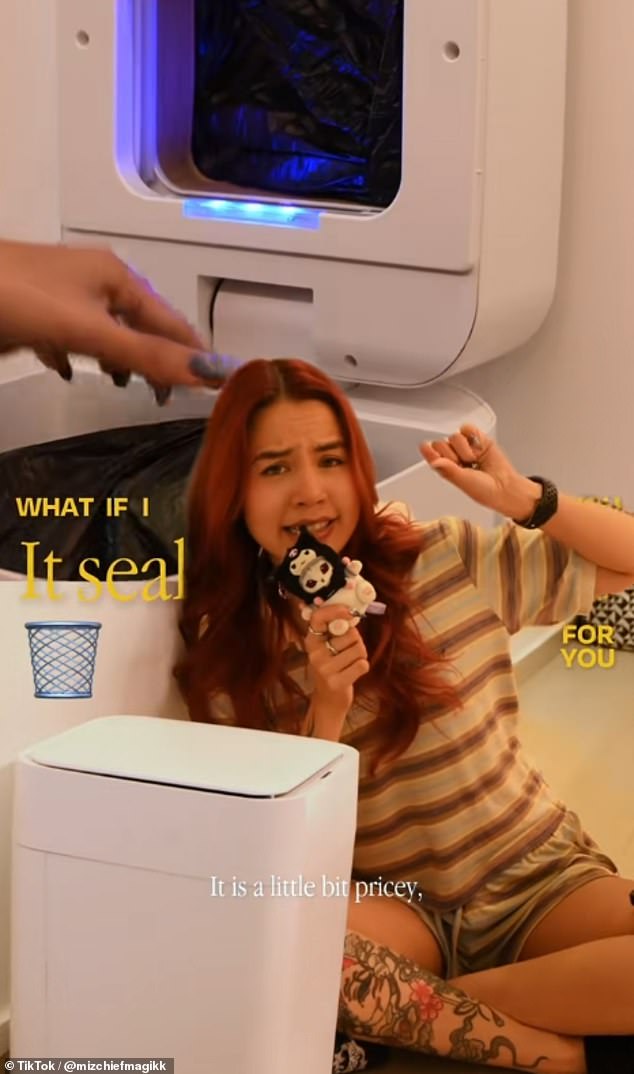
Elsewhere, Leah, who lives in the city-state shared a myriad of her favourite home-tech in a video
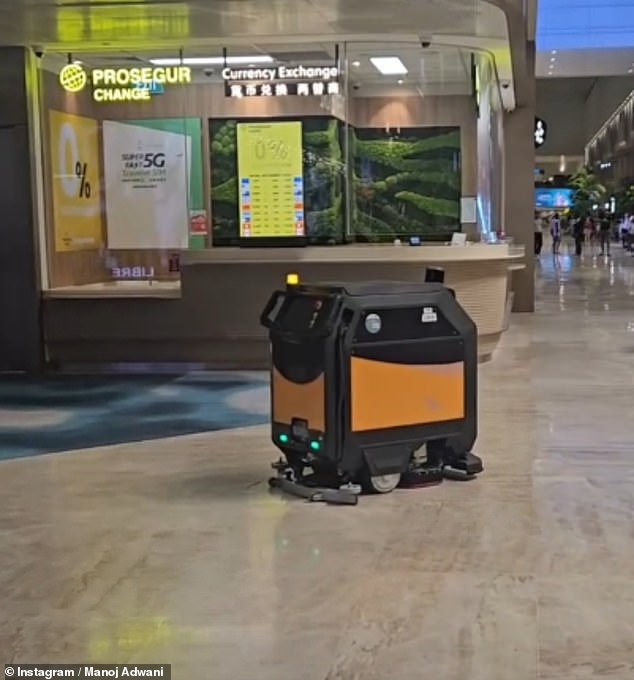
When it comes to public spaces, the tech is even more involved. One creator, Manoj Adwani, was baffled by a self-sufficient cleaning robot at the airport
‘It does the job for me,’ she shared’ ‘I just place it on, press start and it automatically begins cleaning.
‘It’s not just for windows. I also use it on bathrooms, glass, large mirrors. It’s small and compact, sprays evenly and even maps the cleaning route on its own!’
Elsewhere, Leah, who lives in the city-state shared a myriad of her favourite home-tech in a video.
One of them included a high-tech bin that, as well as having a sensor to open and close the lid, also wraps the bin bag up for you.
She admitted that it’s ‘pricey’ (these ‘self-sealing’ models go anywhere from £100 to upwards of £200) – but is ‘worth it for her sanity’.
Another popular item is a ‘3-in-1 sink dishwasher’ from Chinese brand Fotile. It is a countertop-installed gadget which opens up into a high tech device homeowners can use to wash dishes and disinfect ingredients, depending on the setting they use.
Elsewhere, there are also plenty of fridge drink organisers which carefully stack your cans and come with an automatic spring that immediately replaces your beverage as soon as you’ve taken it out.
Dehumidifiers with a myriad of functions – including one that helps rid the area of damp and prevent mould – are also a must have, and many sharing cleaning videos of their flat use a handheld steamer to clean sofas and other furniture.
When it comes to public spaces, the tech is even more involved. One creator, Manoj Adwani, was baffled by a self-sufficient cleaning robot at the airport.
‘It cleans the designated areas,’ he told Instagram followers. ‘Runs on the battery, and most importantly, when its battery runs out, it automatically comes to the docking station to charge itself.’
Elsewhere earlier this year, Channel News Asia reported that there are now even ‘self-cleaning tables’ at a food court at the country’s Nanyang Technological University, creator by operator Food Haven.
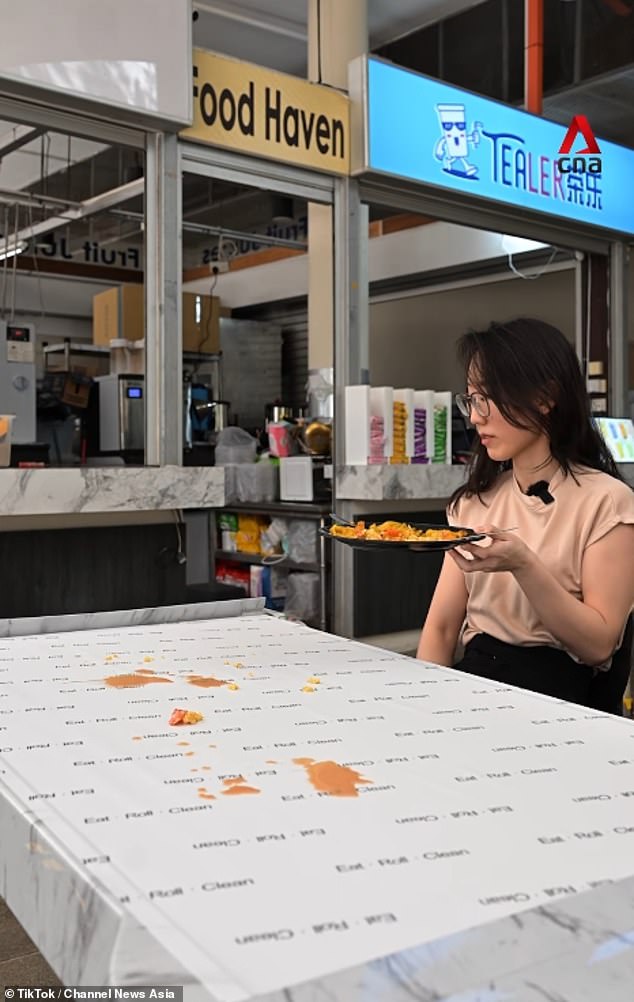
Elsewhere earlier this year, Channel News Asia reported that there are now even ‘self-cleaning tables’ at a food court at the country’s Nanyang Technological University, creator by operator Food Haven
Disposable sheets are stretched across, and a mechanism pulls it away and disposes the leftovers and mess before replacing it with a fresh layer for the next diner.
The company’s director Shane Tay told the outlet: ‘There’s always this struggle of maintaining proper hygiene within the large dining area of food courts because of manpower issues.
‘It’s hard to hire workers and hard to retain workers also. We are trying to eliminate this dependency on manpower (with the automation of the cleaning process).
‘So every diner after… (they) are done eating, they return their trays. The next group of diners can just sit down with the press of buttons.’
It comes as social media users have also recently been left stunned at Japan’s incredible cleaning gadgets – after the nation’s football fans were praised for tidying away rubbish at Wembley.
A viral video by a Japanese homeowner, posted to TikTok, has revealed some of the nation’s most innovative cleaning contributions that show their commitment to smart living in the home.
Amassing more than 8,000 likes, the clip shows a woman’s daily cleaning rituals, but with a few rather remarkable twists.
In it, a space-saving laundry machine is seen mounted to the bathroom wall, rather than on the kitchen floor, and contains numerous personalised settings.
The cleaning fanatic also added a sophisticated layer to her laundry ritual by using a miniature home washer for the smaller items.
Even shoes have their own special washing compartment, ensuring there is no need for them to be put into the same load of laundry as your clothes.
Dried with an electric machine that seeks to keep them fresh, these shoes are not bundled into a messy cupboard in the hallway or placed on a traditional shoe rack. Instead, they are kept in a specially heated drawer for maximum comfort.
Advanced incense machines are used to offer a sense of calm to the home, while the woman also uses a specialist toothbrush sanitiser that dispenses toothpaste at the click of a button.
The electric toothbrush heads are also clamped to prevent any bacteria from getting through – a simple, yet easy way to prevent any unwelcome germs.
Yet the unusual home cleaning products do not stop there. Even in the kitchen, the woman is spotted arranging her eggs in a large egg drawers, while a vacuum sealer machine helps to keep her leftover food fresh with ease.
In a bid to avoid any supermarket fruit or veg from being unsanitary, she also places a vegetable washing machine/purifier into a bowl with her products.
And when it comes to keeping the bedroom clean – the innovative home owner uses a mattress cleaning vacuum and, for those who enjoy seeing the results, proudly shows the vast amount of rubbish collected afterwards.
The variety of weird and wacky home machines have sent social media users into overdrive, who quickly took to the video’s comments to praise the homeowner for her innovative cleaning products.
‘I want everything in this video,’ commented one user, while another added: ‘I need that shoe washer.’
‘It would be great if they sold these hygiene products all over the world,’ added one watcher, while another remarked: ‘that washing machine!!!’
The remarkable footage comes amid a rise in so-called ‘smart living’, with impressive home innovations beginning to dominate our everyday.
Indeed, numerous celebrities have embraced this change in home cleaning rituals – with Stacey Solomon and Australian TV personality Hannah Ferrier firm fans of a robot vacuum cleaner, while Kris Jenner favours a £250 ice cream maker.
Yet these weird and wonderful forms of technology appear to be expanding even further, with Japan often posited as being at the forefront of smart living – integrating unique health-monitoring toilets and AI kitchen appliances into the everyday.
In Japan, cleanliness forms a huge part of the culture and is instilled in people from an early age.
Scott North, a professor of sociology at Osaka University, told the BBC in 2018 that tidying is a way of ‘demonstrating pride in the Japanese way of life’.
‘It’s not just part of the football culture but part of Japanese culture,’ he said. ‘You often hear people say that football is a reflection of culture. An important aspect of Japanese society is making sure that everything is absolutely clean and that’s the case in all sporting events and certainly also in football.
‘Cleaning up after football matches is an extension of basic behaviours that are taught in school, where the children clean their school classrooms and hallways,’ he added.
‘With constant reminders throughout childhood, these behaviours become habits for much of the population.’
Futurologist Tom Cheeswright, who has predicted the most exciting breakthroughs set to improve our home lives, previously told the Daily Mail: ‘It’s become fashionable to bemoan a future dominated by AI, robotics and relentless technological change, but really, we have a lot to look forward to.
‘When you take a step back and look at the progress we’ve made so far in the 21st century, from decoding the human genome to renewable energies becoming the fastest-growing power sources, it’s clear that human ingenuity has the power to outpace pessimism.
‘Across every industry, from healthcare and housing to retail and travel, we’re seeing the early signs today of breakthroughs that promise to change our lives for the better.
‘If we back these bold ambitions, harness these innovations, the next 24 years have the potential to be the greatest era of human progress in our long history.’
SHOP THESE SINGAPORE-INSPIRED CLEANING GADGETS…