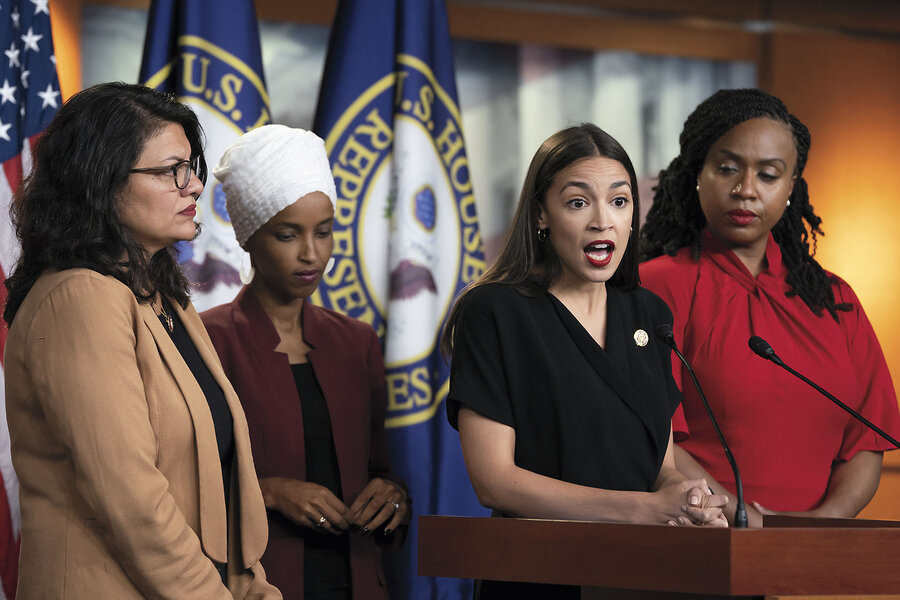
In the hours after the U.S. first struck Iran on Feb. 28, Democratic Rep. Alexandria Ocasio-Cortez put out a statement that was characteristically blunt.
“This war is unlawful. It is unnecessary. And it will be catastrophic,” she wrote.
Her full-throated denunciation stood in contrast to the carefully calibrated messaging from Democratic leaders in Washington, who sternly criticized President Donald Trump for failing to seek congressional authorization, but also condemned Iran as a “bad actor” with dangerous nuclear ambitions.
Why We Wrote This
New York Rep. Alexandria Ocasio-Cortez is keeping quiet about her political future. But in a tumultuous political environment, where many voters dislike both parties, some say the young, charismatic lawmaker is well-positioned to mount an outsider bid for the White House in 2028.
And it helps explain why Ms. Ocasio-Cortez is increasingly seen by many insiders as a serious contender for the Democratic presidential nomination in 2028.
At a time when many Democratic voters are looking for leaders who will push back forcefully against President Trump, Ms. Ocasio-Cortez’s brand as an outspoken change agent may hold appeal. Her views on issues, including pushing for universal health care and a wealth tax, and opposing U.S. aid to Israel, resonate with a younger generation of voters frustrated with the status quo. With fellow democratic socialist Sen. Bernie Sanders not likely to mount another White House run, there’s an opening in the left-wing, antiestablishment lane – if the former bartender from New York wants it.
The 2028 campaign won’t officially begin for another year or so. But not-so-subtle maneuvering is already taking place. Many Democratic White House hopefuls are visiting early primary states, peddling political memoirs, and raising money for local candidates.
Ms. Ocasio-Cortez has not engaged in such overt signaling and has generally deflected questions about her political future. But the New York congresswoman has positioned herself for a possible run. Last year, she joined Vermont’s Senator Sanders on a nationwide “Fighting Oligarchy” tour that drew huge crowds. She also made some shrewd endorsements – including New York Mayor Zohran Mamdani, another democratic socialist who rose from obscurity to pull off one of the biggest political upsets in recent history.
It was a similar upset that catapulted Ms. Ocasio-Cortez onto the national stage in 2018, when she beat 10-term Democratic Rep. Joe Crowley, a member of the House leadership, to become the youngest woman ever elected to Congress. She quickly became a darling of the left – and a villain to the right – criticizing the Washington establishment and pushing for progressive policies.

Now, she’s arrived at a kind of crossroads. Longtime observers and people in the four-term lawmaker’s orbit say she is looking past this fall’s midterm elections and carefully considering all her options. She could remain in the House and keep working her way up the seniority ladder, using her social media megaphone to steer her party. She could mount a primary challenge to New York Sen. Chuck Schumer, the Democratic leader whose approval ratings have fallen as his party has languished in the minority. Or she could take an even bigger risk and run for president – offering herself as a young and charismatic underdog with fresh ideas and online savvy, at a time when the nation will be coming off its two oldest presidents ever.
“AOC conceivably fits in the Obama lane as an outsider,” says former New York Rep. Anthony Weiner. “The base is excited [by her]; she gives good speeches.” Paradoxically, he adds, she may benefit by being underestimated. “She’s seen as not having enough experience and is not being taken super seriously except by outsiders. Nowadays having less of a record is better than having more of a record.”
In national and early primary state surveys of whom Democratic voters would like to see as their next nominee, Ms. Ocasio-Cortez often lands in the top two or three. She is without question a polarizing figure, with policy preferences that put her to the left of the mainstream voter. But just as Mr. Trump moved the GOP in a more populist direction in 2016, the Democratic Party may be ripe for a takeover next year, particularly if frustrations with the war in Iran, rising health care and grocery costs, housing affordability, and Israel continue to build.
“We’ve seen progressives succeed at all levels across the country,” says John Paul Lupo, a Democratic political consultant. “She is the most electable progressive that we have, and she’d be foolish not to take a look at 2028.”
Playing the long game
Since coming to Washington as an inexperienced 29-year-old in 2018, Ms. Ocasio-Cortez has transformed from a brash newcomer to someone who seems to be playing the long game.
She antagonized some of her new House colleagues before she was even sworn in, joining youth climate activists to occupy Democratic Speaker Nancy Pelosi’s office that December. She partnered with Justice Democrats, a political action committee that recruits challengers to run against incumbents, including targeting newly selected House Democratic Caucus chairman Hakeem Jeffries.
Along with three other left-wing newcomers known as “The Squad,” Ms. Ocasio-Cortez amassed one of the largest social media followings on Capitol Hill – and used that platform to voice displeasure with border security legislation and Speaker Pelosi’s reluctance to launch impeachment proceedings against President Trump.
Ms. Pelosi publicly panned The Squad’s influence, while privately telling them to tone down their tweets if they ever wanted to accomplish anything.
Ms. Ocasio-Cortez seemed to heed the advice. Over the next six years, she became a more skilled Washington insider, promoting progressive policies such as Medicare for All and the Green New Deal while also contributing campaign funds to moderate Democrats in swing districts.
She developed a friendly relationship with President Joe Biden, who adopted her agenda to reduce greenhouse gas emissions and expand health care access for millions of Americans. When other Democrats began calling on President Biden to suspend his reelection campaign after a disastrous debate performance in the summer of 2024, Ms. Ocasio-Cortez forcefully defended him.

More recently, she has staked out positions on issues from online gambling to AI and privacy to the construction of data centers that have drawn approving comments from conservatives.
Still, navigating the corridors of power on Capitol Hill doesn’t guarantee a successful leap to a presidential campaign. In February, Ms. Ocasio-Cortez drew a slew of negative headlines after a high-profile stumble at an international security conference.
In her first major foreign policy address, she told an audience of global leaders in Munich, Germany, that income inequality has fueled the growth of far-right populism, urging Europe’s left and center-left communities to unite against it.
But when asked about other topics, her answers were less assured. She called the Transatlantic Partnership the Trans-Pacific Partnership, said Venezuela was below the equator, and paused for an excruciatingly long time when asked how the United States should respond if China invaded Taiwan. The criticism was so scathing that the congresswoman was forced to respond with a phone call to The New York Times.
To some, it was evidence of the greater scrutiny and higher standards that female candidates often encounter compared with male rivals.
“AOC has to avoid the ambition trap. Women of politics, particularly women of color, get seen as being impatient,” says Christian Amato, a campaign strategist from the Bronx. At the same time, he adds, “She has one of the clearest defined arcs to grow out of any candidate.”
The Senate option
In the wake of the Democrats’ 2024 electoral losses – when the party belatedly pushed its 81-year-old president out of the race, only to lose the White House to Mr. Trump and be shut out of power on Capitol Hill – generational tensions have continued to grow.
That winter, Ms. Ocasio-Cortez mounted a bid for ranking member of the House Oversight Committee, but lost out to eight-term Virginia Rep. Gerry Connolly, who died six months later. She declined to seek the position a second time, telling reporters “the underlying dynamics in the caucus have not shifted with respect to seniority as much as I think would be necessary.”
Since then, the clamor from Democratic voters for a new generation of leaders has only gotten louder. A number of younger candidates are challenging veteran lawmakers in primaries.
Much of the base’s ire has been directed toward Senator Chuck Schumer, whose popularity has dwindled to its lowest level in 25 years. Last November, after eight Democratic senators voted with Republicans to end the longest government shutdown in history without securing any real policy concessions, several House Democrats called for his removal as minority leader.
Ms. Ocasio-Cortez blasted the decision to end the shutdown, but sidestepped questions about Mr. Schumer. Asked whether she would consider running for his seat when it comes up in 2028, she said only, “That is years from now.”
Still, some Democratic insiders see it as a strong possibility. Mr. Amato says Ms. Ocasio-Cortez has been building authority on a range of issues including civil liberties, executive overreach, and tech abuses. If she decides to challenge Mr. Schumer in a primary, he says, she will be well positioned to do so.
“Her behavior suggests, ‘I don’t want the seat if it’s handed down,’” he says. “She wants optimal conditions that make a different kind of leadership necessary.”
Mr. Schumer has not yet said whether he plans to run for reelection. But many speculate he will, especially if Democrats take control of the Senate in 2026.
Still, the minority leader has been losing support for much of the past year. Only 27% of statewide voters think he is doing an excellent or good job in office, according to a February Marist poll. Ms. Ocasio-Cortez topped him 48% to 34% in a head-to-head matchup among New York City voters surveyed by the Honan Strategy Group in December.
Bradley Honan, the New York pollster who conducted the survey, says Ms. Ocasio-Cortez would be a formidable Senate candidate. But he believes her ambitions run higher.
“The leadership role she’s played in the party, holding rallies with huge turnout at a time when Democrats are feeling disaffected. … I think she is looking past the U.S. Senate race – which is hers to lose – and very seriously considering a presidential bid,” he says.
Then there’s the Mamdani effect. The splashy electoral success of Mayor Mamdani, on the heels of two grassroots-powered presidential runs by Senator Sanders, may give Ms. Ocasio-Cortez a boost in scaling up a campaign, tapping into a network of consultants and workers.
Gustavo Gordillo, co-chair of the New York City Democratic Socialists of America, said he is hearing “a lot of excitement” among his political organization’s members for another democratic socialist candidate for president.
“Bernie’s campaign was so helpful for working people in this country, even though he didn’t win,” he says. “I think that we’re hungry for another bite at the apple.”