The Iran war has become a test for Germany’s strategic independence and economic resilience. Germany, so far, appears to be failing the test. As Germans debate the issue and reconsider past policy choices, no party has seized the moment more deliberately than the Alternative for Germany, now one of the strongest political forces and the clearest nationalist challenge to Berlin’s governing consensus.
The conflict is not simply a distant war in the Middle East, but yet another sign of deeper disorder within the Western alliance. After the U.S. and Israeli strikes on Iranian targets at the end of February, Tehran responded with disruptions in the Strait of Hormuz, a vital chokepoint for global energy supplies. The result has been a sharp rise in oil and gas prices, with immediate and painful effects on European economies, including Germany.
The AfD’s response rests on a clear insistence that this is not Germany’s war. In a recent speech at the party conference in Saxony, co-chair Tino Chrupalla argued that Berlin must not allow itself to be drawn into foreign conflicts. German security, he warned, would not be aided by joining another Middle Eastern escalation. He pointed to Spain’s refusal to allow its bases to be used in the conflict as a model of sovereign decision-making. Germany, he declared, should not commit itself to a conflict without a defined objective or a realistic path to disengagement.
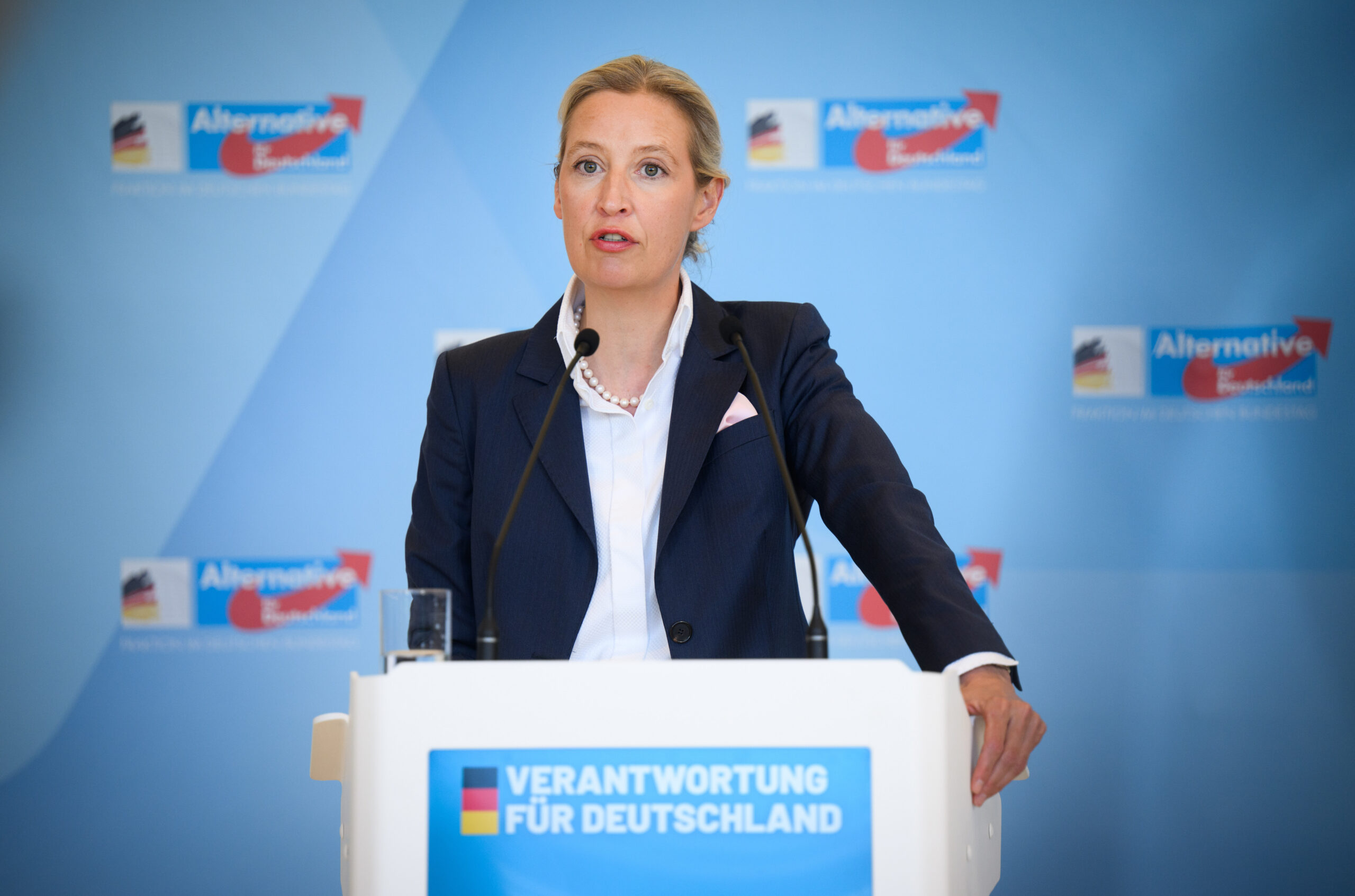
Increasingly AfD leaders say that Germany does not benefit from the “protection” afforded by the United States. The latest war underscores the point. Germany does not determine the course of events, yet it will inevitably absorb the fallout. Party leader Alice Weidel has warned that a prolonged conflict could have devastating economic consequences, driving inflation, raising energy costs, and further weakening an already strained industrial base. These risks are no longer theoretical. Energy prices in Europe have surged dramatically, placing direct pressure on German households and industry through higher fuel and heating costs.
Within Germany’s nationalist camp, these arguments resonate far beyond foreign policy, and here is where the AfD challenge to the Berlin establishment becomes visible. The crisis is increasingly understood as a direct threat to domestic stability and social cohesion. Rising energy costs, industrial uncertainty, and further economic decline are long-standing concerns that have now gained urgency. Moreover, anxieties about migration flows and internal security have become inseparable from the external situation. In this reading, the crisis does not stand alone or outside the borders. It reinforces a broader pattern in which Berlin’s policy decisions produce domestic burdens exacerbated by events shaped in foreign capitals.
For some Germans, political responsibility appears to be ambiguous, but for AfD the current crisis reflects a broader issue: Germany’s political class has become more responsive to international expectations than to the needs of its own citizens, strengthening the appeal of the AfD’s position. And it’s worth remembering that Berlin has joined Washington in previous interventions, including Afghanistan, which was justified in the language of alliance solidarity but in practice produced long-term commitments, unclear outcomes, and limited direct benefit for German security.
The Iran war raises a fundamental question: What, exactly, are Germany’s core interests, and would they be served by its involvement? While the Chancellor Friedrich Merz has ruled out direct participation in the U.S.–Israeli war, the crisis extends beyond questions of war and peace. They expose deeper structural weaknesses in Germany’s social model of mass migration and deindustrialization.
The consequences for Germany of the Iran war are not simply imported from abroad but result from deliberate policy choices that have left the country vulnerable to precisely this kind of external shock. Years of energy policy decisions have weakened the industrial base, reducing resilience and increasing dependence on volatile global markets. These pressures are not temporary disruptions, but long-standing vulnerabilities now exposed under geopolitical stress. Reliable and affordable energy sources have been replaced by more expensive and politically dependent alternatives, including liquefied natural gas from the United States and the Gulf region. If the war sparks a refugee crisis, Germany’s porous borders could allow unvetted outsiders to enter.
Germany already faces higher costs and greater exposure to geopolitical volatility, while losing the competitive advantages that once underpinned its industrial strength. Higher fuel prices illustrate the problem with particular clarity. They are not simply the result of global supply dynamics. Domestic policy decisions, including taxation and regulatory burdens, amplify their impact. A significant portion of fuel costs is determined by state-imposed charges, meaning that price increases generate additional revenue even as they strain consumers. Perhaps for that reason, government “solutions” have largely taken the form of symbolic measures, rather than addressing the underlying drivers of inflation.
What is required instead is a fundamental reorientation. Lower energy taxes, the removal of carbon pricing mechanisms, and a reassessment of sanctions that restrict supply would provide immediate relief and improve long-term stability. Without such changes, the risk is not only temporary economic hardship, but a sustained erosion of Germany’s industrial base.
In many respects, this debate mirrors familiar arguments in the United States. Questions about the limits of intervention, the economic costs of global commitments, and the risks associated with entering conflicts without a clearly defined national interest have become central to American political discourse. They are now emerging with increasing force in Germany as well.
Germans have been reassessing America, whose recent policy decisions, especially the willingness to escalate conflicts in the Middle East with limited European consultation, have imposed significant social, economic, and strategic costs on its allies. The crisis reinforces the perception that Washington often sets the direction, while European nations, including Germany, bear a disproportionate share of the consequences through economic strain and migration. Germans do not necessarily reject the bilateral relationship, but they demand a genuine partnership based on mutual respect and balanced burdens.
This logic extends directly to NATO. While the alliance itself is not in question, its structure, dominated by American priorities, deserves scrutiny. The war with Iran affects European security directly, but because it is a war of aggression, NATO’s collective defense provision hasn’t been triggered. Washington is pressuring European allies to join the fight, but doing so would pose great risk for Germany, which is likely within range of Iran’s ballistic missiles. Even America’s use of bases in Germany exposes the country to possible retaliation.
Clearly, Germany must build greater strategic autonomy: the ability to assess each conflict on its own merits and decline participation when vital interests are not served. This includes a serious discussion about the scale and purpose of foreign military presence on German soil.
Even within the AfD, this question is not entirely settled. While calls for greater sovereignty and a reduced American military presence are central to the party’s outlook, a more cautious strain of thinking emphasizes current strategic realities. Beatrix von Storch has argued that any reduction of American forces must be tied to Germany’s actual ability to defend itself and fulfill its obligations within NATO. Given Germany’s limited military capabilities and continued reliance on the American nuclear umbrella, she has warned against premature steps that could weaken deterrence. This reflects a broader tension within the nationalist right between long-term strategic ambition and short-term security constraints.
Subscribe Today
Get daily emails in your inbox
Another shift in political thinking is becoming visible, with growing skepticism toward military intervention and declining confidence in automatic alignment with American strategy. Clearly defined national interests are once again being reasserted across the political spectrum, even if different parties draw different conclusions.
For American readers, this development carries wider significance. Debates now unfolding in Germany reflect concerns that have long been present in the United States. Questions about intervention, alliance structures, and economic sovereignty are no longer confined to one side of the Atlantic. They are becoming central to Western politics as a whole. The Iran war has not created this shift but has accelerated it and brought it into sharper focus.
These are complex debates, but some conclusions are obvious: Germany should avoid entanglement in distant conflicts that do not serve its interests. It should reassess the degree of its dependence on external powers, in particular the United States. It should assert control over its own borders to reduce exposure to foreign crises. And it should restore the economic foundations necessary to sustain genuine sovereignty. For Germany, the Iran war is not an isolated event. It is a signal of deeper structural challenges that can no longer be ignored.