I moved to Walton-on-Thames 13 years ago, swapping London life for what I imagined would be more space, more greenery and the perfect place to raise a family.
And at first, it really did feel like I’d made it.
There was a buzz about Walton-on-Thames back then. A sense that this was the Surrey commuter town to watch. Millions had been poured into regeneration. New developments were springing up. Property prices were climbing steadily.
It felt like a place on the up.
But looking back now, there were early signs of what was to come.
Because while the town was growing quickly, it wasn’t always growing evenly. New homes appeared at pace, but the infrastructure around them and the overall feel of the town didn’t really keep up.
And that’s perhaps where the shift began.
Today, there’s a growing sense that Walton-on-Thames has been built up quickly, but without everything around it evolving in the same way. It means that it’s been left feeling slightly overdeveloped and under-served.

Nicola Rowely felt like she’d ‘made it’ when she swapped London life for a quieter life in Walton-on-Thames 13 years ago
It’s not the buildings or homes themselves that are the issue. It’s what’s missing around them.
And somewhere along the way – particularly since the pandemic – that original sense of energy and momentum has quietly slipped away.
A high street that’s lost its heart
Today, the high street tells a very different story.
Once lively and full of recognisable brands, it now feels eerily hollow. Aside from the dependable presence of Aldi and Pets at Home, much of it has become a patchwork of empty units, community-based charity shops and short-lived businesses trying – and often failing – to make it work.
Of course, charity shops have their place. But when they begin to dominate, it’s usually a sign of something deeper: rising rents, shrinking footfall, and a town centre struggling to keep up.
There’s a tiredness to it now. A sense that the energy has drained away.
And after dark? That’s another story entirely.

The PR business owner believes that – particularly since the pandemic – the original sense of energy in the area has quietly slipped
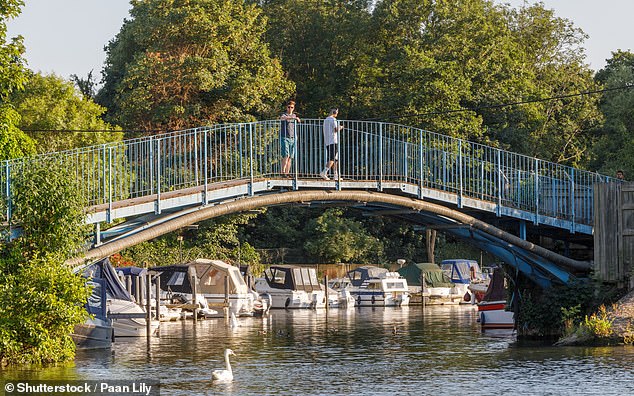
Nicola said the town ‘no longer feels like the same place’, with groups of hooded teenagers weaving through the streets at speedon their bikes
Where I once wouldn’t have been concerned about spending an evening, now I think twice.
Groups of teenagers on bikes, faces hidden under hoods, weaving through the streets at speed – it’s not constant, but it’s enough to shift the atmosphere. It no longer feels like the same place.
The cost of Surrey living (without the Surrey charm)
And then there’s the cost of it all.
Living in the Elmbridge borough has never been cheap – but it’s a bitter pill to swallow when what you’re paying for no longer matches what you’re getting.
While it may no longer top the list as the most expensive council area in England, it remains firmly among the priciest, with band D council tax sitting at around £2,558.
For that, you expect a thriving town centre, a sense of pride and a place that feels cared for.
Instead, Walton feels like it’s treading water.
Commuter reality – the squeeze is real
Of course, one of the biggest selling points for Walton-on-Thames is its proximity to London.
Like many people, my working life has shifted significantly in recent years. I now run my communications agency, NJRPR, largely from home, which means I spend far more time around my home than I did in my early commuting days.
And perhaps that’s why the changes in Walton feel more noticeable now – because when you’re actually living in a place day in, day out, rather than just passing through it morning and evening, you start to see things differently.
On paper, it’s prime commuter territory. Just 25 minutes into London Waterloo on the fast train.
In reality? It’s a daily endurance test.
By the time the train reaches Surbiton, it’s already packed. Shoulder-to-shoulder doesn’t quite cover it. Commuters stand wedged together, exchanging polite, slightly defeated smiles as personal space becomes a distant memory.
And when something goes wrong on the line – which it inevitably does – everything grinds to a halt.
Platforms fill. Departure boards flicker with delays. And hundreds of weary commuters stand staring upwards – willing a train – any train to appear.
It’s not quite the idyllic Surrey commute many imagine.
The surrounding Surrey spots – the good, the bad and the underwhelming
Having lived in this pocket of Surrey for over a decade, I’ve come to know the neighbouring towns well.
Some are charming. Some are thriving. And some promise more than they deliver.
Addlestone – a glow-up that forgot the soul
Addlestone has had a serious makeover in recent years.
The shiny new development, complete with The Light cinema, the recently departed hybrid football sports venue KickX, and a handful of restaurants, suggests a town reinventing itself.
And on the surface, it kind of works.
But step just beyond the development, and the illusion starts to fade.
The surrounding high street still feels worn down and disconnected from the glossy centrepiece.
It’s as though two different towns are trying to exist side by side – one modern and ambitious, the other struggling to keep up.
The cinema is excellent. But it shouldn’t be the only reason to visit.
Chertsey – blink and you will miss it
Chertsey should have everything going for it.
It’s historic, iIt’s well-located and it even has a museum. Yet it somehow feels invisible.
The high street is small and quiet, with just enough there to get by – a Pizza Express, a handful of shops, and the lovely Bridge pub – but not enough to really draw you in.
Drive through it, and you could easily miss it altogether. For a town with so much history, it feels strangely forgettable.
Staines-upon-Thames – a rebrand can only do so much
Adding ‘upon Thames’ was clearly an attempt to elevate Staines.
On paper, it makes sense. Lean into the river, create a sense of heritage and position it as somewhere more picturesque, more desirable. But a name change can only go so far.
Yes, there’s a shopping centre. Yes, it’s busy. And yes, it serves a purpose. You can get what you need, meet friends and tick off the essentials.
But it lacks charm and an identity, and despite the rebrand it still feels more functional than aspirational.
There’s also a slightly chaotic energy to it – particularly at weekends where it feels less like a curated Surrey town and more like somewhere people pass through on their way to somewhere else.
The riverside should be its biggest asset. And in parts, it’s lovely. But it doesn’t quite translate into the rest of the town in the way you would hope.
You don’t go to Staines to wander or discover something new. You go because you need something. And then, more often than not, you leave again.
Woking – Surrey’s mini-city that forgot its roots
Woking has changed beyond recognition. Towering buildings now dominate the skyline, giving it a distinctly urban feel that sits at odds with what many expect from Surrey.
There are highlights – the New Victoria Theatre is genuinely impressive and the productions staged there equally so – but much of the town centre surrounding it feels hollow.
Empty units. Littered streets. A sense of something slightly unfinished.
To be fair, the town isn’t short of green space. Woking Park is expansive, well-kept and packed with families at the weekend.
But step out of those pockets of greenery and back into the town centre, and the contrast is stark.
It’s not that Woking is bad. There are just so many parts of it that don’t feel like Surrey anymore.
But Surrey does get it right…
What makes this part of Surrey particularly interesting is how close everything is – and yet how different each town feels.
Within a short drive, you can move from somewhere that feels tired and disconnected to somewhere polished, thriving and full of life.
It’s that contrast that makes the shortcomings harder to ignore. Because you know how good those areas could also be.
And while there are many frustrations, this corner of Surrey still has some truly brilliant places to live.
And when it works, it really works…
Cobham – beautiful, polished and full of 4x4s
Cobham is, undeniably, one of Surrey’s crown jewels.
A sought-after place to live with a price tag to match – the high street is littered with boutique shops such as Evie Loves Toast, independent cafes and beautiful walks. There is a genuine sense of affluence and community holding everything together.
Nearby Painshill Park is breathtaking, and the surrounding countryside is exactly what you hope Surrey will be – lush and green and complete with woodland ripe for exploring or walking your dog.
But it comes with its quirks.
Namely the cars. Huge 4x4s – the kind better suited to American highways than narrow Surrey lanes. Some barely fit into parking spaces. Others seem to dominate entire car parks.
But it’s all part of the Cobham experience.
There’s also an unmistakable sense of exclusivity.
It’s the kind of place where everything looks effortless – from the perfectly curated shop windows to the steady stream of designer athleisure, wellness businesses and takeaway coffees on offer.
Beautiful? Absolutely. Accessible? Only if your budget stretches comfortably into the millions.
Esher – the sweet spot
Esher gets the balance just right. It has charm, but not pretension. A strong high street, but not overwhelming.
The Everyman Cinema is a standout, as is Starling, a Michelin Star neighbourhood bistro by Great British Menu winner Nick Beardshaw, which is almost always full – a good sign in any town.
The independently run Giro cafe is also an inspired pit stop for the growing number of cyclists who pass through, especially at weekends.
Add in the proximity to Claremont Landscape Garden and excellent transport links, and it’s easy to see why Esher remains so desirable.
Esher Common provides acres of woodland and greenery and a chance to recharge in nature and Sandown Park Racecourse draws in the crowds for events and on racing days.
Yes, it’s expensive. But here, it feels justified.
It’s also on the same train line as Walton-on-Thames and so your journey time in and out of London is around 30 minutes, which is always a plus if you’re looking to venture further afield.
Weybridge – quietly having a comeback
Weybridge has been through its ups and downs in the time that I’ve lived in the area. But right now, it feels like it’s on an upward curve.
There’s a renewed sense of investment. New restaurants and cafes are opening and it feels as if the town is finding its identity again.
The much-loved pirate park remains a huge draw for families, and while there are still empty units waiting for redevelopment, there’s a growing sense of momentum.
The only downside to it is how busy it gets in morning and evening rush hours or around school times, as the town quite literally can come to a standstill. Not surprising when it’s a through route to the M25, but it’s future feels, dare I say it, hopeful.
So where does that leave Walton?
Walton-on-Thames isn’t beyond saving. Far from it.
It still has its river walks. Its sense of community. Its unbeatable location for London commuters.
But right now it feels like a town that’s lost its way slightly – caught somewhere between what it once was and what it’s trying to become.
At times, it even feels like it’s having something of an identity crisis.
Perhaps that’s the real shift.
It’s not that places like Walton-on-Thames have suddenly become undesirable overnight. It’s that expectations have changed.
People want more from where they live now. More atmosphere, identity and reasons to stay local rather than travel elsewhere for everything.
And when those things start to feel like they’re slipping, even slightly, it changes how a place is experienced day to day.
In a county such as Surrey, where expectations are high and neighbouring towns are thriving, that’s enough to make people quietly look elsewhere, stretching their budgets just a little further in search of something that feels more… complete.