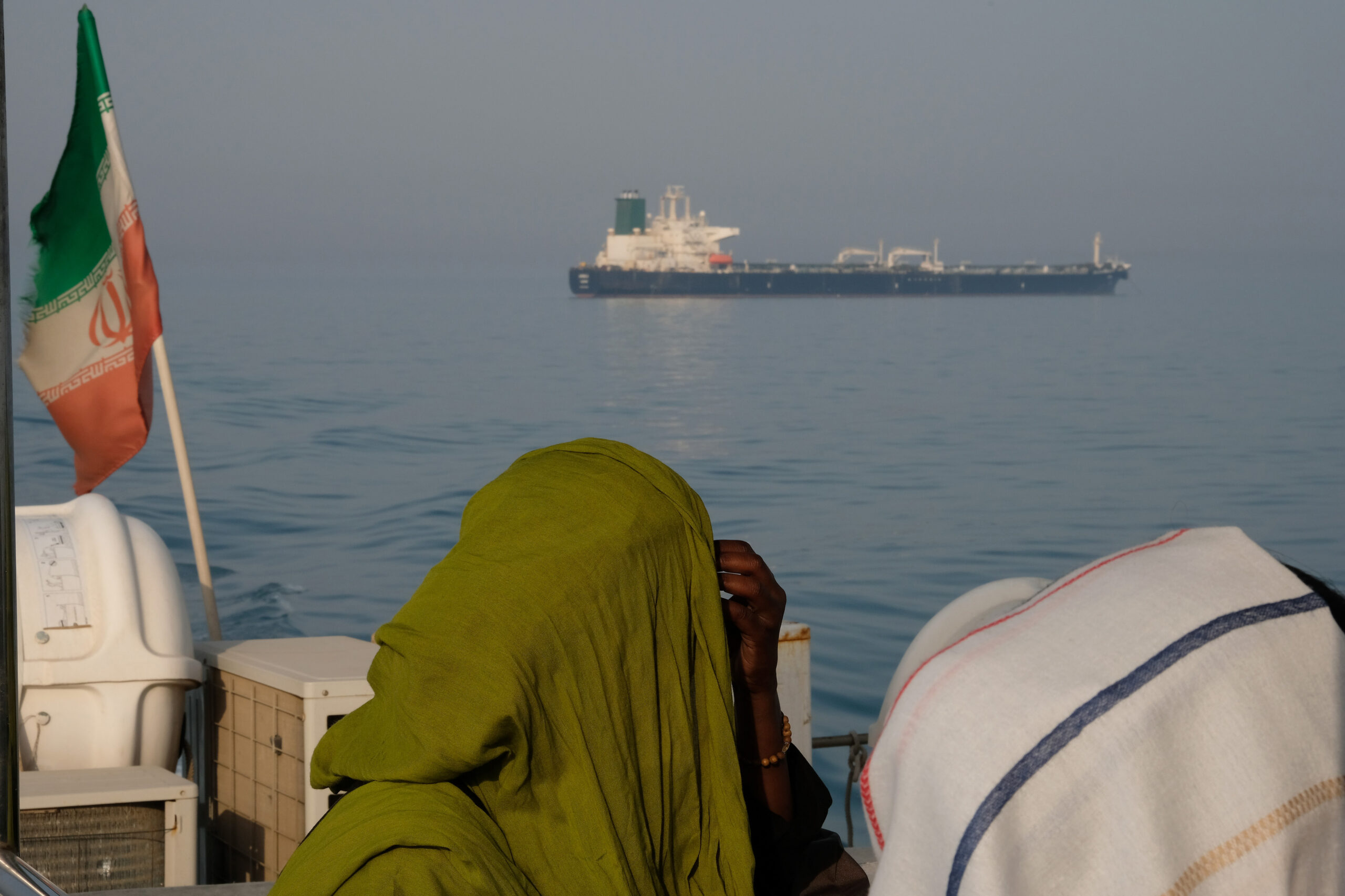
When Israel and the United States struck Iran on February 28, Tehran declared the Strait of Hormuz closed, warning that any vessel attempting to pass without its permission could be attacked.
The Trump administration and many of its supporters have characterized the present crisis as “short term pain for long term gain.” But with Iran and Oman reportedly developing a plan to control traffic through the Strait in any post-war period, the U.S. decision to attack Iran will likely have lasting consequences on global shipping and the U.S.-led world order.
I spoke with Sal Mercogliano, a maritime historian and naval expert, whose YouTube series tracks shipping through the strait in real time. He breaks down what is actually happening, the legal and strategic stakes of Iran’s closure, and the historic shift in freedom of navigation we are now witnessing.
Freedom of navigation as a principle has been enshrined in international law for centuries. It was codified through the Law of the Seas four decades ago, and the general principle has been considered customary international law for more than four centuries.
When Israel and the United States decided to attack Iran on February 28, Iran did what many predicted it would do, which is to declare the Strait of Hormuz closed, putting vessels under threat of attack if they attempted to pass without permission of the Iranian government. It really seems like we are witnessing this historic transformation to freedom of navigation. Can you explain a bit how so?
Yes. I think that freedom of navigation has been under attack even before this. I mean, if you go back to the Houthis and the Red Sea and even the creation of the dark fleet with Venezuela, Iran, and and more importantly, with Russia following Russia’s invasion of Ukraine, we’re seeing that.
You’re exactly right. I go back to the end of World War II when literally you create the great blue commons, where ocean travel is basically assured. The allied navies vanquished the German and the Japanese navies and for 80 years, we have not had an issue. There have been minor events but largely, ocean traffic was free to move and, under those conditions, what we’ve done over 80 years is increase the volume and velocity by which we move goods. And we got used to that…
Now that’s being threatened. It’s being threatened economically because we’re seeing higher costs associated with it. We’re seeing geopolitical threats. You can’t sail through this area. You’ve got to divert around. And then we’re seeing the other elements, which is the creation of what I like to call the parallel fleet: ships that are out there, operating outside the bounds of the traditional system that’s been established, insurance, registry, classification, evading Western sanctions.
One of the other challenges, especially in recent weeks, is simply trying to figure out what’s even going on. There’s claims from a variety of popular aggregator accounts on platforms like X, like Polymarket for example, which have millions of followers, and have claimed that traffic is now surging in the Strait of Hormuz.
Now, if people watch your excellent YouTube series, they very quickly discover that all those sensational headlines are very far from true, that shipping traffic through the Strait of Hormuz remains in the single digits. It’s down from a daily average of about 130 vessels per day. Can you give us an update on what traffic through the Strait looks like right now and could you try to explain why you think we’ve seen so much misreporting on this topic?
Well, I think a lot of it has to do with sea blindness. A lot of people don’t understand how shipping works. If your first moment is viewing marine traffic and looking at ships moving, it seems to be maybe, okay, ships are moving. This seems to be okay. Until you go, and what I’ve done, especially with Polymarket and other sites, is I post the Strait of Hormuz traffic for February 27, the day before the attacks. And what you see there is a swarm of ships. On that day about 150 went through the Strait of Hormuz. On March 31, there were five. It’s a substantial difference.
Another problem is how those boats are even going through the Strait of Hormuz. The traffic we’re seeing now isn’t going through the center of the Strait, the normal place we see them. Vessels are going through Iranian territorial waters. They’re taking this huge securitist route between Larek and Kisham Island because the Iranians have set up this toll booth. They’re controlling the flow in and out of the Strait of Hormuz.
And I think it’s important to note, since the beginning of the operation, we’ve had maybe 21, 22 ships attacked. Which isn’t a great deal when you consider the fact there’s about a thousand deep draft vessels stuck in the Persian Gulf. But you don’t need a lot of attacks to cause problems. You just need a few attacks and a few very visible ones, which is what the Iranians have been able to do. They’ve inflicted damage. They’ve inflicted losses. They’ve killed people.
And that’s enough to convince ships not to make the transit. What they do is they bottle everything up.
But the problem is it’s very hard to aggregate against these huge accounts that sit there and say everything is fine, you know everything is going well. And especially when you get the president of the United States and Fox News saying “eight to 10 tankers” went out even though they did not. We’re not seeing those numbers. Those numbers are not materializing. And they’re not even with the dark fleet, the mast vessels that turn off their AIS [automatic identification system]. Because we do have visualizations of those. We have satellites. We pick them up when they get out of the straits. So we know that this is not happening.
It’s just hard when literally the accounts that we rely on, the mainstream—and I’m not just talking about mainstream media, I’m talking about the president and his cabinet—when they voice a narrative that’s not meeting with what the data is showing. That’s a problem.
Right. Trump said that Iran gave us this gift, originally 10, but he raised it to 20 Pakistan-flagged ships that were allowed to cross the Strait of Hormuz. How many ships does Pakistan even have? Do they even have 20?
No, they don’t have 20 tankers. I guarantee you that. And there’s not 20 Pakistani ships inside the Strait of Hormuz. So there was one, the Karachi, that came out.
In terms of the long-term consequences of this new status quo in the Strait of Hormuz, just this week, Iran’s parliament voted to formalize a toll system. They will partner with Oman and reportedly charge about 2 million dollars in Iranian Riyal for each vessel to pass through. They say they’ll continue to block vessels linked to the United States and Israel. When it comes to this new toll, do you expect that consumers would have to eat those costs on the variety of commodities that flow through the strait, not just oil and gas but helium, fertilizer, and other important resources?
Yeah, I believe so, tremendously. They seem to have used the same playbook in the Red Sea. We think the Houthis did the same exact thing, except the difference with the Houthis in the Red Sea was there was an alternative. You can go around Africa, you can take the bypass, which for shipping companies, they complained about it, but in truth, it generated a lot of revenue for them. So they would say vocally, “Oh, we hate this,” but at the same time, man, they were pocketing good money.
But there’s no shortcut around the Persian Gulf. It’s a cul-de-sac of oil and energy. You’ve got to get in there. You’ve got some access with pipelines, but some countries, Kuwait, Bahrain, Qatar, they don’t have any other outlet. They’re stuck. Southern Iraq, they’re stuck. They don’t have an outlet. The Saudis do. The UAE does. Nobody else does.
That’s going to be a bane for them. We’ve got five U.S. ships stuck inside the Persian Gulf with 100 crew members on board that can’t get out. I mean, this is a problem. Iran now has a toll booth. This cost is going to get translated to everyone.
When it came to the Red Sea, we weren’t able to deter the Houthis. The Americans tried it twice and were unsuccessful. They shot down a lot of missiles and drones, but they could not get 100 percent success. And so shipping didn’t fully return. You’re going to see the same thing here. And if you’re a country like Saudi Arabia, for example, two of the three access points to get to the ocean are now in the hands of Iranians or Iranian clients.
And there is now a chance of the Houthis coming back in. If you’re loading tankers in Yambu and the Houthis start attacking, that’s a big problem.
I will say this about the Houthis: they don’t have a great track record at targeting ships. And what I mean by that is not just hitting them, but hitting ships that are directly owned by the U.S. or Israel. If you look at the data, of the 120 something ships they attacked, maybe about 40 percent of them can be linked back to the U.S. and Israel. The rest of them aren’t. In global shipping generally, it’s hard to know who controls what, who owns what, because there are shell corporations. We do everything we can to really mask ownership.
So if the Houthis suspect a U.S. or Israeli ship is sailing by, the fear is they attack them. This is going to jack up insurance rates. One of the things we saw, the reason the ships went around Africa really wasn’t because the Houthis were masters at anti-ship operations. They really weren’t. But the insurance rates went up. This is what stopped ships going through the Strait of Hormuz. The insurance rates went up and everybody had to go get new insurance.
The Houthi are going to be a threat if all of a sudden you cannot sail very large crude carriers. These are the big supertankers. These are the one to two million barrel supertankers through the Babel Mandab, that little narrow strait between Yemen and Africa. Now, all of a sudden, if you want to get that seven, eight million barrels a day out of that pipeline that’s in Yambu, you’ve now got to sail all the way around Africa, go through the Suez Canal and go to Yambu. And by the way, you can’t take a fully loaded VLCC, very large crude carrier through the Suez. So you’re talking about shuttling fuel. This is going to make everything more expensive.
Subscribe Today
Get daily emails in your inbox
And it’s also worth pointing out that this could have all been avoided if we didn’t attack in the first place. The Strait of Hormuz was open. Nobody was paying any tolls on February 27.
I’m going to add this to it too, Harrison: The U.S. knew this would be Iran’s play.
Everybody knew this. I mean, I worked for the military 30 years ago and we all knew Iran’s going to play for the Strait of Hormuz. Everybody knew this. This is not a surprise.