The science is mind-blowing, the implications for space travel quite unfathomable.
But when the four Artemis Il astronauts transit the dark side of the Moon tomorrow, it will also be a mind-blowing personal journey as they become the first humans to gaze directly into the depths of its most mysterious feature.
Appearing like a giant bullseye, the Mare Orientale – or Eastern Sea – will loom before them as a 200-mile-wide crater, formed 3.7billion years ago by an asteroid smashing into the surface at nine miles a second.
It will surely be a life-changing moment for Commander Reid Wiseman, 50, mission specialists Christina Koch, 47, and Jeremy Hansen, 50, and pilot Victor Glover, 49.
All contact with mission control will have been blocked by the Moon, leaving the crew alone to marvel at the sheer power of space.
The destructive impact of that asteroid is beyond comprehension, three times the size of the one thought to have wiped out dinosaurs here.
Surrounding the crater are mountain ranges, bullseye rings formed by a cloud of debris caused by the impact.
Apollo astronauts saw it half a century ago, but from a far lower altitude than Artemis I’s 4,000-6,000 miles, and never in sunlight. That meant the best images, by Apollo 17’s Ronald Evans, were dingy and black and white.
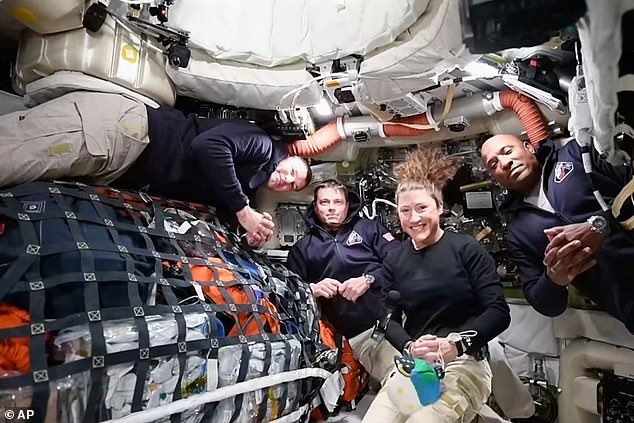
The Artemis II crew (pictured from left) Canadian astronaut and mission specialist Jeremy Hansen, Commander Reid Wiseman, mission specialist Christina Koch and pilot Victor Glover
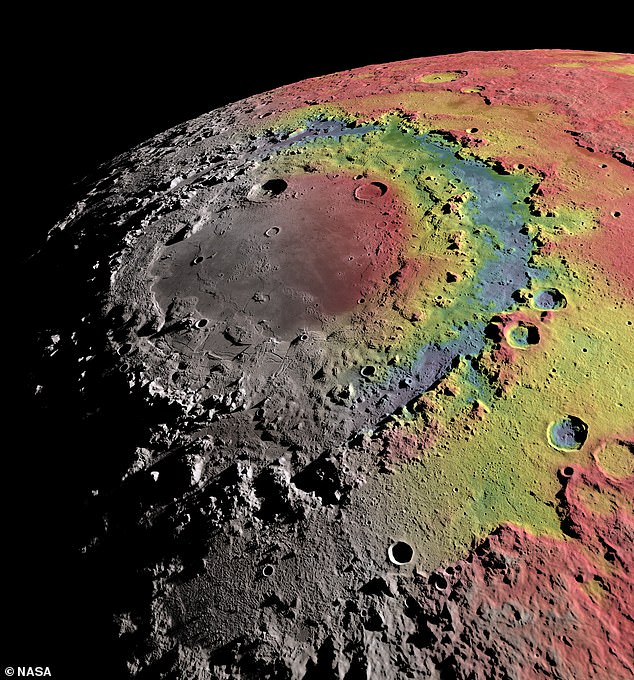
The Mare Orientale will loom before the astronauts as a 200-mile-wide crater, formed 3.7billion years ago by an asteroid smashing into the surface at nine miles a second
Artemis Il will have no such problem: they and the Sun will be directly overhead.
While it has been photographed by satellites, taking images from Earth is hampered by the ‘tidal locking’ phenomenon – the reason the Moon has a dark side.
Only rarely does ‘libration,’ a wobbling of its axis, reveal the Orientale as a shadowy smear.
Tidal locking ensures the Moon takes exactly as long to spin full circle as it does to complete its monthly orbit of Earth – as NASA puts it: ‘Like a dancer circling, but always facing, its partner.’
This is the result of Earth’s gravitational pull for billions of years, causing the Moon to slow its spin until precisely synchronised with the length of its orbit.
For all the sights Artemis I will encounter tomorrow – for good measure, a ‘Kreutz sungrazer’ comet will pass close to the sun’s surface – the crew knows this mission is of huge scientific significance.
They will closely study a surface pock-marked by craters formed by a bombardment of asteroids.
One theory is that one such asteroid hit Earth, distributing the seeds of life.
Christina Koch describes the Moon as a ‘witness’ to all that’s happened to Earth.
She said: ‘We can learn more about solar system formation, about how planets form… about the likelihood of life out there, starting with studying the Moon.’