This article is taken from the April 2026 issue of The Critic. To get the full magazine why not subscribe? Get five issues for just £25.
I’m Sorry, Prime Minister would have been better entitled “I’m Sorry, The Audience”. Jonathan Lynn’s lamentable cash-grab on the seminal political comedy that he and Antony Jay created is a classic example of returning to the well one too many times, to dismally, even painfully unfunny effect.
It is a source of astonishment to this critic that a play as unwatchably laboured and essentially unfinished as this one might attract actors of the calibre of Griff Rhys Jones, Clive Francis and William Chubb, but then West End theatre often thrives on the commercial appeal of brand names.
More than four decades after Yes Minister was first broadcast, this play, billed as “the final chapter of Yes Minister”, comes to Shaftesbury Avenue to tantalise, or torture, audiences one last time.
Critic readers need no reminding of the central dynamic of Lynn and Jay’s original show, which was superlative on television when it starred Nigel Hawthorne as the supercilious mandarin Sir Humphrey and Paul Eddington as the hapless politician Jim Hacker, but — and this is the crucial thing — was barely less good when it came to the West End as Yes, Prime Minister in 2010.
Back then, Jay and Lynn updated the original series with a dash of The Thick Of It edginess to make it more palatable for contemporary tastes, but David Haig as Hacker and Henry Goodman as Sir Humphrey were every bit as accomplished as the originals, and the whole thing zipped along nicely.
Unfortunately, I’m Sorry, Prime Minister, which returns to London a decade and a half later, is about as amusing as a war crimes trial, and seems to last twice as long.
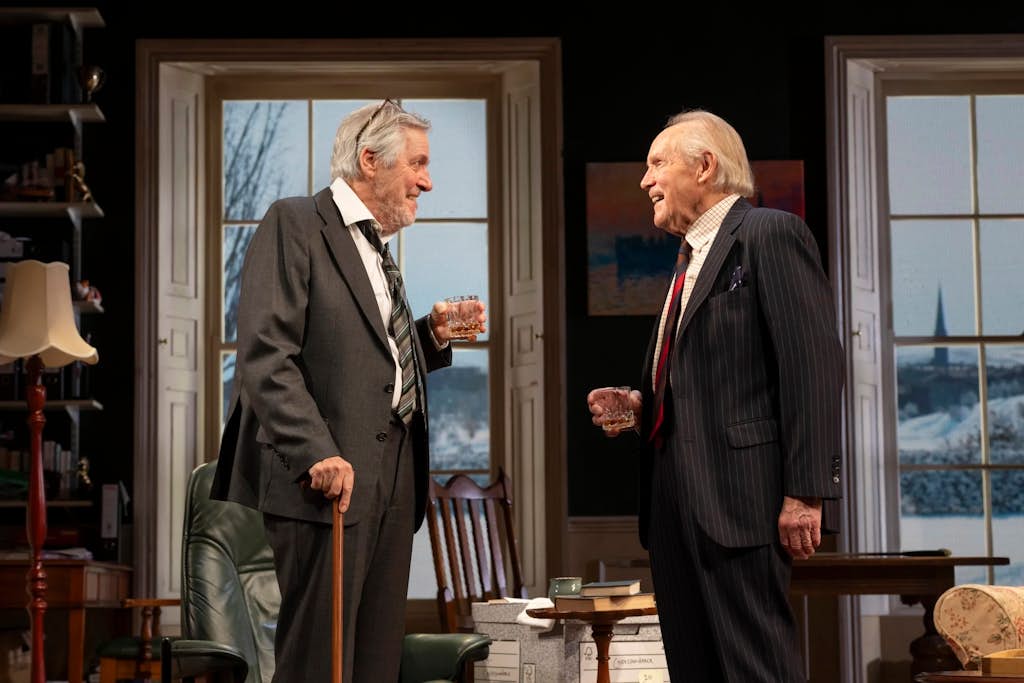
It is set in an Oxford college named after its founder and first master, Jim Hacker, and when it begins, Hacker is interviewing a care worker (which, we are informed more than once, “sounds like sex worker”, in an example of the kind of humour we can expect from the evening) named Sophie.
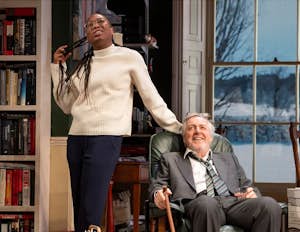
In Stephanie Levi-John’s courageous performance in a truly thankless role, Sophie is a black, queer woman whose sole function on stage is to reprimand Rhys Jones’s Hacker and (when he appears) Francis’s Sir Humphrey for their un-PC and unreconstructed comments.
In other circumstances, this might have made for an interesting foil to two old buffers, but unfortunately her entire part consists of huffing and eye-rolling, and occasionally being laughed at by the audience for existing, until events in the second act allow her to take centre stage to tediously preachy effect. Without wishing to spoil matters, the “Rhodes must fall” debate is rehashed, all over again. Oh, and Brexit comes up, too.
It takes a considerable amount of the first half to reveal the “plot”, such as it is, but the calculation that Lynn — who also directs, alas — makes is that the audience will be so pleased to see their favourite characters back on stage again that they are content to spend time in their company.
This has worked in several recent instances, such as the Only Fools and Horses musical and the redux of Fawlty Towers, but the problem with Yes Minister was that, firstly, it was a show driven as much by situation as character, and secondly that recent political events have been so much more dramatic — and comedic — than anything in the original series that you would need a Jesse Armstrong or Armando Iannucci to make it seem remotely relevant for a contemporary audience.
You do not have an Armstrong or an Iannucci. Instead, the play comes laden with “jokes” about dementia, physical infirmity and children trying to shove inconvenient relatives in care homes and run off with their money.
This might be satirical in a different, and better, context, but there is something depressing about watching Rhys Jones, himself a spry and talented farceur, having to do his best with material that involves Hacker being incontinent, or Francis’s Sir Humphrey — once, in the Hawthorne/Goodman incarnation, being not just the sharpest tool in the box, but a deviously Machiavellian figure who would have given Lucifer a run for his money — being portrayed as a doddery old buffer who stuffs his pockets full of stolen biscuits.
The audience laughs at I’m Sorry, Prime Minister, rather than with it. It only lasts two and a quarter hours — including an interval at which various brave souls made their escape, enviously watched by those whose professional obligations made them stay until the decidedly bitter end — but every one of those 135 minutes can be felt.
I am an unapologetic booster for sophisticated and intelligent comedy in the West End, but this laborious and cynical exercise in faux nostalgia is the most tedious and unrewarding thing I’ve had to sit through in living memory. Everyone involved, but most especially Lynn, should hang their heads in shame at their involvement in it.
Even the wine in the interval was undrinkable, and anyone who has to suffer through the remainder of this dismal show could be forgiven for packing their own cyanide capsules to ease the pain instead.
I’m Sorry, Prime Minister is at the Apollo Theatre, Shaftesbury Avenue, until 9 May