Experts have uncovered a rare marble artefact that could rewrite the history of baptism.
Archaeologists have been excavating the remains of a cathedral in the ancient city of Hippos in Israel, near the Sea of Galilee.
According to the gospels, Jesus’ earthly ministry centred around this area, making it a significant site in the history of Christianity.
And it is here that the team came across an unusual object – a unique marble item featuring three hemispheric cavities which they believe used to hold three different oils.
Traditionally, during baptisms, a person is anointed with two oils – one used before the water baptism and a different one used after.
But the new discovery indicates people used to be anointed with oils three times – and it could force historians to rethink the history of the practice.
‘Near the baptismal font, we began uncovering remarkable liturgical objects,’ Dr Michael Eisenberg, from the University of Haifa, said.
‘Only after careful research did we realize how unique they are for understanding Christian ritual practices in the cradle of Christianity by the Sea of Galilee.’
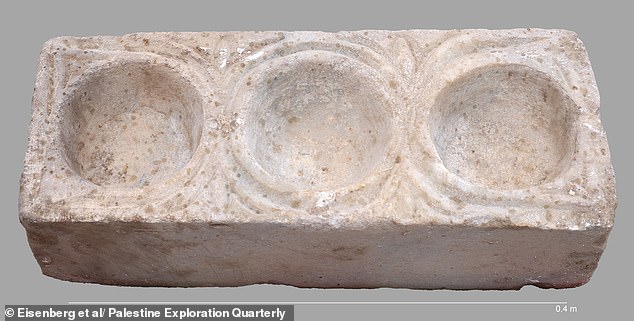
The team uncovered a unique marble item featuring three hemispheric cavities which they believe used to hold three different oils
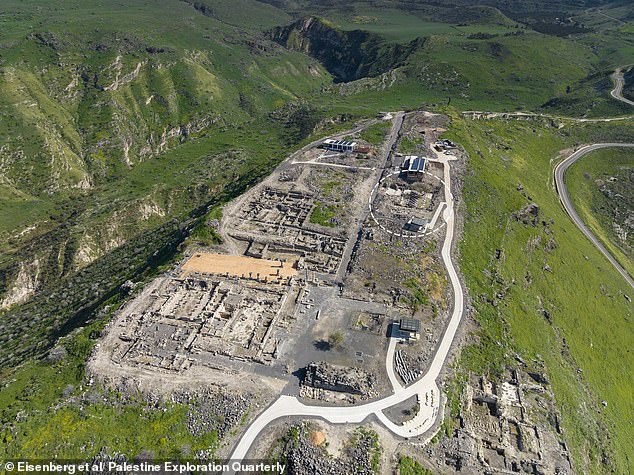
The ancient city of Hippos in Israel, with the cathedral’s location marked within the circle. Researchers have called this area the ‘cradle of Christianity’
After extensive examination and comparison, the team concluded that no known similar marble artefact exists.
They believe the discovery, which dates back around 1,300 years, is evidence for a lost stage of early Christian baptismal rites.
‘We suggest that the cups of the stone held oil, possibly three different types of oils, which may correlate with a local tradition of three–phase anointing during that baptismal rite,’ the study, published in the journal Palestine Exploration Quarterly, reads.
‘Baptismal rites involved threefold immersions, and anointing was often made before and after the immersion, although the details of the rite were constantly changing.
‘The use of different oils is attested in a few sources, but nowhere is it clearly specified that three different oils are used within baptismal rites.’
The current excavation focused on a hall annexed to the south of the cathedral of Hippos, which was a central church in the region.
They uncovered a partially preserved room containing a baptismal font – the second in the cathedral.
This is the only known church in the archaeological record to contain two designated halls with baptismal fonts, the researchers explained.
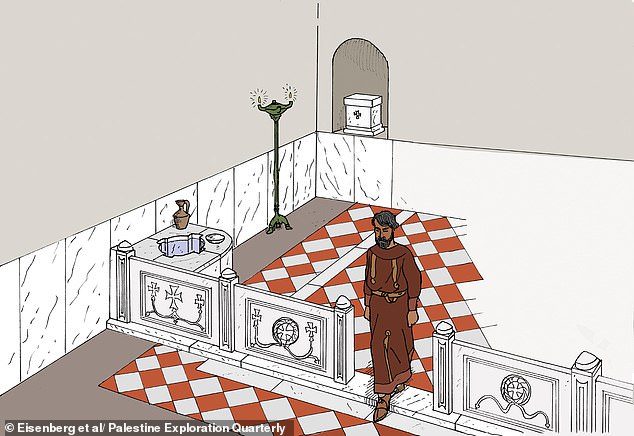
A proposed reconstruction of the small hall containing a baptismal font, which may have been used to baptise infants and children
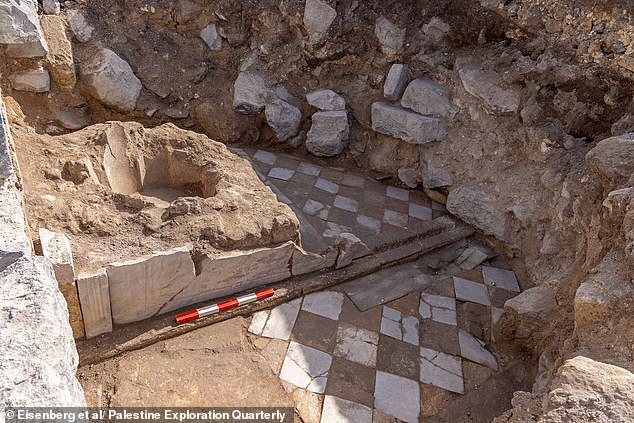
The small hall and the baptismal font in its corner, faced with decorated marble slabs with an inlaid marble floor
It could be that the larger hall was used for adult baptism while the smaller, newly uncovered hall served for the baptism of infants and children.
Among the notable finds were a bronze lamp stand called a candelabrum – the largest ever discovered in Israel.
They also unearthed a marble reliquary, a container for holy relics, which was also the largest of its kind found in the country.
The hall was destroyed in an earthquake in 749 AD, burying the artefacts beneath the rubble and preserving them until their recent discovery.
‘Baptism was one of the central rites of Christian communal life and gradually took shape during the Byzantine period,’ Dr Eisenberg said.
‘In different regions, distinct liturgical traditions developed, many of which are not documented in written sources.
‘This find offers a rare glimpse into how the baptismal rite was shaped and practiced in the Byzantine Christian community of Hippos.’