Long before he became president, Donald Trump had a history of putting his name on things – hotels, casinos, golf courses, bottled water.
Now, 14 months into Mr. Trump’s second term, his penchant for self-promotion appears to know no bounds, as his name is being affixed to entities big and small, from the Trump-Kennedy Center for the Performing Arts to the enormous White House ballroom under construction to a 24-karat gold commemorative coin bearing his image to be issued by the U.S. Mint.
Mr. Trump’s signature will soon adorn U.S. paper money, a first for a sitting president. Parents of newborns can sign them up for Trump Accounts. And in Florida, Palm Beach International Airport will be renamed President Donald J. Trump International Airport, effective July 1, per legislation signed this week by Florida’s Republican governor. Customarily, the renaming of an airport for a president happens after departure from office.
Why We Wrote This
President Donald Trump is erecting new structures at a furious pace, while putting his name on everything he can. Critics say it echoes a strongman’s style. Others simply see a penchant for legacy-building – and a long history of promoting the Trump brand.
Another project, the 250-foot-high Independence Arch, dubbed the “Arc de Trump” – to be built across the Potomac from the Lincoln Memorial – has triggered lawsuits, delaying the start of construction. The arch’s ostensible purpose is to celebrate the 250th anniversary of American independence.
But for Mr. Trump, the naming and building spree is about legacy-building – and a seemingly insatiable desire for self-validation, the likes of which has never been seen in an American president, say historians and longtime Trump observers.
All presidents, almost by definition, have outsize egos. But traditionally, American presidents have eschewed the trappings of royalty and emphasized their role as public servant. Mr. Trump, in his first term, suggested that his face should be added to Mount Rushmore.
“Trump seems to have personality needs that can never be fulfilled,” says George Edwards III, an emeritus presidential scholar at Texas A&M University and author of a book on Mr. Trump’s first term. “He has to view himself as in glory.”

To some, all the grandiose projects carry echoes of strongman-style rule. Though it could also be a sign that Mr. Trump is building toward the end of his presidency, despite quips about a third term. Notably, Term 1 included far less of the “Developer Trump” persona that Term 2 has seen.
To Trump defenders, all the new construction is a refreshing upgrade, with the more-expensive projects funded by private donations, not U.S. taxpayers. To critics, it’s all part of a Trump family grift and a distraction at a time of global turbulence. In addition, Mr. Trump plans to spend $377 million renovating the executive residence in fiscal 2026, and wants $174 million more next year, according to a Politico analysis of the fiscal 2027 budget request.
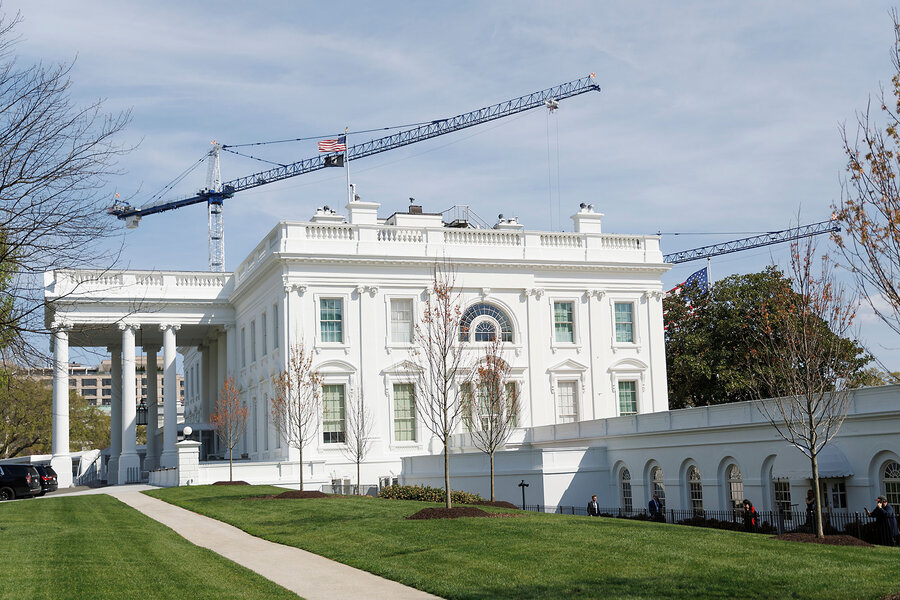
In short, to say that Mr. Trump and his allies are flouting the norms of the American presidency is an understatement. Nowhere is that more evident than at the White House, where the 90,000-square foot, $400 million ballroom was approved on Thursday by the National Capital Planning Commission. The federal body is dominated by Trump appointees – including its chair, White House Staff Secretary Will Scharf.
The ballroom project still must be approved by Congress, a federal judge ruled on Tuesday, ordering a halt to construction. But Congress appears reluctant to vote on the ballroom, which polls poorly. And Mr. Trump doesn’t always wait for a green light. He demolished the East Wing last October on his own say-so, sparking outrage.
“When completed, it will be the Greatest and Most Beautiful Ballroom of its kind anywhere in the World, and a fabulous complement to our Beautiful and Storied White House!” Mr. Trump wrote on Thursday evening on Truth Social.
The president has also called attention to the “massive,” secure military bunker that is being constructed under the ballroom, speaking publicly about a matter that is usually kept secret.

At the Trump-Kennedy Center, which will close for a two-year renovation on July 4, some observers are concerned that Mr. Trump will raze the whole structure – including a recent, modernist addition. The 1960s complex didn’t win rave design reviews back when it was built, but it has grown on the public, and its Kennedy association adds emotional weight. Mr. Trump took over the Kennedy Center a year ago, leading to mass cancellations by performers. The center’s renaming is already subject to litigation.
Gwenda Blair, a Trump biographer who interviewed him multiple times before he became president, sees a man who has spent his whole career building a personal brand, be it in real estate or as a reality TV star on “The Apprentice.”
Over the years, Ms. Blair says, Mr. Trump has learned “you have to keep making the brand bigger.” Back in the day, even just putting the Trump name on a Manhattan skyscraper was a big deal. Today, “putting your name on a building in New York City is small change.”
The current outrage, she believes, will eventually die down.
“His real estate background taught him that once a building is there, people forget what used to be there,” Ms. Blair says. And when something gets a new name, “people forget the old name.”

This week also saw the release of plans for the future Donald J. Trump Presidential Library and Museum – a glittering skyscraper on the Miami waterfront, as depicted in a video posted by son Eric Trump. It will include a golden escalator, reminiscent of the one from his first campaign announcement, a golden statue of Mr. Trump, and a retired Air Force One in the lobby.
On Tuesday, Mr. Trump suggested to reporters in the Oval Office that the building could also be a money-making venture. It “could be [an] office, but it’s most likely going to be a hotel with a beautiful building underneath,” he said.
He also took a swipe at former President Barack Obama’s soon-to-open presidential center in Chicago, a brutalist-style structure that will include a museum, a public library branch, event space, and athletic facilities. “It’s a very unattractive building,” Mr. Trump said.
Not that Mr. Trump’s own taste wins universal praise. Chances are high that the next president, especially if he or she is a Democrat, will alter some of the Trump touches – starting, perhaps, with the gold filigree that now adorns the Oval Office. Renaming things is also easy.
But some of the Trump-era changes – like the new buildings, and particularly the ballroom, assuming it’s eventually built – will be as permanent as any building can be. And just as the White House’s Truman Balcony was controversial when it was built in the 1940s, today, it’s an accepted and even well-loved part of the structure.