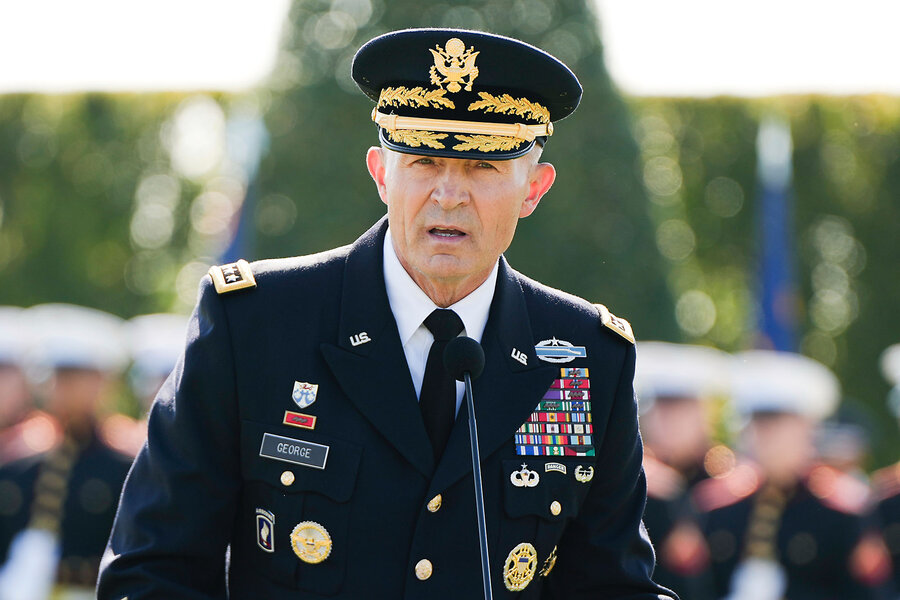
Defense Secretary Pete Hegseth on Thursday fired the Army’s top officer, Gen. Randy George, a move that is prompting concerns about the politicization of America’s military, particularly during a U.S. war in the Middle East.
General George became the latest of more than a dozen high-ranking officers in the military dismissed in President Donald Trump’s second term. Two other generals, including the Army’s top chaplain, were also fired Thursday.
In a social media post, Defense Department spokesman Sean Parnell thanked Mr. George for his “decades of service’’ and said that the general’s retirement would be effective immediately. “We wish him well,” he said.
Why We Wrote This
Defense Secretary Pete Hegseth’s removal of over a dozen senior officers is raising concerns about what effect those decisions will have, and whether they could undermine the military’s nonpartisan tradition through politicized appointments.
As the Army chief of staff, General George worked closely with Secretary of the Army Daniel Driscoll, a Trump administration appointee with whom Mr. Hegseth has clashed.
Appointed by President Joe Biden in 2023, Mr. George was a decorated veteran of the wars in Iraq and Afghanistan. He was asked to step down amid reports that he had disagreed with Mr. Hegseth’s decision to block the promotion of several top Army colonels to one-star general, including Black and female officers. Service chiefs generally serve for four years.
The timing of these latest firings, against the backdrop of speculation about whether there will be a U.S. ground invasion of Iran, has also raised questions about how Mr. Hegseth handles military advice that runs counter to his wishes on the war front.
In October last year, Mr. Hegseth forced out Mr. George’s deputy, Gen. James Mingus, from his job as the Army’s vice chief of staff as part of a broader purge of generals deemed “woke” or not aligned with the administration’s vision. The Trump administration has also fired top lawyers for the Army, Navy, and Air Force.
Analysts say the firings could undermine the American tradition of military leadership giving frank advice to political leaders, even as they salute and carry out orders ultimately issued by the civilians who, by constitutional design, are in charge.
In part to uphold this revered tradition, some current and former U.S. military officials are urging troops still rising through the ranks – including those who now say they are tempted to leave due to a loss of faith in the institution – to stay right where they are.
“Don’t throw in the towel,” retired Gen. C.Q. Brown said Thursday night upon hearing about the firings, just minutes before giving a talk at Harvard University on the topic of “Leadership in Challenging Times.”
Service and sackings
Mr. Brown was the first Black Air Force chief of staff. He was hired during President Trump’s first term, then was fired from his job as chairman of the Joint Chiefs of Staff last year during the president’s second term.
It was part of a spate of sackings that included Adm. Linda Fagan, the commandant of the U.S. Coast Guard, and Adm. Lisa Franchetti, chief of naval operations. Both were the first women to lead their respective service branches.
While hundreds of men have attained the rank of four-star general or admiral throughout America’s military history, including Admirals Fagan and Franchetti, only 10 women have done the same.
The Trump administration has also fired top lawyers in each of the military services.
The dismissals, for which the administration has often given no official reason, raise “troubling questions about the administration’s desire to politicize the military and to remove legal constraints on the president’s power,” five former U.S. secretaries of defense wrote in an open letter last year.
One of the letter’s authors was retired Gen. Jim Mattis, appointed by President Trump to be defense secretary during his first term.
“Talented Americans may be far less likely to choose a life of military service if they believe they will be held to a political standard,” warned the former defense secretaries. “Those currently serving may grow cautious of speaking truth to power,” and America’s historically high trust in the military could also “begin to wither.”
A growing gap in trust
Studies show that this is already happening. A poll from the conservative Reagan Institute in December found that overall public confidence in the U.S. military has declined sharply since the group began doing the survey. It’s now at roughly 50%, down from 70% in 2018.
The survey also found a widening partisan gap in trust since Mr. Hegseth began serving as defense secretary in 2025. While confidence among Democrats has dropped to 33%, confidence among Republican respondents has rebounded to 67%.
“The tough part here is that we have a smaller and smaller part of the population that actually knows somebody in the military,” retired General Brown said in a discussion at the Harvard event. “And the less you know about the military, the harder it is for you to have that trust – or a small event can actually really erode that trust.”
For some, one such event has been the reports last month that Mr. Hegseth blocked the promotion of four Army officers – two Black men and two women – to one-star general from a list of roughly 35 candidates.
Only between 3% to 5% of colonels are selected for promotion to one-star, or brigadier general, in any given year.
In his talk at Harvard, Mr. Brown recalled making the controversial decision to speak out about the Black Lives Matter movement following the death of George Floyd. He said he was aware it could affect the Senate’s vote on his confirmation, scheduled for the same week. “In my heart of hearts, I thought it was the right thing to do. And if I did not get confirmed, so be it.”
He ultimately got the job in a 98-0 vote.
On Thursday, a West Point graduate, who later became one of the first women to earn a prestigious Ranger tab, asked how to maintain faith in an institution that seems to be evaluating officers based more on identity than performance.
Mr. Brown reflected on the value of service even as he recalled “having to represent by working twice as hard to prove the expectations and perceptions” held by some of the leaders he once saluted were “invalid.”
To this, he told her, “Prove them wrong.”