It’s often described as the ‘female pleasure centre’.
And now the clitoris has been mapped for the very first time.
To create the map, scientists used state–of–the–art X–ray imaging techniques to scan two postmortem female pelvic samples.
Their results revealed a complex web of nerves branching through the female sexual organ – including many that are crucial for orgasms.
The researchers, from Amsterdam UMC, hope the map will help to break the cultural taboo surrounding women’s sexual health.
‘The clitoris is a unique organ in the female body, responsible for sexual pleasure,’ they wrote in their study.
‘Early references to the clitoris can be traced back to ancient times, exemplified by the writings of Aristotle.
‘However, the cultural taboo around female sexuality has hindered its scientific investigation for centuries.’
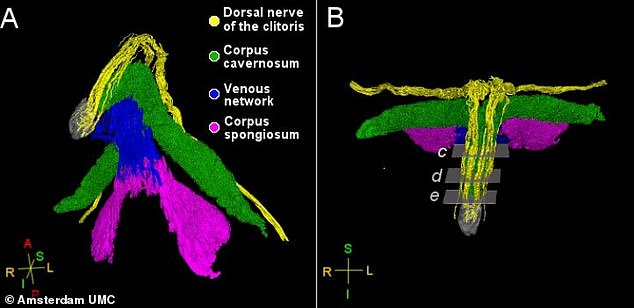
It’s often described as the ‘female pleasure centre’. And now the clitoris has been mapped for the very first time
The clitoris is the only human organ with the sole purpose of providing pleasure.
It’s made up of nerves that carry electrical impulses between the brain and the rest of the body, which enable women to feel and respond to touch.
While the tip (glans) of the clitoris is found outside the body, much of the organ is located internally.
This includes the dorsal nerve – a wishbone–shaped nerve that runs down either side of the clitoral shaft and is responsible for clitoral sensation.
Until now, mapping the sexual organ has been problematic.
Writing in their study, published as a preprint on bioRxiv, the researchers, led by Ju Young Lee, explained: ‘The detailed anatomy of the clitoris is challenging to address through a gross dissection, as most of its parts are embedded internally, surrounded by pubic bone and several pelvic organs.
‘While clinical imaging methods such as magnetic resonance imaging can capture the gross 3D morphology, they lack the spatial resolution required to resolve the detailed structures.’
Instead, the researchers took micron–scale CT scans of the female pelvises, using a ‘synchrotron radiation X–ray source’.
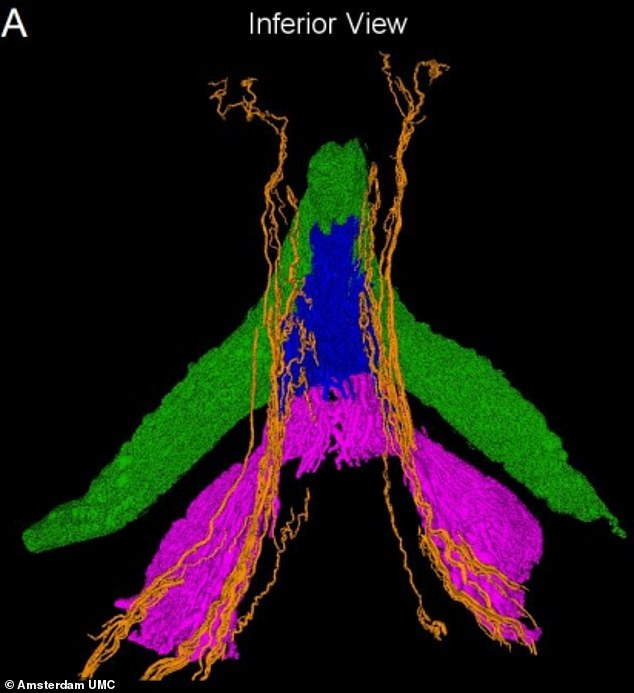
The researchers took micron–scale CT scans of the female pelvises, using a ‘synchrotron radiation X–ray source’. This allowed them to map the nerves running through the sexual organ in unprecedented detail – with some measuring just 0.2mm in diameter
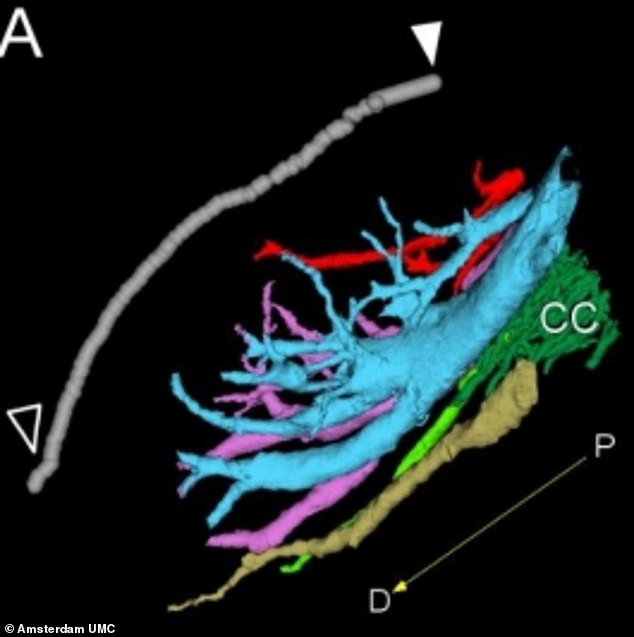
One of the most surprising findings surrounds the dorsal nerve (DNC), which is responsible for clitoral sensation. Previous studies have suggested that this ‘gradually diminishes’ as it reaches the tip –but the researchers found that this isn’t the case
This allowed them to map the nerves running through the sexual organ in unprecedented detail – with some measuring just 0.2mm in diameter.
One of the most surprising findings surrounds the dorsal nerve (DNC), which is responsible for clitoral sensation.
Previous studies have suggested that this ‘gradually diminishes’ as it reaches the tip –but the researchers found that this isn’t the case.
‘The DNC does not diminish but instead exhibits a complex tree–like branching pattern within the clitoral glans,’ they explained.
The researchers hope the findings will help to address the knowledge gap in women’s sexual health – noting that the penis was mapped more than 30 years ago.
What’s more, the map could help to redefine the ‘danger zone’ used in female genital cosmetic surgeries.
‘In recent years, popularity for such surgeries has dramatically increased, exemplified by a 70% increase in labiaplasty from 2015 to 2020,’ they explained.
‘The “danger zone” has been suggested to help surgeons avoid nerve damage during the operation.’