Amid a febrile atmosphere in a Zulu community hall two days ago, 800 tribespeople gathered to demand a major police investigation into a spate of grisly murders.
As grieving families wailed and tempers flared, elders cited a litany of recent cases where men, women and children were abducted from their homes and workplaces, or as they walked the lonely country lanes, then dismembered while they were still alive.
Locals are convinced the spree is the work of a ruthless syndicate selling body parts to witchdoctors who claim they can cure illnesses and bring good fortune.
Ten of the victims they named lived in and around Mkuze, a town with 50,000 residents, set in the vast wilds of Zululand.
Astonishingly, however, the eleventh was an elderly white Englishwoman.
This was Lorna McSorley, 71, a retired South West Water employee from Teignmouth, Devon, who vanished without trace here last September, during a coach tour of South Africa operated by the travel company TUI.
For six months, police have failed to discover what became of Lorna, who disappeared while walking through a sugar cane plantation near the aptly-named Ghost Mountain Inn, where she was staying with her 81-year-old partner, Leon Probert.
Though it seems patently obvious to local people that she was kidnapped and killed, police continue to treat her as a ‘missing person’.
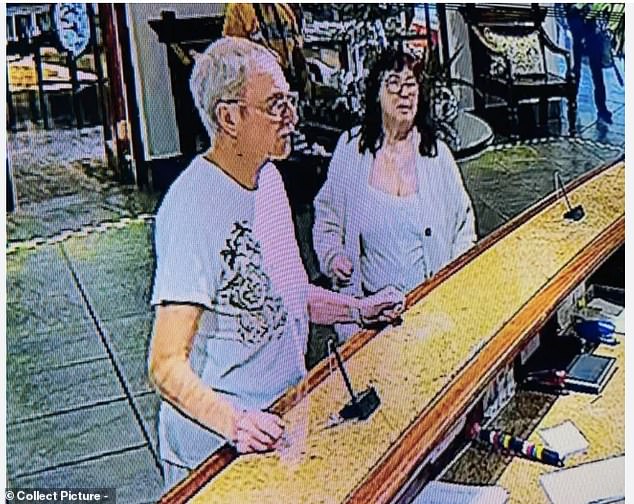
British tourist Lorna McSorley, 71, (right) pictured with her partner Leon Probert (left) at the reception desk of the Ghost Mountain Inn where the couple were staying
An angry local mayor told the meeting he believed Lorna’s case has been swept under the carpet lest it frightens off British tourists who bolster the town’s sugar economy.
In January, however, a mile away from the lonely mud-track where Lorna was last seen, another elderly woman was snatched by intruders, who burst into her house and later dumped her body, minus one arm.
The mounting unsolved murder toll is causing a combustible amalgam of fear and unrest, and Lorna’s disappearance finally appears to be getting the attention it merits.
In the coming days, I have discovered, it will be removed from the case load of an overstretched detective sergeant, who froze like a rabbit caught in headlights this week when I confronted him at Mkuze’s dilapidated police station and asked whether he believed Lorna was murdered by body part snatchers.
It will be reassigned to two top detectives, to be deployed from Durban, four hours away.
It is a decision that will doubtless come as a mercy to those closest to Lorna: Mr Probert, now back in Devon and, he says, mired in ‘guilt’ for abandoning wildlife lover Lorna on her fateful last walk.
And her Hertfordshire-based younger brother, Geoff Sheward, who tells me he is coming to accept the appalling probability that she did indeed fall into the clutches of a gang who murder to order for ‘sangomas’.
Ordinarily, these traditional healers use plants and animals to concoct their purportedly magic potions, or ‘muti’, but corrupt ones use human skulls, limbs and organs.
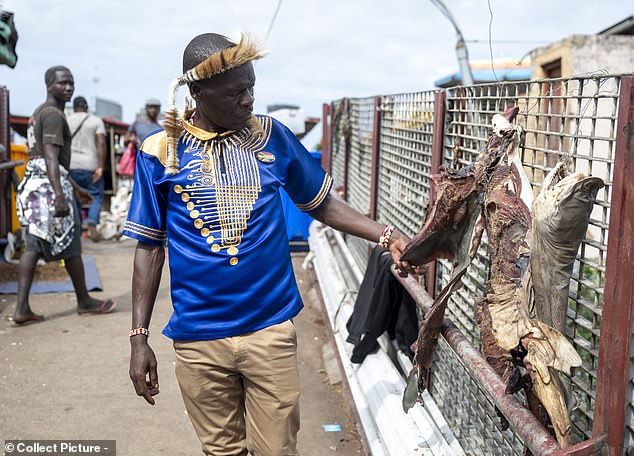
Pictured: Jabulani Sambo, a Sangoma and Nyanga who operates out of the Warwick Junction Muthi market
‘I suppose it has to be true,’ said Mr Sheward ruefully, when I asked him whether he thinks his sister was murdered in this unspeakable way.
‘I can’t think of anything else. If a wild animal had attacked her, it would have left something behind. But there was no trace. Nothing at all.’
With a murder rate 50 times higher than Britain’s, and robberies and rapes also at epidemic level, a tour of South Africa is not for the faint-hearted, enchanting though its culture and scenery may be.
Yet Lorna, who served in the Army for five years after leaving a Hertfordshire grammar school, was a doughty traveller who
frequently ventured overseas after retiring.
She stood little more than 5ft tall, yet her oldest friend, Jean Young, says she was feisty and remarkably fit for her age, and would have ‘fought back’ ferociously if attacked.
She and Leon, both divorcees, got together 30 years ago while working together for Woolworths, in Swindon, and later retired to a semi-detached house in Teignmouth.
Their South African holiday, which cost about £2,000 each, began in Johannesburg and took them along the Garden Route to Cape Town, on a safari in Kruger National Park and up
to Swaziland, from where they and their fellow tourers were driven to Mkuze.
They checked in to the Ghost Mountain Inn on Saturday September 27 last year.
The elegant safari and spa hotel is named after a nearby massif whose caves are a catacomb for the mummified remains of ancient Zulu chiefs.
Locals believe their spirits still shroud the strange-looking mountain, bringing ill-fortune to anyone who dares to disturb them. It’s a story that enhances the magic of this captivating area.
Strolling beyond the inn’s electrified fence, soon after checking in, however, Lorna and Leon were taking a less ethereal risk.
A sign by the security barrier would have alerted them to the possibility of encountering a hippo (Africa’s most deadly mammal) or one of the
crocodiles lurking in the lake, around which they intended to walk.
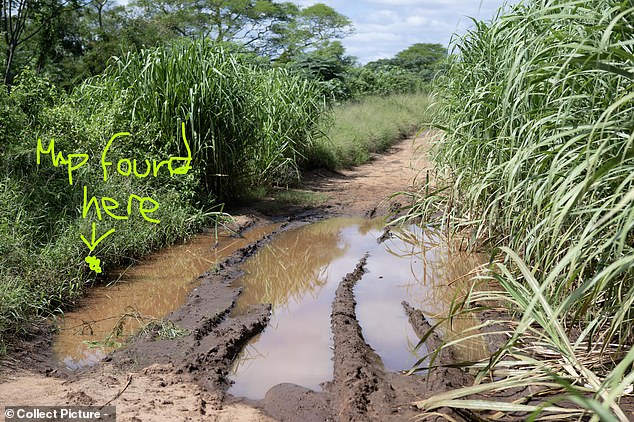
Picture shows the site where the crumpled map that Lorna was carrying was found
As the dense subtropical bush also conceals leopards, and pythons big enough to swallow a person whole, reception staff would have urged Lorna to go out with a guide, a senior staff member assures me, but she did not heed the warning.
‘In the UK you go on nature rambles and maybe they thought it would be like that. We’ve all heard about mad dogs and Englishmen,’ says my source, adding: ‘Sadly, all this happened because she didn’t take our advice.’
It appears so. At about 2.30pm, armed only with a map provided by the hotel, she and Leon left the compound and headed out on the open road.
The temperature was in the mid-80s, the humidity stultifying, and for some unfathomable reason they’d left their mobile phones – their only lifeline – in their room. Dressed in white trousers and a matching blouse, Lorna carried her
camera, a gold watch, her credit card, and 2,000 Rand (just under £100) in a black shoulder bag, yet they didn’t even take a bottle of water.
Matters started to go wrong about 800 yards along the route.
By then they had turned off the Tarmacked Durban road – passing the country club where raucous Boer farmers were watching South Africa play Argentina at rugby – and were following a muddy track strewn with deep puddles.
As they both brought only one pair of shoes each on holiday, Leon later told police, he suggested they should turn back. Perhaps hoping to photograph some of the 420 bird species nesting around the lake, such as the Pink-throated Twinspot, and maybe even a crocodile, Lorna demurred.
So, while he trudged off back to the hotel, she went on alone.
It was an undeniably reckless decision, for the track was almost deserted and if she met with trouble there would be little she could do.
Only two people admit to having seen her before she vanished.
The first was a 30-year-old plantation guard nicknamed Spider, who carried a fearsome-looking machete. He told me they exchanged polite ‘good afternoons’ as she passed him, and that she ‘seemed fine’.
The second was burly farmer Koos Prinsloo. By now Lorna was lost, so stopped at his house to ask for directions, but declined his kindly offer of a lift back to the hotel.
Though she had been walking for about 45 minutes in sapping heat, Prinsloo says, Lorna said she felt ‘fine’, so he told her how to get back to the inn and returned to his meal.
That was the last sighting of her. At about 5.30pm, Leon, who had been waiting for more than two hours at the hotel, reported her missing.
Inevitably, some cruel internet ghouls have placed him under suspicion. Next day, however, when the coach departed, local police kept him behind and, after questioning him, they were satisfied his version of events was truthful.
The first person to search for Lorna was the inn’s sustainability manager, Jean Toucher, who combed the mud tracks in her car, to no avail.
Having worked at the hotel for 23 years and led safaris, she considers the two-and-a-half-mile-long path that Lorna ought to have followed ‘as safe as houses’.
No one has ever been attacked while walking along it, either by a human or an animal, she tells me. The last hippo to live near the lake, a troublesome bull, was shot a month before Lorna arrived; as for the crocodiles, rangers capture those that grow to man-eating size and relocate them on a game reserve.
‘My feeling is that someone took her away, but everything is a theory because you can’t find anything concrete,’ says Toucher.
That Saturday evening, and during the following week, the hunt dramatically widened. The police were aided by private security firms and droves of sugar plantation workers.
The dense thornveld was scoured by aircraft, drones, sniffer dogs and expert trackers, and townsfolk walked through it, shoulder-to-shoulder, yet this operation produced just one indication to Lorna’s likely fate.
Bumping along the maze of tracks striating the plantation in her sister’s truck, Koos Prinsloo’s teenage daughter spotted the A4 map Lorna was carrying, crumpled up in a grassy verge near the Mkuze River.
Search leaders think the kidnappers may have snatched it from Lorna’s grasp and carelessly thrown it away.
For almost six months since then, nothing more has emerged.
Not a shred of clothing, no smattering of blood, no tell-tale signs of disturbance in the bush.
No one has sent a ransom note or used Lorna’s credit card. ‘It’s as if she’s been abducted by aliens,’ locals repeat, when her name arises.
Though they occasionally return to the inn to question staff, the police are similarly nonplussed.
Determined to discover what happened to ‘the British lady’, however, Francois Nel, 52, the plantation’s bullish security manager, is conducting a more assiduous parallel probe.
While there are no statistics on the number of muti murders in South Africa each year (because they are lumped in with the 27,000 others that demean the Rainbow Nation) as many as 300 people are feared to be killed for body parts.
Like the Zulu community, Nel believes Lorna McSorley should be categorised among them.
He knows the plantation like his own back garden and believes the gang stalked her after a scout informed them that a defenceless woman tourist was out walking alone.
He suspects the lookout may be an outwardly poor local man who inexplicably found the funds to buy a new car soon after Lorna vanished.
The gang would have had a clear sight of Lorna across open ground, because the sugar cane, which grows to 9ft, had just been harvested.
Nel thinks they captured her when she reached a dip in the track where no one would see them, for this is where the map was found.
There is more compelling evidence to support this theory. With police permission, he says, Nel checked whether any mobile phones were active in that area, late in the afternoon of September 27.
Between 4.44pm and 5.11pm, the period when a septuagenarian walking at a moderate pace might have reached this spot, four SIM cards were triangulated within a 50-metre radius.
While their users can’t be traced directly, because burner SIMs can be obtained in backstreet South African shops without registering one’s identity, Nel believes this to be a crucial finding, for it suggests Lorna was ambushed by several people, and by checking their itemised phone bills police could get the evidence they need to trap them.
The ‘pings’ from one SIM showed its user leaving the main road and heading towards the place where the map was dropped, staying there for a few minutes, then speeding off.
‘If they had been local robbers, they would have cut her throat, taken her watch, camera and cash, and left her in the bush,’ Nel surmises.
‘But in Lorna’s case the prize was her body. It sickens me to imagine the way I think she would have died.’
Community policing chairman Bongani Mathenja agrees. When we met on Wednesday, in gathering dusk beneath Ghost Mountain, he revealed details of the ten other suspected muti murders in the area over the past six years.
One mutilated girl was just eight years old. There were two young women, aged 17 and 22.
But some victims were much older, belying the notion that sangomas only use ‘powerful’ young bodies (and those with congenital abnormalities such as albinos).
More proof of this came three years ago, when Anthony and Gillian Dinnis, who emigrated to South Africa from Kent and were in their seventies, were spirited away from their lonely farmhouse near Mooi River, a six-hour drive from Mkuze.
In that case, a gardener who took part in the kidnap admitted their fingers and ears had been sliced off for muti before they were killed and disposed of – near running water, as ritual demands.
In court, however, the self-confessed culprit claimed his statement had been beaten out of him by police. The magistrate ruled it unreliable and he was freed. To their children’s distress, the Dinnises’ remains have never been found.
Despite these evil acts, studies reveal that a quarter of South Africa’s 63million population believe in muti. And as I saw when visiting Durban’s teeming muti market, where the rotting carcasses of sharks and monkeys hang beside baskets of roots and herbs, it is now a huge industry.