With Iran in flames, a blockaded Cuba running out of oil and Venezuela’s ex-president Nicolas Maduro appearing in a trial in New York, Donald Trump is certainly making life difficult for his enemies.
And now British banking chiefs are worried that the UK, too, could be brought to its knees by the combative US leader.
Not by missiles, fighter planes and submarines this time, but by two of America’s most devastating economic weapons: Visa and MasterCard.
America’s European allies were in his sights again this week amid complaints that the Nato alliance had done ’absolutely nothing’ to help in Iran.
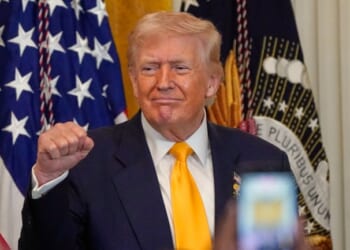
Trump has focused his ire on Britain and Keir Starmer in particular, and only yesterday attacked the Prime Minister for his lack of support in Iran with a mocking impersonation during a White House lunch.
Faced with Trump’s willingness to use American fiscal power to achieve his foreign-policy goals, the largest British banks are now accelerating plans to create a homegrown alternative to the two US credit-card giants.
Barclays, Lloyds, NatWest and Nationwide were among the lenders who have met to discuss a new British-based card, a so-called ’sovereign payments system’ that could handle the more than 30billion card payments totalling £1trillion a year.
Without it, they fear the British economy could collapse if we were ever to fall out with Uncle Sam, and Trump or a future president hit the kill switch on Visa and MasterCard – to say nothing of the risk of a cyber attack bringing the systems down.
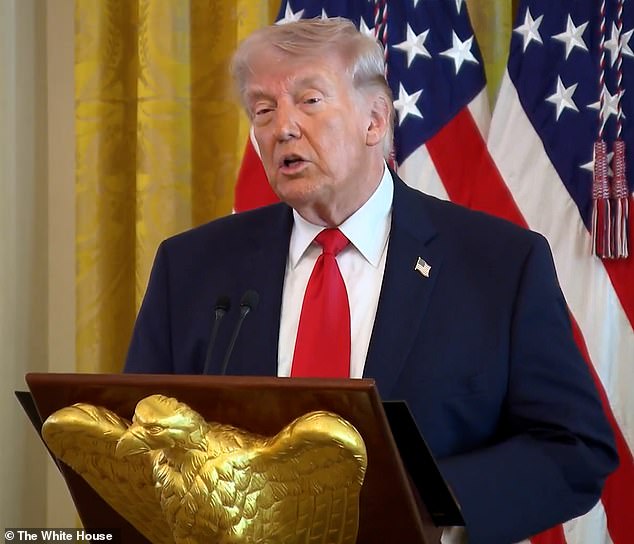
Trump has focused his ire on Britain and Keir Starmer in particular, and only yesterday attacked the Prime Minister for his lack of support in Iran
It’s not hard to see how serious such a move would be. The two US credit card companies are indispensable to the British economy – one of the most cashless in the world – handling around 95 per cent of card transactions.
Suspending them in the UK would involve rather more than just flicking a switch: a US President would have to impose sanctions (based on American laws such as the International Emergency Economic Powers Act) on the UK and then inform the card companies they must comply by restricting their services.
It’s likely there would be a notice period. The two payments giants would need time to adjust their systems to block transactions from the UK, which they would only do reluctantly as it is one of their most profitable markets.
From buying a sandwich with the tap of plastic or smartphone to wealthy people making six-figure debit-card purchases online, we all rely on these cards so instinctively, say critics, that it’s easy to ignore the catastrophic repercussions that would arise if they were suddenly denied to us one day. Experts say that if Visa and MasterCard were switched off in Britain tomorrow, the immediate consequence would be a near total collapse in the retail and service sectors.
Small and medium-sized businesses, which constitute the backbone of the economy, would be hardest hit as they rely almost entirely on cards.
Contactless and ’chip-and-PIN’ terminals in shops, restaurants, petrol stations and vending machines would stop working. Poorer people, the elderly and those in rural areas – the groups that most commonly rely on cash today – would be worst affected. The trend for British banks to close branches to cut costs would only make the situation worse.
There would be a run on the banks and obtaining cash would swiftly become easier said than done. ATM machines are often connected to Visa and MasterCard networks for the authentication of debit cards, so many of them would fail.
Long queues would form for the remaining bank branches’ ATMs, and cash supplies would soon run dry. The vast majority of online retail transactions would become impossible, including recurring subscriptions for services such as Netflix. Tourism would inevitably suffer heavily. After all, who nowadays bothers with the hassle of traveller’s cheques?
As people stopped making purchases, the effects would ripple through the economy: supply chains would grind to a halt and many businesses would collapse for want of revenue. A full-blown economic meltdown, in other words.
Trump hasn’t yet threatened the UK with cutting off Visa and MasterCard but the risk is not entirely theoretical: the White House has done it before. In March 2022, on the orders of President Joe Biden, the two companies announced that they were suspending operations in Russia after pressure from Ukrainian president Volodymyr Zelensky.
The move caused considerable hardship for ordinary Russians and did damage the economy – but could have been far worse.
That’s because, after facing international sanctions for invading the Crimea in 2014, Russia had created its own card payment system, MIR, which allowed its people to continue paying by card inside their country after Visa and MasterCard were blocked, even if they couldn’t buy anything abroad.
Britain had a small taste of such chaos back in June 2018, when the entire Visa system shut down across Europe for several hours because of a hardware failure at a data centre.
Hundreds of thousands of people were stuck in queues at supermarkets, petrol stations and transport hubs, unable to pay. Diners were left red-faced when they found they couldn’t settle up in restaurants, while even an MP drove away from a petrol station without paying.
More than five million credit- and debit-card transactions failed, the chaos being compounded by the fact that people later discovered that, even though their card was being repeatedly declined, the money was still coming out of their bank account.
And all that was in just a few hours without Visa cards, not a long-term shutdown of both payment cards that could be ordered by the White House.
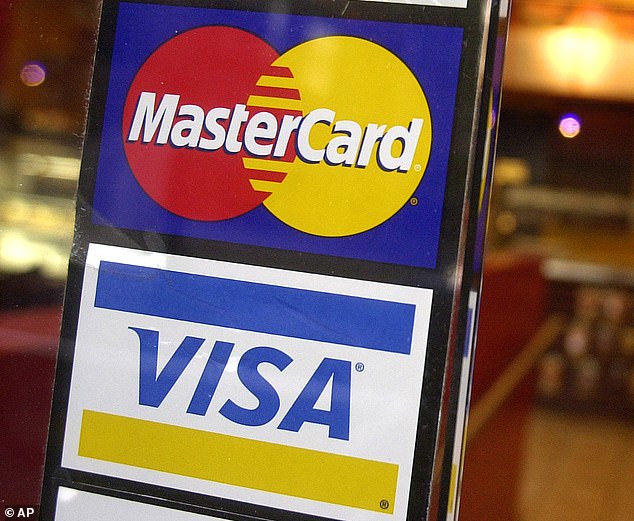
The risk of the US cutting off Visa and MasterCard is not entirely theoretical – President Joe Biden ordered the two companies to suspend operations in Russia in March 2022
’People would have to return to paying for everything with cash,’ a UK bank executive was quoted saying. ’If MasterCard and Visa were turned off, it would send us back to the 1950s.’
In fact, it would be worse than that. After all, 70 years ago, everyone had cash and every shop accepted it.
Today, the majority of British people now carry no cash and some smaller businesses – such as cafes, corner shops and hairdressers – don’t accept notes and coins at all.
The European Union – a particular bugbear of Trump – is even more worried than British bankers are. In January, Aurore Lalucq, chair of the European Parliament’s economic and monetary affairs committee, said: ’Trump can cut everything off… You can’t say you weren’t warned.’
Experts have been saying for some time that Britain is in a dangerous position from relying so heavily on American payments companies. However, say critics, the financial industry has in the past ignored the warnings because card payments are so lucrative (banks cream off fees for each transaction) and also provide valuable data they can sell on to marketing companies.
Even if the Government and banking sector do belatedly get their act together and agree to create a new British payments card, it won’t be in operation for at least another five years.
Meanwhile, sceptics say that the basic problem isn’t relying on US payment cards, but payment cards in general – as they are always going to be prone to cataclysmic system failures, even if that’s more likely from a cyber attack than a Trumpian fit of pique.
The real solution, they say, is to discourage people and businesses from giving up on cash. So should we be returning to the old ways and stuffing £50 notes into a mattress? Actually, experts say it is highly advisable to keep a decent amount of cash at home, even if that provides an additional security headache. And even if that sounds like a return to the dreaded 1950s.