While indulging in chocolate treats over Easter is all part of the fun, the consequences can be less appealing.
In light of this, nutritionist Christelle Page has revealed seven smart ways to enjoy Easter treats without the guilt.
Speaking to the Daily Mail, Page, a Nutritionist Resource member, said: ‘Easter and chocolate go hand-in-hand, but for many people it can quickly turn from enjoyment to overindulgence, followed by guilt.
‘As a nutritionist, I would never tell people not to enjoy chocolate at Easter. The real problem is often the all-or-nothing mindset around it.
‘Once people feel they have ‘blown it’, they are more likely to keep eating mindlessly and end up feeling physically and emotionally worse afterwards.
‘The good news is there are clever ways you can still enjoy eating your Easter chocolate guilt-free without feeling like you have undone all your hard work – and it is often less about whether you eat chocolate, and more about how you eat it.’
Read on to discover the nutritionist’s top tips for enjoying chocolate more mindfully this Easter.
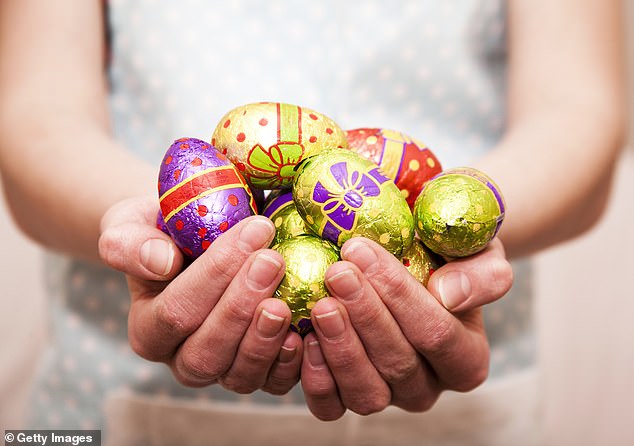
Nutritionist Christelle Page has revealed seven top tips to enjoy chocolate guilt-free this Easter period
1. Time your treats right
According to Page, timing is everything when it comes to mindful chocolate consumption.
She said: ‘If you are going to have chocolate, it is often better to eat it straight after a meal rather than on an empty stomach or as a stand-alone snack.
‘Having chocolate after a meal that contains protein, fibre and healthy fats can help slow down how quickly sugar enters the bloodstream, reducing the sharp spike-and-crash effect that can leave people feeling tired, hungry again quickly, or reaching for more sugar later.’
2. Eat chocolate with nuts
Page added that it’s not just timings, but also the foods paired with chocolate.
The nutritionist explained: ‘To help avoid the blood sugar roller coaster when eating chocolate between meals, try pairing it with a small handful of nuts or a spoonful of nut butter, or choose a chocolate with nuts or a nut filling.
‘You could even melt some chocolate and mix in nuts to make an easy homemade bark.
‘Nuts provide protein, fibre and healthy fats, which help slow sugar absorption, make the snack more filling and keep energy levels steadier. That makes it less likely that one piece of chocolate turns into half an egg.’
3. Choose dark chocolate
When it comes to selecting an Easter egg, one made with dark chocolate is often the best bet. Page said: ‘Choosing a better-quality chocolate can make a real difference.
‘Dark chocolate with a higher cocoa content, such as 70 per cent or above, tends to contain less sugar than milk or white chocolate and is often more satisfying because the flavour is richer and more intense.
‘Dark chocolate also contains natural antioxidants, along with minerals such as magnesium, iron, copper, manganese and zinc.
‘Together, these nutrients and compounds may help support normal energy metabolism, mood, immune function and the body’s natural antioxidant defences.
‘Some research also suggests that dark chocolate flavanols may have benefits for heart and brain health. That does not make Easter chocolate a health food, but it does make darker chocolate a more nutritious option than very sugary alternatives.’
4. Go for a walk straight afterwards
It might come as little surprise that Page also highlighted the importance of exercise after indulging.
She said: ‘Going for a 10 to 15-minute walk after eating chocolate or a sweeter meal can be a simple but effective way to help your body use glucose more efficiently and support steadier blood sugar levels.
‘It can also help draw a line under the treat, rather than turning one chocolatey moment into a whole afternoon of grazing.’
5. Don’t keep chocolate in easy reach
Page continued: ‘If you are surrounded by lots of Easter chocolate at home, it becomes much harder to rely on willpower alone.
‘A helpful strategy is to be selective about what comes into the house in the first place, or to put some of the chocolate away out of sight rather than leaving it on the kitchen counter.
‘The more visible and easily available food is, the more likely people are to eat it automatically rather than make a conscious choice.’
6. Portion it out instead of picking at it
Portion size is also important, Page explained, saying: ‘One of the easiest ways to overeat chocolate is to eat it straight from a large egg, gift box or sharing bag without really noticing how much you are having.
‘Breaking off a portion, putting it on a plate or into small containers, and then putting the rest away creates a natural pause.
‘That pause gives your brain time to catch up with what you have eaten and decide whether you actually want more, rather than continuing simply because it is there.
‘The same applies to individually wrapped mini eggs or small chocolates. Deciding in advance how many you are going to have can help put you back in control.’
7. Drop the guilt
Lastly, the nutritionist explained that mindset matters. She said: ‘This is probably the most important tip of all. Guilt often drives the very behaviour people are trying to avoid.
‘If you tell yourself you have failed, you are more likely to keep picking, overeat, and then promise to “start again” on Monday.
‘In reality, one Easter egg or a few chocolates do not ruin your health or your progress. What matters far more is what you do consistently over time.
‘Even the healthiest people overindulge sometimes, but they do not beat themselves up about it. They simply go back to eating normally. Enjoy it, move on, and return to your usual routine at the next meal.’