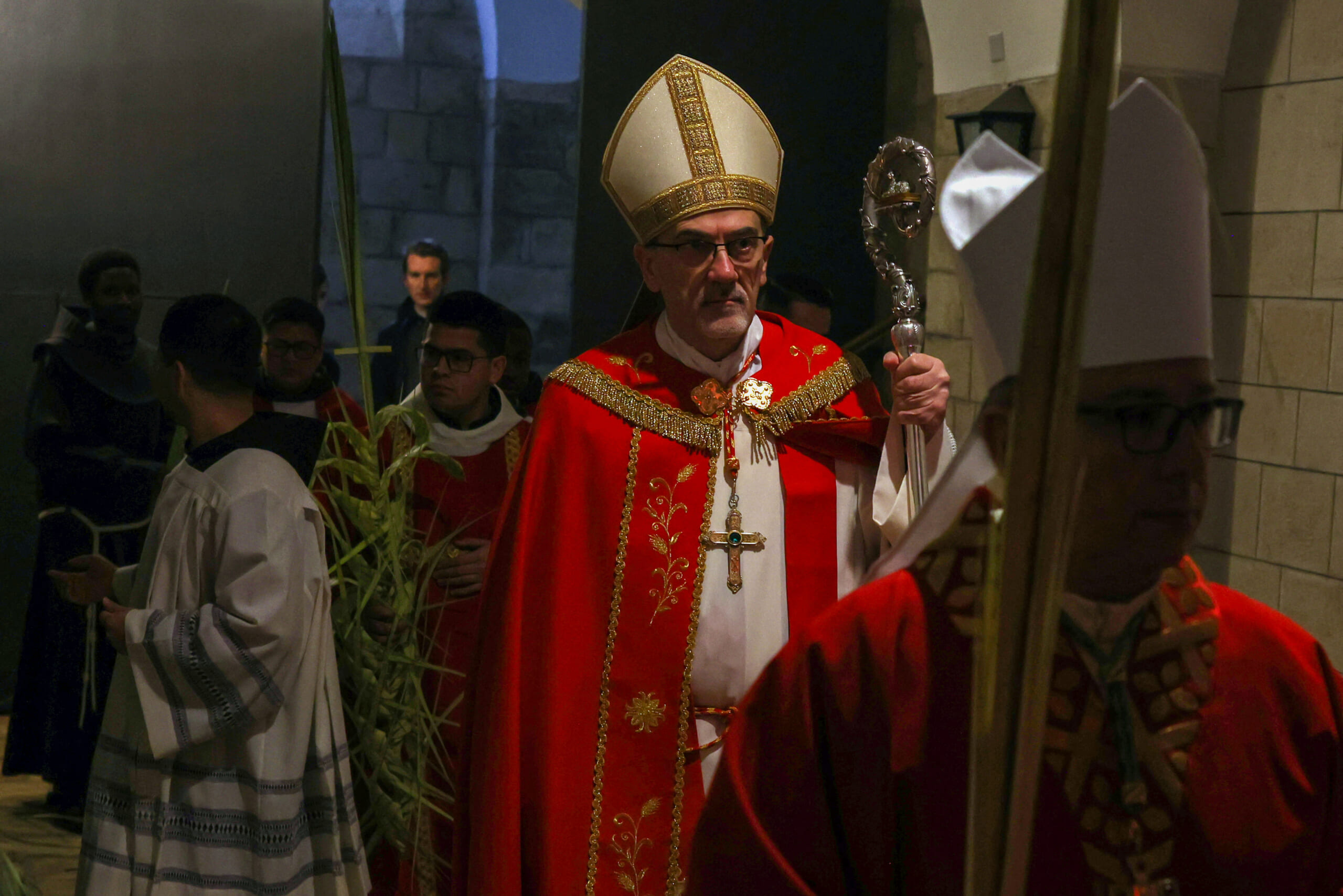
On Palm Sunday, Israeli police stopped Pierbattista Cardinal Pizzaballa, the Latin Patriarch of Jerusalem, and Francesco Ielpo, the Custos of the Holy Land, on their way to the Church of the Holy Sepulcher. The church called the decision “manifestly unreasonable and grossly disproportionate,” noting that for the first time in centuries, its senior leaders were prevented from celebrating Palm Sunday at Christianity’s holiest shrine. Only after global outrage did Prime Minister Benjamin Netanyahu reverse the restriction.
This event should alarm everyone, not just practicing Christians.
Palm Sunday is Christianity’s great anti-empire procession. Jesus entered Jerusalem without a chariot, legions, or spectacle. He came on a donkey. He did not arrive to flatter power but to expose it. He did not mirror the empires of his age; instead, he unmasked them. Palm Sunday is what happens when the Kingdom of God enters a city and reveals how insecure worldly power really is.
That is what makes this episode so revealing. A modern state with one of the world’s most sophisticated military and security apparatuses found itself threatened by a humble Christian observance. There is bitter irony in that. On the very day Christians remember Christ’s repudiation of imperial theater, armed power moved to police the memory of it.
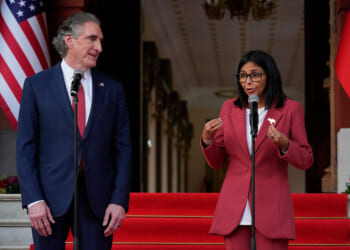
Israel says this was about security during wartime. But even if one grants the seriousness of the moment, the facts still expose something deeper. The planned Mass reportedly would have involved fewer than 50 participants, within the gathering limits Israel itself was enforcing. U.S. Ambassador Mike Huckabee, rarely a critic of Israel, called the decision an “unfortunate overreach” and said it was “difficult to understand or justify.”
U.S. Senator Ted Cruz agreed that the security concerns should not have prevented the patriarch from entering the church. When Huckabee and Cruz are complaining that Israel has gone too far, Americans should pay attention.
Huckabee and Cruz now seem startled that a state they have treated as morally untouchable could trample Christian freedom in Jerusalem. But this is what happens when politicians spend years confusing biblical loyalty with political indulgence. Eventually the idol stops pretending to be holy.
Neither the leaders in Jerusalem nor those in Washington, DC should be romanticized as guardians of religious liberty simply because they wrap themselves in biblical language.
The deeper problem is not one bad decision that was quickly corrected. It is the logic underneath it.
For months, Muslim worship at Al Aqsa was heavily restricted, especially during Ramadan. Jewish worshippers at the Western Wall also lived under wartime limitations, so fairness requires saying plainly that this pressure was not borne by one community alone. But Palm Sunday revealed something that cannot be dismissed as routine.
When Pizzaballa was blocked from entering the church, the world saw how easily a broader security regime can become a mechanism of humiliation and control. It is hard not to see a pattern, or at least a test of limits. If the world shrugs when one holy site is constricted, power learns it may be able to constrict another. If the outrage is manageable, the precedent becomes useful. That is how freedom is narrowed, not always by one dramatic act, but by little steps.
Christians should be especially clear-eyed about what the Church of the Holy Sepulcher represents. It is not merely an ancient building or picturesque stop on a pilgrimage route. Christians have venerated this church for centuries as the site of Christ’s crucifixion and resurrection. In the grammar of Christian faith, this is not ornamental; it is the hinge. The church stands or falls on the confession that Jesus was crucified, buried, and raised from the dead. To obstruct worship there on Palm Sunday is an assault, symbolic if not yet total, on the public witness of the resurrection itself.
And the man who was barred is not some imported dignitary with little connection to the suffering people of the land. Pizzaballa is the highest Catholic authority in Jerusalem and across the Latin Patriarchate’s territory, which includes Israel, the Palestinian territories, Jordan, and Cyprus. For Palestinian Christians, he is a shepherd who has gone to Gaza, more than once, to stand with a battered flock. In 2023, he even said he was willing to offer himself in exchange for Israeli hostages. His presence has become a source of hope precisely because he has refused to abandon them.
Jesus wept over Jerusalem, not because the city lacked power but because it did not know the things that make for peace. He wept because he saw the use of sacred language coexisting with spiritual blindness. Two thousand years later, the tragedy remains. Jerusalem still knows how to control a crowd better than how to welcome peace. It still knows how to securitize holiness. It still knows how to mistake force for authority.
Subscribe Today
Get daily emails in your inbox
Palm Sunday announces that God’s answer to empire is not a stronger empire but a different King—one who rides into the city in a lowly manner but who exposes domination instead of sanctifying it. This King wept over Jerusalem even as its people were preparing to kill him.
That is the final irony here. The men with weapons, gates, and orders imagined they were controlling access to a church. But Palm Sunday has always been about something they cannot control: the public unveiling of a Kingdom that terrifies every empire precisely because it does not need to become one.
If Israel, backed by the most powerful friends in the West, still feels threatened by the memory of a peaceful procession led by the church, then perhaps we are seeing a gripping embodiment of how fragile power becomes when confronted by the truth of a donkey, a cross, and an empty tomb.