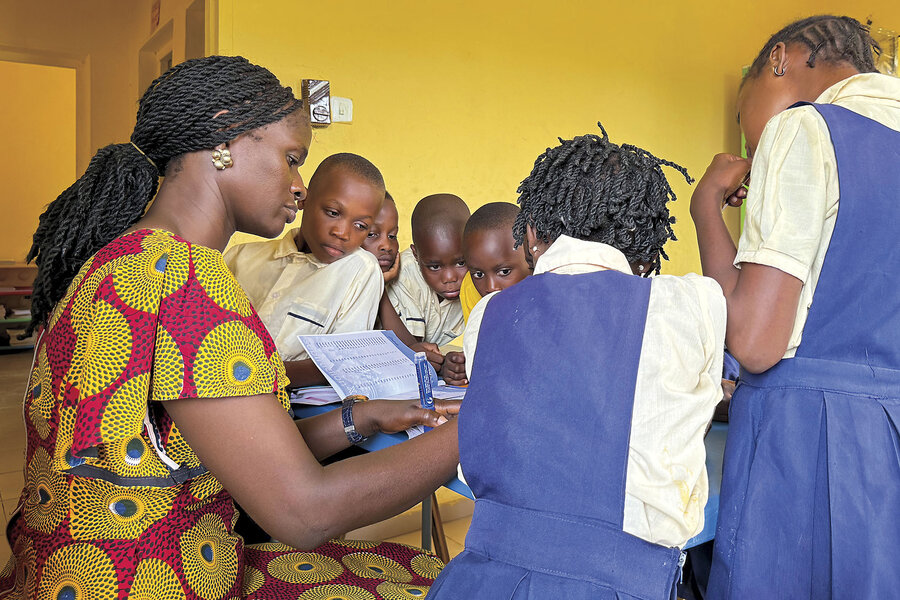
The road to Talent Mine Academy in southwestern Nigeria is a long, sunbaked path of bumpy red earth. Nothing on the road suggests the happiness happening inside the school’s yellow and blue walls.
As soon as a visitor steps through any classroom door, the high-pitched voices of young learners break into a cheerful “Good morning!” They stretch out the singsongy greeting, having decided that this moment in their tuition-free school deserves to be celebrated.
“I wanted to create a safe and supportive space where the kids can feel empowered,” says school founder Aramide Kayode, who along with her husband, Oluwaseun Kayode, is working to ease Nigeria’s education crisis. “Our goal is to turn [students] into solution providers and create a path out of poverty.”
Why We Wrote This
In Nigeria, schools are crumbling, teaching quality is often poor, and teacher-student ratios are high. One couple has been looking for solutions, hoping to improve teacher training and create a path out of poverty for children.
Following their hearts
Talent Mine Academy, in the town of Ota, enrolls children from low-income households, many earning as little as 15,000 naira (about $11) a month. The energy in the school’s classrooms belies the dire learning crisis in the country, where schools are crumbling, teaching quality is often poor, and teacher-student ratios are high. Approximately 11 million children ages 5 to 14 don’t attend school, one of the highest numbers globally.
Aramide and Oluwaseun Kayode each turned down lucrative offers in finance to work in education. They met in 2018 as part of Teach for Nigeria, a program requiring fellows to teach in low-income communities for at least two years. Ms. Kayode had just graduated from Covenant University in Ota with a degree in economics when she started her fellowship. Mr. Kayode, an accounting graduate, was a year ahead in the fellowship and already working to start Schoolinka, a social enterprise that trains teachers.

Courtesy of Oluwaseun Kayode
Their choice to work in the education sector was initially unpopular with their families.
“The teaching profession has an unfavorable public image in Nigeria, coupled with the poor pay, so it’s not able to attract talent,” says Godwin Henry, an education policy analyst at The Nigerian Economic Summit Group, a Lagos-based think tank.
Ms. Kayode’s father gave her six months to prove herself in education, while Mr. Kayode’s mother agreed to two years. If the couple failed, they were expected to pursue well-paid careers.
Ms. Kayode won her parents over early on in her fellowship.
“At some point, my mom donated a full box of clothes she’d bought from the [United Kingdom] to the kids,” Ms. Kayode says, the surprise still fresh in her voice.
Keeping kids in class
Talent Mine Academy began in 2019 as a Saturday class for out-of-school children whom Ms. Kayode met in her fellowship. “I was literally their first volunteer,” Mr. Kayode points out. He taught digital skills – one of three subjects, along with math and English.
After the COVID-19 pandemic interrupted the class, Ms. Kayode and some friends raised funds to put the children in private schools but “weren’t seeing the kind of results we wanted,” she says.
One student had been invited to an after-school coding class alongside wealthier children. When the student heard the others speak, she went silent because she didn’t believe that she belonged. “Their accent is so smooth,” she told Ms. Kayode afterward.
Ms. Kayode’s students also were singled out as suspects when a teacher’s money went missing, and some students reported verbal abuse in the classrooms.

Talent Mine became its own school in 2023, providing 12 years of free education. More than 100 students are enrolled this academic year, with significant support from donors.
Each student is matched with a sponsor. When one progress report noted a child was going hungry, the donor began paying for daily meals. Students not covered by donors now receive food for nominal rates.
Adeola Sunday’s son, Samuel, has been a student at Talent Mine for two years. At his former school, Ms. Sunday struggled to scrape together his school fees. “Talent Mine has now made everything easy for me,” she says.
Though Nigerian law mandates free education for every child, “books, bags, meals – none of that is accounted for,” Mr. Henry says. “What Aramide is doing ensures children stay in school.”
A teacher-training platform
Mr. Kayode grew up in a working-class neighborhood in Lagos where educational role models were scarce. When he finished his undergraduate degree and was sent to teach during his required year of national service, he found little had changed from his own schooling years: teachers who didn’t show up, students without books, poor school infrastructure.
Mr. Kayode began collecting used books from friends and setting up donation drop-off points across southwestern Oyo state. He then took the books to underresourced schools.
Next, two years as a Teach for Nigeria fellow laid bare the problem of teaching quality, which eventually led Mr. Kayode to start Schoolinka and create its online teacher-training platform. More than 1,000 teachers have accessed its free courses, which Mr. Henry says improve teacher quality and retention.
The basics, and more
On Fridays, classes at Talent Mine end at 1 p.m. Students rush outside toward a battered, well-loved trampoline, its springs exposed and rusting. Still, the kids drop their shoes on the grass and scramble, five or six at a time, onto the trampoline.
Ms. Kayode posts about the kids on social media a lot. The posts have built an audience that shows up when it counts – most recently to raise 20 million naira to buy the children a school bus.
Once, a teacher says, the kids were told that a video about them went viral. They didn’t know what it meant, and didn’t much care.
What they do understand is that this school is theirs to treasure. They have only to show up and learn.