In a gallery of the Ikon Gallery an excrement-brown canvas stands unevenly. Injured in one corner, the canvas on its wooden stretcher stands erect and slanting, supported from behind by a mangled prop, which has been shoddily taped to the main form. It is abject and unsettling. Its compromised state and unstable balance remind us of human weakness. The object tells us that secret vices deform us and cannot hold in the long run — that drug consumption, alcoholism, sex addiction or destructive habit will undo you in the end.
Reach (Red/Black) (2002) gives us a co-dependent relationship. Two paintings are stacked on top of each other. The top canvas is a glossy red endowed with lush translucent depth and is trimmed in black. The painting beneath is broken and sagging; it is a dull black, trimmed with red. There is a family resemblance in the forms and (reversed) colours. The pairing suggests how a person can support a family member, allowing them to be resplendent, but suffering as a consequence, becoming overlooked, disregarded and taken for granted.
As you can imagine, for those with a surfeit of selective empathy, Angela de la Cruz: Upright is a trying exhibition. Again and again one encounters objects that seem imbued not just with character but even the capacity to experience shame, fear and embarrassment. The very ordinariness of materials — crumpled and torn canvas, battered furniture, junked instruments — makes these painting-sculptures relatable. You can see how pieces have been assembled, but that explicability does nothing to lessen a viewer’s capacity to emotionally engage with what is ultimately hardly more than the contents of an art-college skip.
Spanish artist Angela de la Cruz (b. 1965) has been mining a rich vein of painting-cum-sculpture for 30 years. While at Goldsmiths College in the early Nineties, she took up the forms of Minimalism — a style that produced ideal objects to be admired as satisfying forms and substance — and revivified them by subjecting them to entropy in order to elicit empathy.
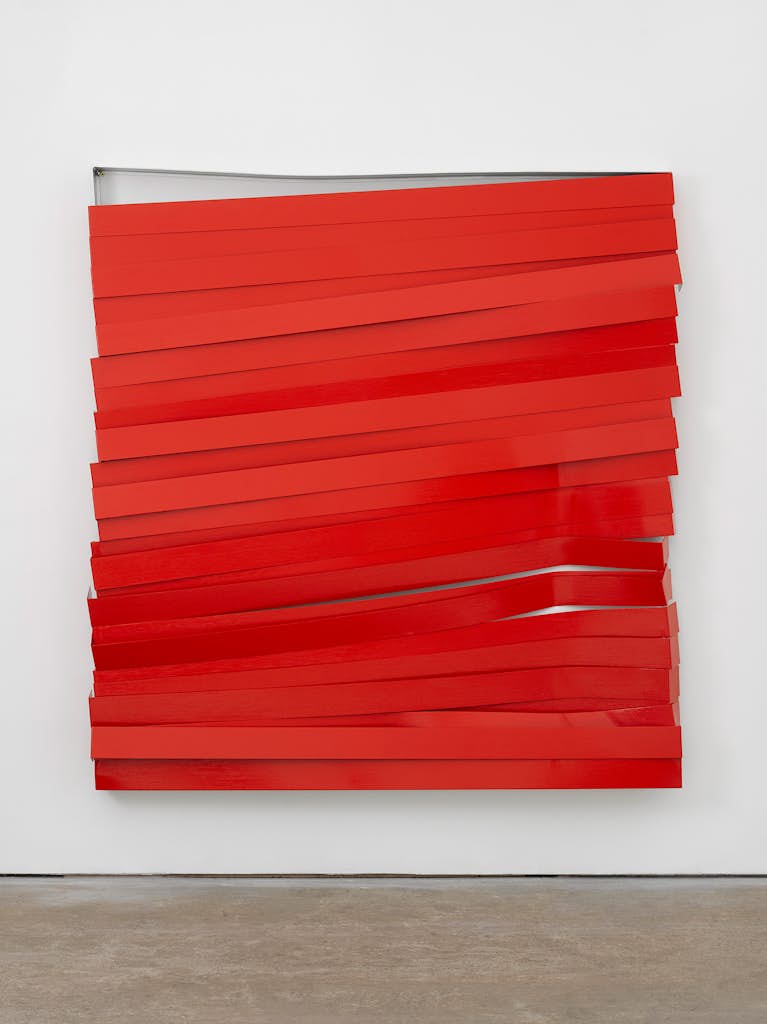
For example, take Shutter (Red) (2017), which is a shutter made of metal bands stacked horizontally. We all know what it should look like. This one evokes the roller-shutters used to protect shop windows, but it is deformed due to violence, as if it had been attacked due to material deprivation or nihilistic aggression. What happens when the ideal form encounters the imperfect human, her art asks. The piece works as a critique of urban dereliction and social policy as much as it is a riposte to Minimalist detachment. We can’t help feeling sorry for the shutter, subject to the slights of an unjust world.
Still Life with Table (2000) is half a table wrapped in canvas, almost consumed, like a victim of the Blob in the titular B-movie. With its hollow interior, the construction is almost a shell – a place for the vulnerable and homeless to shelter. Just as Pollock pioneered making paintings on the floor, so de la Cruz pioneered displaying paintings on the floor. “Very seldom an everyday painting will be displayed on the wall, unless there is a reason for it,” she says. Minimalism eschewed the plinth. Carl Andre put tiles of metal flat on the floor, even allowing people to walk on them. De la Cruz’s art inhabits our space and has no protective distance. Their prosaic everyday elements make her assemblages all the more striking.
Tragedy is never far away, even when objects engage in slapstick antics or are playfully jaunty. A piano is stacked on the base of an identical piano. It is a visual stutter; an odd-looking but potentially playable contraption. Depending on your mood, you might see these painting-sculpture hybrids as akin to silent-movie comedians — all greasepaint, pratfalls and broken balsa-wood props. If you were in a more delicate frame of mind, you’d see them as broken individuals assembled in a freak show. After a while, you start to apprehend these objects as personages, pathetic but resilient. The artist has often talked of her objects as demonstrating or experiencing shame or abjection.
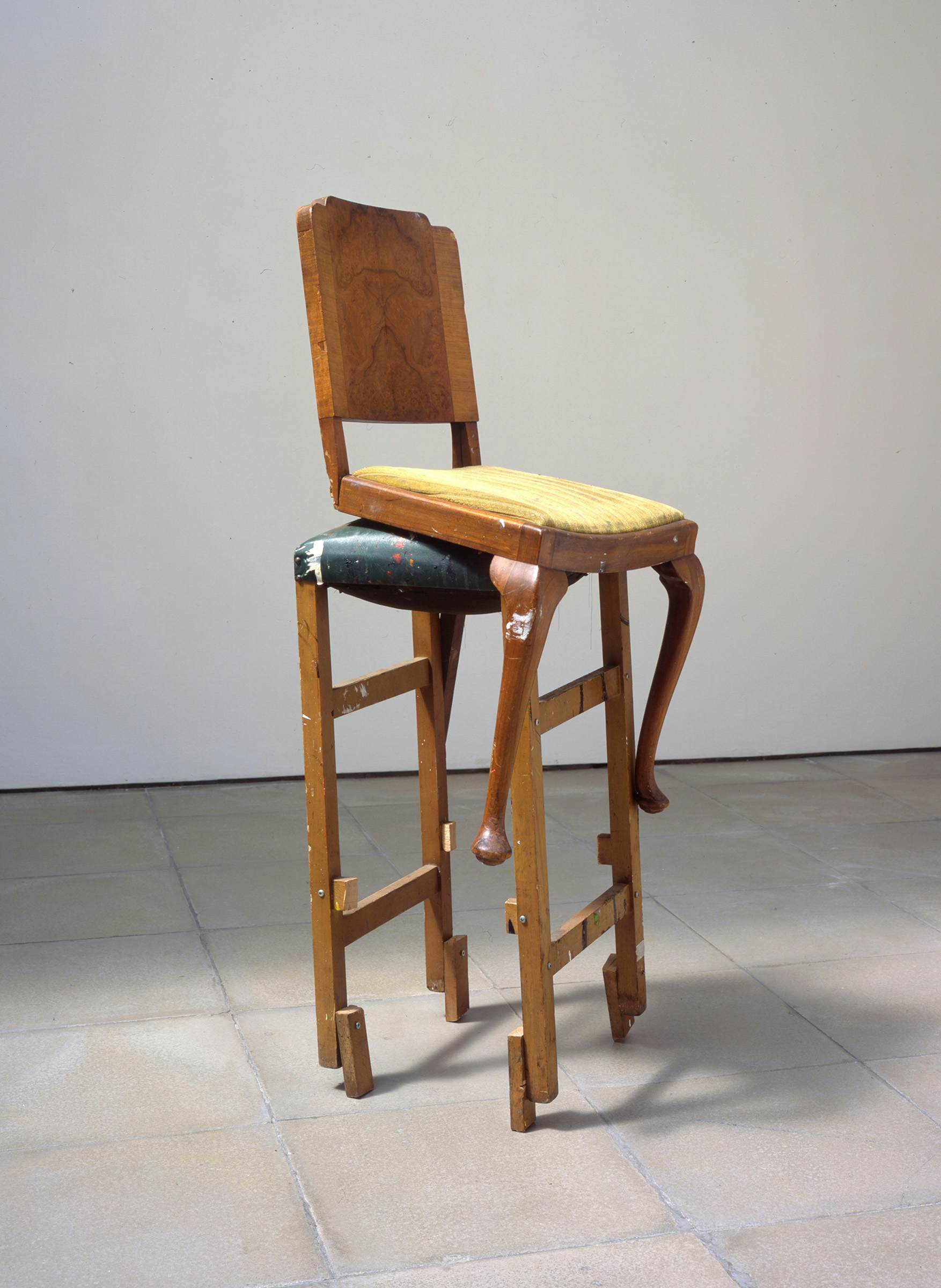
Prostheses come to mind when viewing Three Legged Chair on Stool (2002) where a damaged chair rides on a rickety stool. At first you want to laugh but then you find yourself moved, recalling a relative’s wheelchair or the handrail by the bath. Whom among us will not need such help at the most basic level? Sexy and chic it may be to imagine microchip implants augmenting our capacities; the reality of spectacles and false teeth have more grim bathos than cyborg glamour. A slippery fold of canvas to be found in Blister (2026) is the precise colour of old hearing aids.
The body has a way of revealing its weaknesses, which painfully intrude as one ages. As the artist admits, “I have always been obsessed with bodily excess and with the kind of resignation this excess entails.” Angela de la Cruz’s art has more insightful and pertinent things to tell us about the human body than a dozen Jenny Savile canvases of medical operations. De la Cruz’s art does not describe the presence of the human body but instead implies it. Rather than depicting bodily fluids, the unctuous glistening surfaces of her pieces stand in for saliva, blood and excreta. I’ve never seen deliciously tactile art I wanted to touch less than these artefacts. The shiny Prussian blue Bloated III (Blue) (2012) swells, as if with retained fluid or more sinister growths. Something unspeakably biological deforms the Platonic shape.
As we know what an abstract canvas is supposed to look like, how a wardrobe should stand and how steady a table is meant to be, we easily detect the defects in de la Cruz’s object-personages. We see them as damaged and dysfunctional because we measure their inadequacy against the mental model we have of normality. It is only natural (if one is inclined towards empathy) to project feelings and imagine the objects as experiencing emotion. In turn, that causes us to reflect upon the situation where we think at length about a crumpled ball of canvas or a broken stool and (absurdly but inevitably) develop emotional responses. We see these modest approachable objects as injured. We discover in ourselves our innate trait of pity and discover that (alas!) we are human, all too human.