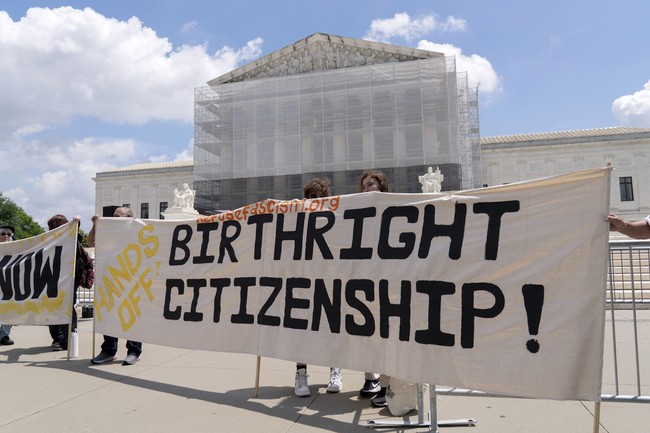
On the first day of his 2nd term, President Trump issued Executive Order 14160, “Protecting the Meaning and Value of American Citizenship.” That order was immediately challenged in court and was prevented from taking effect. The challenge eventually escalated to the Supreme Court and today the Court is hearing oral arguments in the case.
Birthright citizenship is not universally recognized.
Mapped: Birthright citizenship around the world https://t.co/5nM4HC88EG
— Anthony LaMesa (@ajlamesa) January 26, 2025
However, the case in America comes down to the text of the 14th Amendment and a subsequent Supreme Court case called United States v. Wong Kim Ark from 1898. Wong Kim Ark was a child born in San Francisco in 1871 to two parents who were Chinese immigrants. At issue in the case was whether or not Wong Kim Ark was a citizen by virtue of being born here:
The question presented by the record is whether a child born in the United States, of parents of Chinese descent, who, at the time of his birth, are subjects of the Emperor of China, but have a permanent domicil and residence in the United States, and are there carrying on business, and are not employed in any diplomatic or official capacity under the Emperor of China, becomes at the time of his birth a citizen of the United States by virtue of the first clause of the Fourteenth Amendment of the Constitution,
“All persons born or naturalized in the United States, and subject to the jurisdiction thereof, are citizens of the United States and of the State wherein they reside.”
The Supreme Court eventually agreed with the lower court that Wong Kim Ark was a US citizen based on the language of the 14th Amendment. So that’s the precedent at issue in today’s arguments.
President Trump attended part of the oral arguments this morning, the first time a sitting president has ever done so.
BREAKING: President Trump has left the White House en route to the Supreme Court, becoming the first president in history to attend and observe oral arguments as the justices consider his order to end birthright citizenship.
— Breaking911 (@Breaking911) April 1, 2026
The case is being argued by Solicitor General John Sauer. Early on, there was a sign of trouble when Chief Justice Roberts described Sauer’s argument as “quirky.”
Chief Justice John Roberts said in his line of questioning that the examples the administration are raising to support its argument are “very quirky.”
“You know, children of ambassadors, children of enemies during a hostile invasion, children on warships,” he said. “And then you expand it to the whole class of illegal aliens are here in the country. I’m not quite sure how you can get to that big group from such tiny and sort of idiosyncratic examples.”
Jonathan Turley called this a “gulp” moment.
Early on, John Sauer faced a gulp moment when the Chief Justice referred to his examples of different classes to show the narrower meaning are “quirky.” Sauer is doing, as usual, an excellent job…
— Jonathan Turley (@JonathanTurley) April 1, 2026
Justice Gorsuch also sounded skeptical:
Justice Neil M. Gorsuch asked, somewhat skeptically, how the court should interpret the government’s reading of “domicile” — core to the government’s argument that only children of immigrants who are domiciled in the United States should receive birthright citizenship.
“If somebody showed up here in 1868 and established domicile, that was perfectly fine without respect to any immigration laws,” he said. “So why wouldn’t we … come to the conclusion that the fact that someone might be illegal is immaterial?”
Turley also characterized Gorsuch as in play, meaning he sounded pretty skeptical of the government’s arguments.
…Gorsuch has continued to express a degree of skepticism toward the historical arguments of the Administration…
— Jonathan Turley (@JonathanTurley) April 1, 2026
Justice Kagan pointed out that most of the Solicitor General’s argument involved visitors to the US, not illegal immigrants.
“Most of your brief is not about illegal aliens. Most of your brief is about people who are just temporarily in the country,” Kagan told Sauer.
Later, she asked Sauer to explain where he’s drawing his argument about undocumented immigrants from, telling the solicitor general, “You’re using some pretty obscure sources to get to this concept.”
Justice Sotomayor asked Sauer how Trump’s EO could be squared with the Wong Kim Ark decision described above:
Sauer had argued that undocumented immigrants and foreign visitors on temporary visas lack allegiance to the United States because they do not live permanently and legally in the country. Therefore, he said, their children should not be covered by the 14th Amendment’s citizenship clause.
Sotomayor noted that the justices in the Wong case had made a point to quote Secretary of State Daniel Webster, who had said years earlier that the citizenship clause of the 14th Amendment defines allegiance without regard to whether the person in question intends to remain in the country permanently.
“It is well known that by the public law, a noncitizen, while he is here in the United States, owes obedience to this country’s laws,” Sotomayor said.
Justice Alito asked Sauer about the “humanitarian problem” created by illegal immigrants who cross the border and never leave.
Sauer responded by saying the U.S. policy of “nearly unrestricted birthright citizenship is an outlier among modern nations.”
“Every nation in Europe has a different rule, and the notion that they have a huge humanitarian crisis as a result of not having unrestricted birthright citizenship, I don’t think is a strong argument,” Sauer added.
But Justice Kavanugh seemed to argue that none of that was relevant to US law.
Justice Brett M. Kavanaugh asked why the court should buy into the government’s argument that many other countries don’t have birthright citizenship.
“Obviously, we try to interpret American law with American precedent, based on American history,” he said. “I’m not seeing the relevance as a legal, constitutional interpretive matter.”
Turley thinks Kavanaugh is sounding like a no on this.
…In other words, if the Court finds that the earlier Court was right in seeking to limit any new exceptions to citizenship under Wong Kim Ark, little more has to be said…
— Jonathan Turley (@JonathanTurley) April 1, 2026
Turley concludes at least those three conservatives are not a lock for the government.
…The three justices that I previously said were worth watching — Roberts, Kavanaugh, and Gorsuch — all seemed in play and not locks for the government. The justices dismissed the relevance of policy arguments over how many countries reject birthright citizenship today. One…
— Jonathan Turley (@JonathanTurley) April 1, 2026
Other sources are putting Justice Barrett in that same category, i.e. conservatives who sound skeptical of the government case. If so then this could be shaping up as a 7-2 decision in favor of birthright citizenship. Turley isn’t ready to call this yet but he definitely thinks it looks like uphill sledding for the government’s case.
…Majorities can certainly shift in conference and in drafting. The devil is in the details and the details remain murky at best. Many justices correctly found the historical record, according to one, “a mess.” Indeed, it is maddening to try to divine the intent of the drafters.
— Jonathan Turley (@JonathanTurley) April 1, 2026