
In one of the most anticipated cases of the year, the U.S. Supreme Court on April 1 will hear arguments about President Donald Trump’s efforts to reinterpret the Constitution’s guarantee of automatic citizenship at birth.
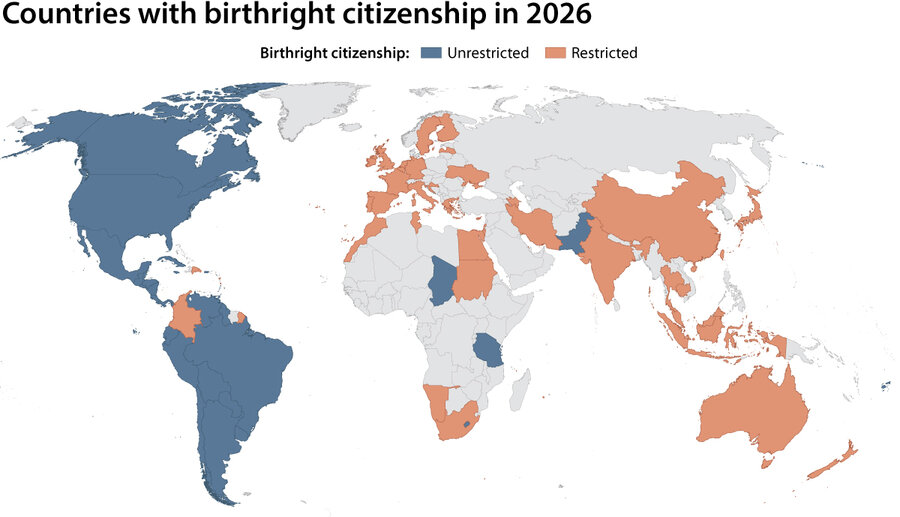
Mr. Trump once said that the United States is the only nation that grants citizenship to anyone born in the country, a policy known as birthright citizenship. In fact, about three dozen countries provide for unrestricted citizenship at birth. It is true that many countries around the world have chosen in recent decades to tighten, or get rid of, their birthright citizenship policies.
The case, Trump v. Barbara, concerns whether an executive order issued by Mr. Trump – that makes the children of unauthorized immigrants born in the U.S. ineligible for citizenship – complies with the 14th Amendment. (“Barbara” is a pseudonym for one plaintiff, a pregnant Honduran woman, who is part of the class action challenge.) The amendment, enacted after the Civil War, holds that “All persons born or naturalized in the United States, and subject to the jurisdiction thereof, are citizens of the United States.”
Why We Wrote This
The U.S. is one of about three dozen countries that provide for unrestricted citizenship at birth. The Supreme Court will consider President Donald Trump’s effort to reinterpret the Constitution’s guarantee of automatic citizenship at birth.
The clause has long been interpreted to mean that any child born in the U.S. is automatically a citizen. The Supreme Court affirmed that reasoning in an 1898 decision. Since the 1980s, some have argued that the words “subject to the jurisdiction thereof” provide grounds for narrowing that interpretation. The Trump administration argues that immigrants living in the U.S. illegally are not “subject to the jurisdiction” of the U.S., and that therefore their children are not entitled to citizenship at birth.
In the Barbara case, the Supreme Court will be weighing those differing interpretations. Outside the United States, countries have been having the same debates for decades. In fact, many countries in the Eastern Hemisphere have changed laws from citizenship by place of birth to citizenship by parental nationality.
Birthright citizenship laws worldwide
The United Kingdom passed a law in 1981 that replaced birthright citizenship. France did similarly with a law passed in 1993. Ireland made the change in 2004, with 80% of the population voting to end birthright citizenship in a national referendum.
Germany is one of several nations around the world with a combination of the two policies. After declaring itself “not an immigration country” in the 1980s, Germany adopted a limited form of birthright citizenship in 2000.
Across the Atlantic Ocean, almost every country in the Americas has unrestricted birthright citizenship. In many cases those nations have enshrined birthright citizenship in their constitutions. A key reason for birthright citizenship laws “in the ‘new world’ is precisely that it was thought of by Europeans as the ‘new world’ – which is to say, largely empty … and in need of people,” says Kim Lane Scheppele, a professor at Princeton University, in an email.
World Population Review
|
Jacob Turcotte/Staff
A debate over constitutional principles
But now, in the United States, “the facts on the ground have changed,” says Andrew Arthur, a resident fellow at the Center for Immigration Studies, which advocates stricter immigration policies.
“You no longer need to have that very liberalized [immigration] policy, to promote development, because the United States is largely developed today,” he adds. “This is clearly a trend that has been continuing in Western countries,” such as the U.K. and France, he continues.
The U.S. has not been isolated from the political and ideological forces that have led to legal changes in Europe, says Martha Jones, a history professor at Johns Hopkins University.

“We’ve been debating birthright since the 1980s,” she adds. “You could say it’s part of one broad rethinking of belonging in an age in which, in some quarters, the view is [that changing] demographics needs to be halted, needs to be contained. That’s true in Europe and that’s true here.”
What is different in the United States compared with most of Europe is that, in the view of many legal scholars, birthright citizenship is enshrined in its Constitution, and the U.S. Constitution is notoriously difficult to amend.
“Raising it to the level of constitutional principle does, I think, make [birthright citizenship] more [durable], more ineradicable than a national law” in the U.S., says John Torpey, a sociologist at CUNY Graduate Center.
Thus, the justices will be more focused on the 14th Amendment than on how the rest of the world has been reviewing its citizenship laws, says Mr. Arthur.
“This Supreme Court isn’t going to involve itself in the policy at all,” he adds. “They’re going to be looking a lot at the floor debates [in Congress in 1868] and the 14th Amendment itself.”