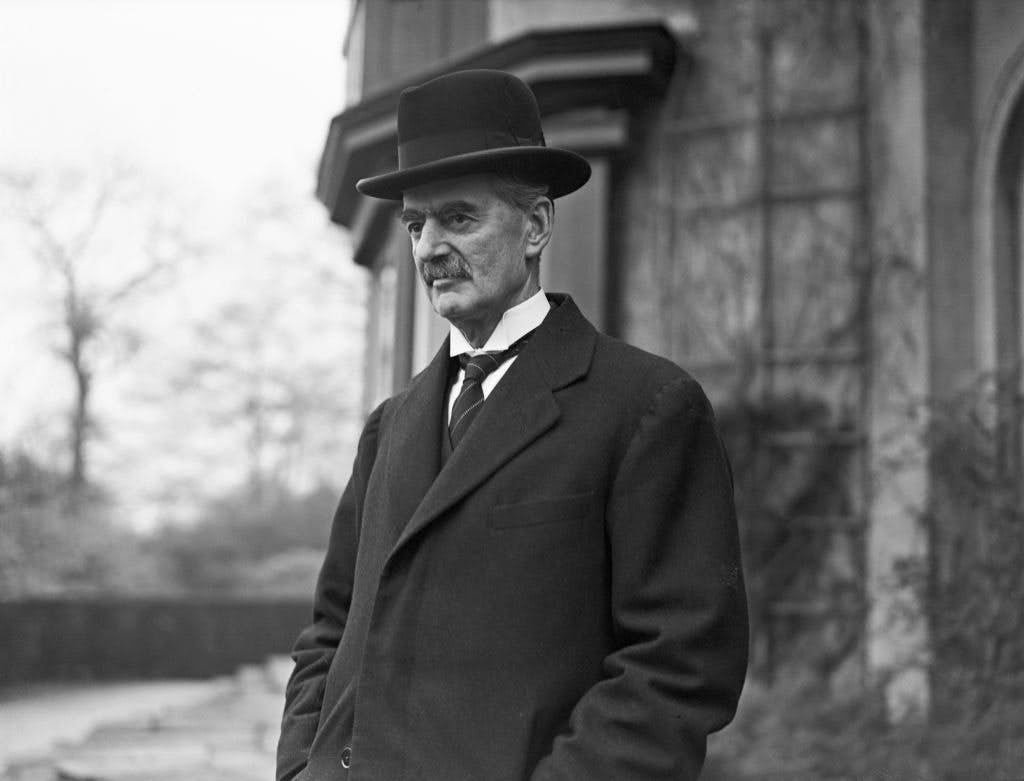
It is wrong to use Neville Chamberlain as a byword for cowardice and fecklessness
There is a vocal group of “Munich hawks” who are fond of using one favourite analogy to accuse today’s leaders of weakness and fecklessness. With j’accuse energy, usually in short-form writing but sometimes in extended works, they like to compare modern presidents or prime ministers with the maligned premier Neville Chamberlain, whose reputation has forever been tainted by his bid to avoid war with Nazi Germany by conceding the Sudetenland of Czechoslovakia to Adolf Hitler in September 1938.
Chamberlain’s policy was known as “appeasement”. It became a dirty word. The Munich analogy, and the slur that accompanies it, is old and relentless. Those who wield it claim this one historical case demonstrates a general truth, that appeasement — the making of major concessions, often at others’ expense, to make another party more peaceful — doesn’t work. A hardline, uncompromising and belligerent attitude is the only pathway to peace against dangerous regimes. Anything that smacks of peaceful diplomacy via compromise is surely capitulation.
By now, the claim that oneself is Winston Churchill, that dissidents are Neville Chamberlain and that the adversary is akin to Hitler should be an ill omen. The wars that leaders have launched with the aid of the Munich analogy have not consistently been triumphs, from Suez, to the Vietnam escalation, to Iraq to Libya. But undaunted by the poor track record of their analogising, the Munich hawks now once again reach for this familiar rhetorical weapon to attack Prime Minister Keir Starmer for his reluctance to join in America and Israel’s current military adventure against Iran in the Gulf, despite it being so well-conceived, carefully planned, and prudently conducted.
It is, of course, legitimate to argue that Chamberlain in September 1938 should never have tried to avert conflict with a powerful European state via a concessionary policy. One can argue that there were more prudent choices available to Britain in the late interwar period. Yet in making this claim, some minimal due diligence is required. Required, yet often missing. More often, those playing the Chamberlain-weakness card offer more bluster than rigour, more dogmatic certainty than careful analysis, in their rush to accusation. To be sure, historians have challenged these commentators before, but it is time to frame the case in offensive, not defensive terms. Here, then, are some questions for the Munich hawks. It’s past time they were asked to show their work.
Firstly, what’s your counterfactual? What precisely should the Chamberlain government have done instead, in the late 1930’s, given all that could be known? On this fundamental point, the hawks offer several varying visions, ones that under interrogation suffer major problems of their own. They divide on this topic depending on their view of the threat. Was war with Hitler avoidable — as Chamberlain initially believed — or was it a conflict better waged earlier and under more favourable circumstances?
A common charge is that Britain in league with other powers could have faced down Hitler’s regime by making an earlier show of strength, either against Germany or (as a warning signal) against fascist Italy or Imperial Japan’s aggression. If the Nazis were not appeaseable, this argument goes, they were deterrable.
The image of a deterrable Hitler is as naïve as the image of an appeaseable one. At their core, Hitler and his gang had a revisionist ambition to wage war to seize mastery of continental Europe. They geared Germany’s economy around this assumption. On their way to war, they were willing to make tactical retreats, if necessary, to pick their moment. Indeed, Britain joined with France and Italy to form a “Stresa front” in April 1935, which made Hitler back off and postpone the Anschluss with Austria to form a greater Germany. This signal despite its short-term success did not extinguish Hitler’s belligerence or his determination to strike at the “Judeo-Bolshevik” conspiracy of his imaginings, a commitment which ran deep. Later, with much of Europe at their heels they gratuitously invaded the Soviet Union and declared war on the United States, unforced. If you think “standing up” earlier to such a bellicose demon would have shelved the problem of Germany’s warlike hyper-nationalism, maybe it’s time to give the Boys’ Own comics a rest.
One tragic bi-product of the “Stresa” attempt at deterrence was to persuade Mussolini’s Italy that it had a free hand to attack Ethiopia. And in turn, Anglo-French reluctance to battle Italy over the Abyssinia crisis was linked directly to their serious intent to keep Germany and Italy detached, with Rome as a potential counterweight and intermediary. Maybe Britain and France should have moved on Italy with their combined naval might and thwarted its expansionism. Yet it’s doubtful even a victory over Mussolini would have dissuaded Hitler from his subsequent onslaught. Italy stood aloof from Hitler’s war as a non-belligerent until June 1940, after all, and that barely touched the Fuhrer’s enthusiasm for war.
What about an alternative anti-Hitler coalition, the “grand alliance” Winston Churchill proposed between Britain, France and the Soviet Union? This is another version of the war-avoidance scenario. Any takers?
Well, from what we can reasonably know, there were few takers in Moscow. Britain in fact tried to achieve this arrangement in tortured negotiations from April 1939 after the Prague coup of March made Hitler’s predatory ways unmistakably clear. This is not the place to relitigate that entire, complex affair. Britain’s own lower-level diplomatic delegation didn’t signal it was a priority. And historians still differ over which party was more to blame for the failure to forge this anti-Hitler combination.
But we can say one thing with confidence: while Stalin probably was sincere in exploring an Anglo-Soviet pact, and only then signed one with Hitler after those talks failed, there was not a realistic deal to be had with Britain. Even a more intensive, higher level and more trusting British effort to strike a bargain with Stalin faced formidable obstacles. In Moscow, the Soviets demanded the impossible. As a precondition for defending Czechoslovakia, they required free passage through Romania and Poland. This transit arrangement both of those countries opposed. The Red Army’s march through their lands could become a permanent occupation. Britain could not make this concession, given Chamberlain had already made security guarantees to Poland. Moreover, the Soviets demanded the prerogative to act against “indirect aggression” in the Baltic area, defined as any act that allowed for German influence. British diplomats feared, understandably, that this mechanism would amount to a warrant for aggression at will.
In the talks, Britain did not, and could not, offer Stalin what Hitler implicitly did, in that same year, in the secret protocol of the notorious non-aggression pact: the partition of Poland and the extension of Soviet control in the Baltic region, along with an effective postponement of a clash. Stalin also probably noticed that — in a hypothetical war with Germany that it was being asked to commit to fighting on principle — France was configured to fight defensively on its eastern borders and in Belgium but not far beyond, and that Britain had only a few divisions to devote to a land war. Even if Britain had treated the talks with greater priority, less bureaucratic inertia, and was less beholden to anti-Soviet suspicion, there wasn’t a politically feasible deal on the table.
Here’s a further question, then: should Britain have upped its offer to Stalin, by offering these territorial concessions? One could argue that Soviet westward expansion was less threatening than German multi-directional expansionism from the heart of Europe. That, indeed, was the calculation that the western powers reached in the war that followed. The hard truth about foreign policy in the 1930’s and 40’s was precisely that being strong somewhere inevitably required being accommodating elsewhere. Nothing important in foreign policy could be gained for free, including the defeat of the Axis powers.
But then, that very stance would also add up to appeasement. Munich hawks are in no position to entertain this policy option, given that they make a virtue of their resolute anti-totalitarianism and their absolute principle over the sovereign integrity of nation-states. If appeasing Hitler over Czechoslovakia was morally and strategically bankrupt regardless of circumstances, then by the standards set by moralists, that would also apply to Stalin in Eastern Europe. And adding the Soviets to the existing coalition of smaller states within range of Soviet predation — Finland, Estonia, Latvia, Poland, Romania — would have made it harder to sustain that very coalition. How, then, do Munich hawks propose that they would have squared this circle?
Even had an alliance formed, Soviet offensive military capability was limited and therefore may not have supplied a strong deterrent to a determined Nazi Germany. Stalin’s purges had decimated the officer cadres of the Red Army. Military attaches agreed that this had set back their capability badly. That question mark over capability was one reason for Britain’s initial reluctance to reach out, along with the problem that by 1938-9, Stalin had killed millions more than Hitler. Munich hawks can scarcely chide Chamberlain for doubting Stalin’s military strength, given their obsession with how Britain’s late rearmament and alleged military weakness emboldened enemies. Moreover, Stalin’s forces were geared for defensive operations. Its rail and road transport and infrastructure were poor and chaotic. These were important material constraints, even if they aren’t prominent on Wikipedia.
What about an earlier war against Hitler, over the Sudetenland issue and in alliance with the robust Czech army and its formidable border fortifications? Germany was weaker in the autumn of 1938 than a year later, so the argument goes. Its under-fortified western flank would have been more vulnerable to a land invasion. Its war machine had not yet fed off the wealth and industry of a captured Czechoslovakia, helping Germany overcome the steel shortages that limited aircraft and munitions production. And the resulting swift military defeat, anti-appeasers argue, would have discredited and destroyed Nazism. If all this is so, Britain and France ought to have capitalised on a more favourable overall military balance while they had it.
As it happens, the prospect of a victorious preventive war waged a year earlier is not a sure thing. The recent, careful net assessment of George Peden finds that it was a margin call at best, with allied armour advantages and opportunities to advance being countered to some degree by German advantages in tactical air power and uncertain morale and cohesion within Czechoslovakia’s military ranks.
For the sake of argument, let’s take the hawkish argument at its strongest, and assume that an Anglo-French-Czechoslovak campaign would have prevailed in short order. But what then? How do we get from defeating Hitler to solving the problem of hyper-nationalist, revisionist belligerence in Germany? One difficulty rarely entertained in anti-appeaser accounts is international and especially American opinion. As Churchill’s military advisor General Hastings Ismay argued, while it may have been better militarily to fight in 1938, it would have been politically worse.
No matter how unfairly, other powers would likely have viewed a war waged over the integrity of a German-majority territory like the Sudetenland as premature, perhaps a war of aggression, against a state that had confined its expansion to territories of ethno-nationalist reunion. Recall that the Dominions had indicated they would not fight a war over Czechoslovakia. And the United States, alas, sympathised with the cause of ethnic reunion and contained powerful voices hostile to Britain and its position. These are vital points, because the manpower supplied eventually in the actual war by the Dominions and the materiel and finance supplied by the U.S. were the centre of gravity for Britain’s ability to fight and sustain a major war for years.
So even if an earlier conflict with Hitler had succeeded militarily, and even if it had resulted in Hitler’s overthrow, this may well have been only the beginning of the problem. Germany’s capacity for aggression was not confined to one leader, or one party. Recall that there was a widely shared belief, one that went well beyond the Nazis, that Germany should not only rearm and revise the Versailles settlement, but that it should pre-empt the rise of the Soviet Union through military action. This belief, and the obsession with destroying a Russian threat from the East through annexations, was a traditional part of German geopolitical thinking. It was held not only by the upper echelons of the Reich’s armed forces, but also by nationalist liberals in the tradition of former Chancellor Gustav von Streseman, who privately and consistently articulated these ambitions. Streseman, after all, had argued in 1923 that once Germany rebuilt itself, it could make alliances and challenge its enemies, and in 1925 wrote to the crown prince that Germany’s foreign policy should aim for “the rectification of our eastern frontiers” and the absorption of Austria. In interwar Germany, the roots of support for violently revising the European order ran deep. Likewise, even those officers who plotted to overthrow Hitler in 1938 did so not out of a principled objection to expansionism, but out of the belief that Hitler was bringing on war too soon.
If, after defeating Germany in 1938, a subsequent occupation had then sparked a nationalist reaction, as it had done when Germany was a weaker power in 1923, and even an insurgency, that occupation would probably have ended well short of the decisive reconstruction that took place after six years of war in 1945. Once again feeling humiliated, with most of its industry intact, Germany could well have remobilised and rearmed. It does not follow from optimistic counterfactuals that a war over Czechoslovakia would have prevented a further war. Only this time, with a larger war still latent in the system, Washington and the Dominions would be more hostile to London and Paris. One of the advantages of postponing the clash into 1939 was that it established Hitler in the public opinion of Britain, Europe and much of the world as the unambiguous aggressor, the greedy state and war-initiator that would never be satiated by removing grievances. To assume that killing off Hitler would have averted war or genocide is to mistake decapitation for regime change. Sound familiar?
The more astute Munich hawks, like historian A.C. Parker, like to add a further argument to their speculation, that even if the matter is uncertain, Britain and France still ought to have given it a shot, given the outcome could hardly be worse. Yet there is an obvious objection to this “might as well” attitude. The outcome could well have been worse. In a hypothetical follow-up war, Germany might have won and Britain might not have been able to sustain a campaign. In a world where the allies attack Germany, others would regard them afterwards as aggressors, no matter how unjust that would be. This could have led them to being starved of resources and aid when a larger war came.
Should Britain have built a larger army earlier, then, we can hear the hawks cry, and/or a larger military? Perhaps. Easier said than done. This was a country, and an hour, where any rearmament was a matter of acrimonious division. The Labour Opposition had voted against the expansion of the Royal Air Force and only converted to supporting rearmament late. Chamberlain’s opponents had accused him of being a “warmonger” for favouring rearmament. Moreover, the timing of defence investment is crucial. Large increases prematurely can be wasteful. A massive earlier crash increase in defence investment might have dislocated the economy and jeopardised a fragile recovery from the Great Depression. And, to quote James Levy, “an early, mass rearmament drive might have been counterproductive, freezing in place the manufacture of weapons that were largely obsolete by the middle to later stages of the war.” So, by all means, make the case for a raising and funding mass army and/or a larger navy and air force in pre-war Britain, explain where the scarce resources would come from, explain how to balance this with the pace of technological change, and imagine trying to swing the country behind it. Good luck.
If critics do still insist on branding leaders fools and knaves, past or present, they at least should do their homework
Does this mean that Chamberlain was clearly right on the main decisions? No, not clearly. That would be saying too much. It might be our demand for clarity that is part of the problem. Does it mean Chamberlain was a philosopher king? Hardly. He was at times self-defeatingly autocratic and dogmatic, and his naïve idealism at times overcame his astute pragmatism. Those who want an all-out defence of the man have come to the wrong shop. And perhaps, in the end, the hawks are right on the “close call” of an earlier war. In the end, these questions are unresolvable. What matters is how we think prudently about foreign policy now, which must be informed by how we recall the choices of our forebears.
The better point is that Britain’s predicament in the late interwar period was hard and murky. It is not the clear, argument-settling case that Munich hawks think it is. And if that is the case, if the main storyline undergirding modern hawkishness is in fact more fraught, this should give us pause in how we think about conflict today. Just as Britain’s choices then were tougher than folk memory recalls, so too should we be wary of those who frame questions of war and security now as matters of certainty. The morality play of heroic virtue versus appeasing folly has not served us well in the years since 1938, precisely because it wishes away the tragic trade-offs and unknowns that run through foreign policy. And if critics do still insist on branding leaders fools and knaves, past or present, they at least should do their homework.