The video clip, taken one recent night in western Tehran, shows a man in plainclothes pointing an assault rifle with a green laser sight high up a tall residential building.
From the upper floors, anti-regime chants are heard calling for the death of Iran’s new supreme leader, Ayatollah Mojtaba Khamenei, and the Islamic Revolutionary Guard Corps and Basij militia – the same forces that killed thousands of Iranian protesters during a crackdown in January.
“What is he pointing at?” asks the man recording the video. Then gunfire echoes among the residential buildings of the capital’s Chitgar district, as Iran’s regime enforcers appear to target the chanting voices of dissent.
Why We Wrote This
The U.S. and Israel aimed vast destructive power at regime targets in Iran. But the Islamic Republic’s true believers in the Revolutionary Guard Corps and Basij militia are operating diligently – and without known defections – to intimidate any Iranian who might heed the call to rise up.
The country is in the fifth week of an existential battle that began with a surprise U.S. and Israeli attack seeking regime change in Iran and the destruction of its military power, missile arsenal, and nuclear program.
Also heavily targeted have been the tools of Iran’s machinery of repression that control the streets, including the Revolutionary Guard (IRGC), the most powerful military force in Iran, with its outsize influence over politics and firm grip on the economy, and the Basij. The vast uniformed and plainclothes paramilitary force is implanted everywhere in Iran, and surveils society from neighborhoods to universities.
In the Islamic Republic’s self-declared “Government of God,” where clerics hold top judicial and intelligence posts, the IRGC and Basij together constitute the foundational force of true believers upon which the regime depends for control and obedience.
Looking beyond the war
Yet, despite the destructive power of the joint U.S.-Israeli onslaught, these security forces continue to work meticulously to warn, threaten, and intimidate any Iranian who might heed the calls of U.S. President Donald Trump and Israeli Prime Minister Benjamin Netanyahu to rise up and topple the regime.

Indeed, analysts say, Iran’s rulers are looking beyond the war, buoyed by additional internal cohesion wrought by the conflict as well as by decades of indoctrination that so far have ensured no security force defections.
Since the start of the war, Iranian police have deployed 1,463 “special checkpoints.” In mid-March, Israeli drones began attacking Basij and IRGC checkpoints, forcing some to move under highway overpasses and bridges.
“Our aircraft are striking terrorist operatives on the ground, on roads, and in public squares,” Mr. Netanyahu said on the eve of Nauruz, the Persian new year. “This is meant to allow the brave Iranian people to celebrate the Festival of Fire. So go out and celebrate. … We are watching from above.”
Israeli Mossad agents have also been active on the ground, even years before the January protests and crackdown. Now, as the war unfolds, Iranian state-run TV reports daily on a campaign of arrests, with scores of people detained in each province and accused of being separatists, monarchists, traitors, or Israeli agents. So-called confession videos also are common.
Iran’s Ministry of Intelligence recently warned that sharing footage with “foreign hostile media” – such as Persian language channels abroad – would result in “maximum punishment.” Anyone filming damaged or sensitive sites “may be an agent of the American-Zionist enemy,” it said, and would be “treated as a soldier of the Zionist regime.”
No security-force fractures
Despite the violence in January, which left morgues overflowing with the bodies of more than 7,000 confirmed victims – and with thousands still unaccounted for – there have been no visible signs of security-force fractures. More than 50,000 people were arrested, and hard-line officials have called for swift justice for “waging war against God.”
The uncompromising demonstration of regime power in January set the example of total street control, for both enforcers and citizens alike, that has prevailed throughout the U.S.-Israeli military campaign.
“I have not observed signs of defections within the security apparatus,” says Ali Alfoneh, a senior fellow at the Arab Gulf States Institute in Washington.

“Any initial hesitation about suppressing protests, [which were] largely driven by economic grievances, appears to have dissipated once the regime confronted armed [domestic] opposition, perceived Israeli efforts to mobilize the Iranian public, and increasing reports of Kurdish militant infiltration along the western borders.
“Under these conditions, Iranian nationalism, rather than Islamism, seems to have been the primary factor sustaining cohesion within the armed forces,” says Mr. Alfoneh, author of “Political Succession in the Islamic Republic of Iran.” “The regime’s coercive institutions are currently performing more effectively than in the past.”
Three men arrested for protesting in January were executed on March 19, with many others on death row. The status of Javid Khalis, a policeman reportedly sentenced to death for refusing orders to kill protesters, is not clear.
And as the war has progressed, attitudes of regime decision-makers have hardened. U.S. and Israeli strikes have killed a host of top leaders, who have been systematically replaced – from the supreme leader on down – with more hard-line successors.
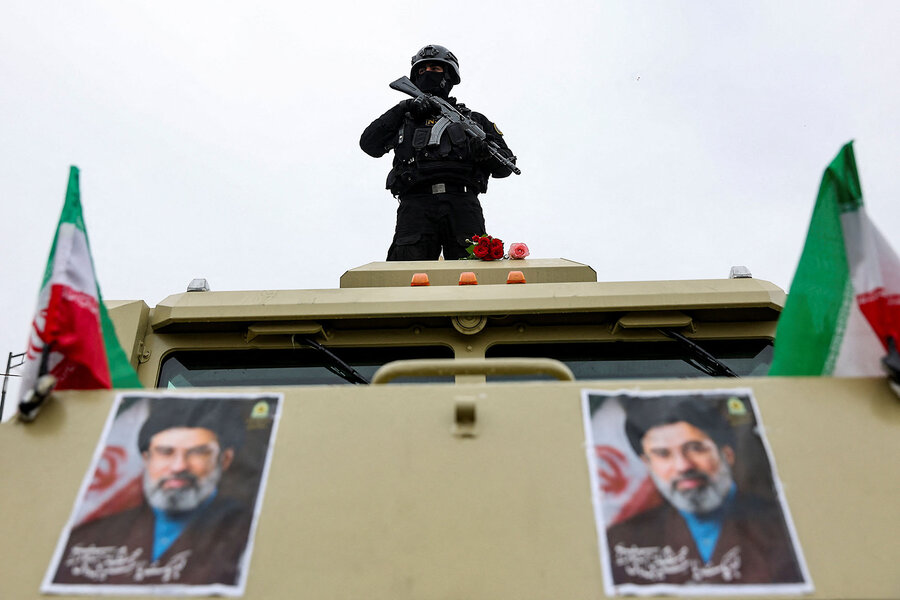
Controlling unrest in the streets remains a priority. Iran’s national police chief threatened this month to use live ammunition against protesters.
And parliamentary speaker Mohammad Baqer Qalibaf – a former IRGC commander – called on regime loyalists to march.
“Your humble soldier has three requests from you: streets, streets, streets,” Mr. Qalibaf posted on March 11. “Your children in the armed forces have risked their lives to defend Iran; strengthen their backs by holding the streets firm.”
Flag-waving loyalists respond
And the loyalists have responded, with almost-daily flag-waving, pro-regime marches, alongside Basij motorcycle parades and widespread deployment of security forces.
“They keep raiding cafes, carrying modems with them to connect people’s mobiles to the internet and check their contents, before making mass arrests and transferring them to unknown locations,” posted Marzieh Mohebbi, a lawyer from the northeastern shrine city of Mashhad.
“They form [checkpoints] in streets and alleyways to control phones for extortion, as if streets are turning into straits, like Hormuz, to pass which you have to pay a fee,” she wrote. “Under the internet blackout, people in Mashhad are at their wits’ end.”

Majid Asgaripour/WANA/Reuters
The regime focus on control is an indication it views the risks from unrest as on par with the ongoing war, say Karen Kramer and Esfandiar Aban, of the U.S.-based Center for Human Rights in Iran.
“The bombs are still falling, and the Islamic Republic’s future is uncertain, but one thing is already clear: The Iranian regime is preparing for its next war – against its own citizens,” they wrote in The Washington Post.
“Confronted not only with external conflict but also with a population that has repeatedly taken to the streets in defiance, the regime is determined to settle scores with its domestic critics and extinguish any internal challenge to its rule.”
And the bureaucracy still works, despite the pulverizing U.S.-Israeli assault. The release of one detainee in mid-March, for example, whose coerced “confession” aired on state TV, was delayed while judicial authorities confirmed the authenticity of a house title deed required for bail.
Critical glue for the security forces is ideological training – using historical Shiite models and legends of divine resistance – which deepened especially after the 2009 Green Movement protests.
Religious justification for violence
Since the bloodshed in January, when the scale of the nationwide protests created, up to that point, the greatest danger to the Islamic Republic during its 47 years of existence, regime ideologues have justified the extreme violence.
Arguing against mercy for protesters, they cite verses from the Quran and rely on Iran’s particular religious construct that the supreme leader is officially “God’s deputy on Earth.”
“The supreme leader is not acting on his own choice, he is only carrying out God’s verdict,” hard-line cleric Ahmad Panahian said in late January. “You, Mr. Policeman! Why are you even talking to these [protesters]? Warning does not work on these outlaws.”
The impact of such indoctrination surprises some Iranians – and portends tight, postwar regime control.
Ali Shakouri-Rad, a reformist political activist and former lawmaker, spoke of Basij and IRGC members in his own extended family who are “very decent people,” in a recording just days after the January crackdown.
“What I am saying [to the regime] is, ‘What have you turned this poor Basiji into, that he now says, “Yes, they should have killed these protesters?”’ A deep, hateful polarization has been created,” said Mr. Shakouri-Rad.
“What have we become?” he asks. “Just today someone told me … ‘Wherever we find a Basiji, we will burn him.’ What has happened? So much hatred on one side, the same on the other.”
An Iranian researcher contributed to this report.