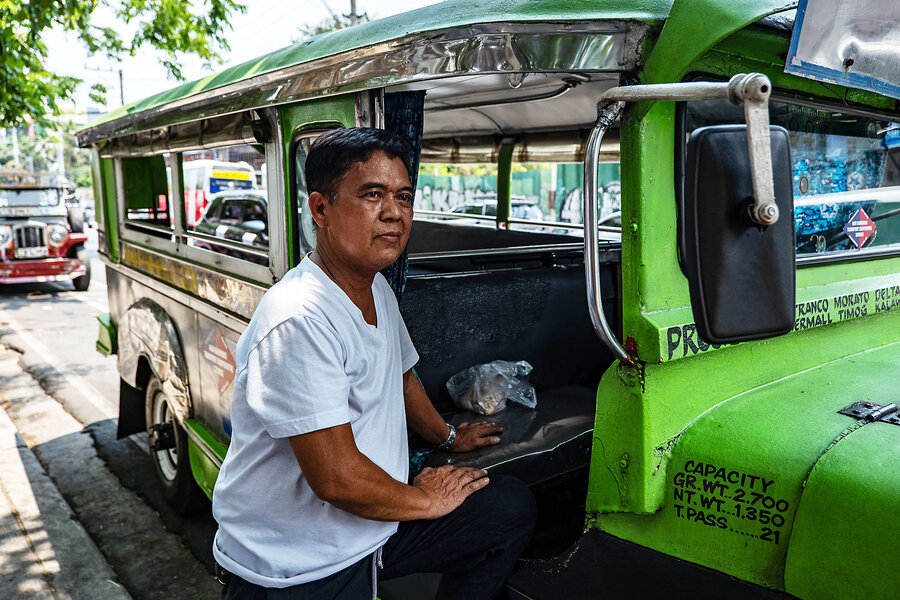
Even before global fuel prices started surging due to the Middle East conflict, life was already a daily calculation for Romeo Esmenda. He makes a living in Quezon City, northeast of Manila, driving a jeepney – an iconic and popular mode of public transportation in the Philippines.
But these days, rising fuel costs are pushing him to consider giving up his jeepney route and finding other work.
“There are days I ask myself if I should even go out or just stay home,” says Mr. Esmenda, who has been driving the same route for the past 29 years.
Why We Wrote This
The war in the Middle East is playing out many thousands of miles from Southeast Asia. But the impact is already being felt by millions of people in countries such as the Philippines, where the government has declared a national energy emergency, due to the skyrocketing cost of oil and gas.
Before the United States and Israel started bombing Iran in late February, he was spending about 3,000 Philippine pesos (just under $50) on diesel, and bringing home 1,500 ($25) in profit most days. Today it costs nearly 6,000 pesos (about $99) to fill his tank, and he’s bringing home 300 pesos (just under $5) on a good day.
“I can’t think of any solution,” he says. “For us jeepney drivers, when fuel prices go up, there’s no way around it because we have no control. There’s nothing left to cut.”
The Philippines imports 90% of its fuel from the Middle East. As oil and natural gas prices continue to shoot up, the country is confronting a familiar vulnerability: its near-total dependence on imported fuel from one specific region. Despite government interventions, the price shock is spreading across industries quickly, tightening household budgets and showing how quickly global disruptions translate into hardship for millions of Filipinos.
Transport workers and food producers “are the first casualties of the oil crisis, as their income dwindles with each fuel price increase,” says Amihan Malabay, spokesperson with the Suki Network, a consumer advocacy group. But they are not alone. For many Filipinos, daily choices about what to eat or how to get to work are getting more and more difficult every week.
Government moves to manage supply and demand
On March 24, President Ferdinand Marcos Jr. declared a national energy emergency. He signed an executive order activating a whole-of-government response through a framework called UPLIFT (Unified Package for Livelihoods, Industry, Food, and Transport). It is aimed at managing fuel supply while supporting transport workers, small businesses, and other vulnerable sectors. Emergency measures include fuel subsidies, commuter assistance, and expanded public transport services.

Mr. Marcos also signed a law on March 25, allowing him to suspend or reduce fuel excise taxes. But this measure is not expected to take effect until later in April. He says his administration is still figuring out when to use its new authority to respond to the fuel crisis.
Officials say existing fuel stocks could last until June 30, giving the government a narrow window to secure additional supply, even as global markets remain volatile.
Mr. Marcos stresses that the government is actively sourcing crude oil and refined products worldwide to boost inventory and prevent a worst-case scenario, adding that authorities are not considering an energy lockdown at this time.
For many Filipinos, however, the crisis is already hitting hard – and not only at the pump. Rising fuel costs are beginning to push up the price of food and other basic goods. For small business owners who operate on the tightest of margins, the impact is immediate.
Rising costs ripple through small businesses
Mike Olea runs a small, family-owned food shop where the biggest seller is a traditional Filipino dish of salted pork adobo, made by simmering the meat in lots of garlic and vinegar. Prices for cooking gas, meat, and other key ingredients have all shot up in recent weeks, forcing him to rethink how to stay afloat.
“I don’t know what to adjust or how to do it,” he says. His shop uses one 11-kilogram cylinder of cooking gas each week, the cost of which has shot up 30%.

Mr. Olea is considering raising the prices on his menu or scaling back his meat and vegetable portions, but he worries that it could hurt his bottom line. “I have already noticed fewer people coming here, because everyone is tightening their spending,” he says.
Among the belt-tighteners is garment worker Emma Almadrones.
She usually commutes by jeepney, but she says some drivers have cut back on the number of trips they offer, or they have stopped operating altogether.
“Fares haven’t increased yet … but I still end up spending more because I have to take extra rides or find other ways to get to work,” Ms. Almadrones says. As restaurants raise prices, she’s started bringing lunch to work, and sometimes walks home rather than waiting for a ride.
A widening economic strain
To conserve fuel and reduce electricity demand, some government offices are shifting to a four-day workweek. The government is encouraging the private sector to follow suit. But for contract workers like Ms. Almadrones, that would mean less income – a concern labor leaders have echoed.
Jerome Adonis, the secretary general with the prominent trade union Kilusang Mayo Uno (or “May First Movement”), says a shorter workweek would benefit employers, while forcing workers to complete the same workload in fewer days.
“Their work hours may be extended to as much as 12 hours per day,” Mr. Adonis says.
The concerns raised by workers and labor groups are part of a broader discussion about whether current government policies can help Filipinos keep pace with rising costs.

According to Sonny Africa, an economist and executive director with the IBON Foundation, a nonpartisan research group, the president’s declaration of a national emergency may have a limited impact.
Mr. Africa says Filipinos’ problems stem from soaring domestic oil prices, “but Marcos’ declaration … doesn’t say anything about public and transparent determination of these prices.”
He adds that the policy offers limited clarity on how vulnerable sectors will be supported and relies on existing government funds, raising concerns about whether assistance will be sufficient if prices continue to rise.