Some 57 years after Americans were united around TVs and radios as the first man took steps on the moon, America is heading back.
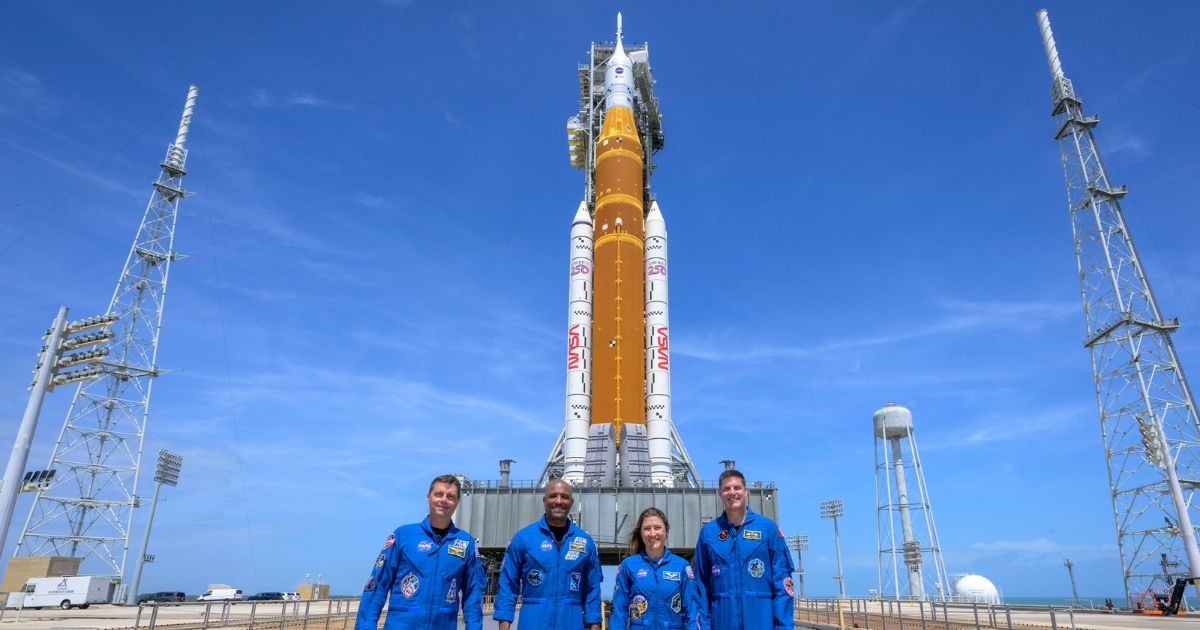
Artemis II is currently scheduled to launch as early as Wednesday, weather permitting, according to NASA.
Artemis II is designed to replicate the Apollo 8 mission, which in 1968 became the first mission in which a manned spacecraft entered the moon’s orbit. The Artemis mission is the first of a line of missions of increasing complexity to build NASA’s capacity and expertise for a journey where humans have never traveled — Mars.
But Artemis II, a key part of President Donald Trump’s efforts to re-establish the American presence in space, will be making history in its own right. The 6:24 p.m. launch will be the first crewed launch of NASA’s Space Launch System rocket and Orion spacecraft.
The countdown begins.
Teams at @NASAKennedy have arrived to their stations at the Launch Control Center. We are about 48 hours from the launch of the Artemis II mission around the Moon. https://t.co/PqaR8eyxu4 pic.twitter.com/shEs8WWtWP
— NASA (@NASA) March 30, 2026
The Artemis II crew consists of NASA astronauts Reid Wiseman, Victor Glover, and Christina Koch, and Canadian Space Agency astronaut Jeremy Hansen.
In an interview with Space.com, Wiseman noted that the astronauts “know what is coming, and we know the risks, and we are ready to go take on those challenges.”
“And you know, I’m an only parent with two daughters, and they’re teenagers. They understand the risk, but they also understand the value of human exploration, human ingenuity, that drive of humanity to go see what is on the other side of that mountain, to go see things that no human has ever seen before. Right now, there are only four humans on planet Earth that have this [new] opportunity, and I’m lucky to be one of them. And I’m flying with three of the best people I’ve ever met: Victor Glover, Christina Koch and Jeremy Hansen. And to get to be a part of this? No one can say no to that,” he said.
The flight kit aboard Artemis II reflects the long story of American exploration in air and space – perfect to honor America’s 250th birthday with @Freedom250 🇺🇸
✈️ a piece of fabric from the original Wright Flyer, making its second trip to space after STS-51D
🇺🇸 the American… pic.twitter.com/8sSdaNSN20
— NASA Administrator Jared Isaacman (@NASAAdmin) January 21, 2026
“From the perspective of the four of us, it’s NASA and American leadership that has created this opportunity. That is something that is important to us. We really want the whole world to feel like they are a part of this mission. I think that’s good for our nation. It is good for America to make the whole world feel like they’re a part of this. We are all on this journey together,” he added.
Wiseman noted that a training simulation prepared the astronauts for the sight of Earthrise, first photographed by the Apollo 8 crew.
“The Earth is really small, and it’s really gorgeous. And so just being able to process that, from the human side. You can hear it in the Apollo 8 audio that we’ve recorded. You can tell that was fascinating and unexpected to them. So I can’t wait to feel that,” he said.
“But then the other thing — when I stand on the surface of Earth now, and I look at the moon at night — and I might see a waxing gibbous, but I know now on the far side that’s a waning crescent. I’m flipping my brain around to all of those things, and just understanding that. Like, I’ve never spent time in my entire life thinking about that. But now it’s all I think about,” he said.
As NASA noted, the Apollo 8 mission was more than a step toward the manned landing on the lunar surface that would come in July 1969. Astronauts used Christmas Eve to read from the Book of Genesis as millions below listened.
“Look at that picture over there! Here’s the Earth coming up. Wow, is that pretty!”
55 years ago today, on December 24, 1968, the iconic Earthrise photo was taken during the Apollo 8 mission. pic.twitter.com/lprlf0q4LF
— National Air and Space Museum (@airandspace) December 24, 2023
“We were told that on Christmas Eve we would have the largest audience that had ever listened to a human voice,” astronaut Frank Borman said. “And the only instructions that we got from NASA was to do something appropriate.”

Advertise with The Western Journal and reach millions of highly engaged readers, while supporting our work. Advertise Today.