Europe has turned its back on Donald Trump’s war in the Middle East, with Italy, Spain and Poland refusing to support American operations against Iran.
The US and Israel began attacking Iran in late February, striking the mullah regime’s leadership, nuclear and ballistic missile programme and armed forces.
Since then, the US has been lobbying its European allies to try and garner support for its military operations against Iran.
But much of Europe has pushed back against these requests.
Italy barred an American bomber flying to the Middle East from landing at one of its bases, Spain restricted its airspace for US warplanes, and Poland refused to send Patriot air defence systems to the region.
A furious Donald Trump lashed out at international partners, singling out France and the UK in a pair of Truth Social posts today.
He said of the UK: ‘All of those countries that can’t get jet fuel because of the Strait of Hormuz, like the United Kingdom, which refused to get involved in the decapitation of Iran, I have a suggestion for you: Number 1, buy from the U.S., we have plenty, and Number 2, build up some delayed courage, go to the Strait, and just TAKE IT.
‘You’ll have to start learning how to fight for yourself, the U.S.A. won’t be there to help you anymore, just like you weren’t there for us. Iran has been, essentially, decimated. The hard part is done. Go get your own oil!’
He said of France: ‘The Country of France wouldn’t let planes headed to Israel, loaded up with military supplies, fly over French territory. France has been VERY UNHELPFUL with respect to the ‘Butcher of Iran,’ who has been successfully eliminated! The U.S.A. will REMEMBER!!!’
France has not formally said it has banned US warplanes from its airspace, though its president Emmanuel Macron said earlier this month that Trump’s strikes on Iran were ‘outside of international law’, adding that his nation ‘cannot approve of them’.
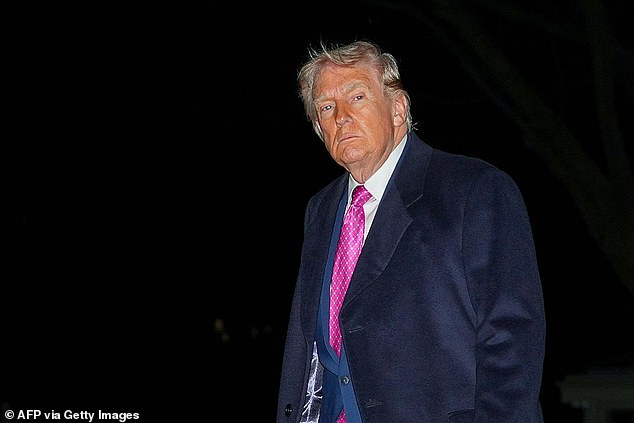
Europe has turned its back on Donald Trump’s (pictured) war in the Middle East
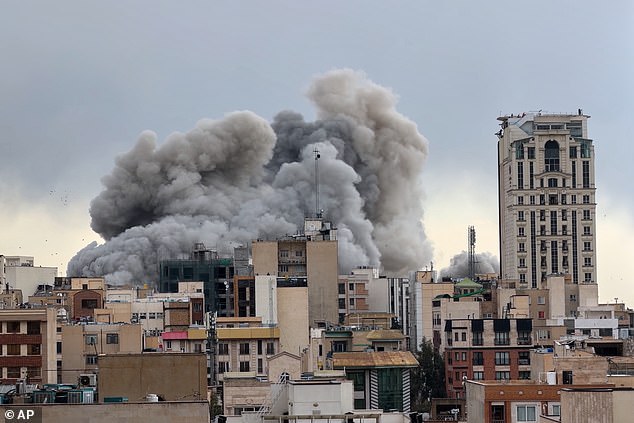
A plume of smoke rises after a strike in Tehran, Iran, March 2, 2026.
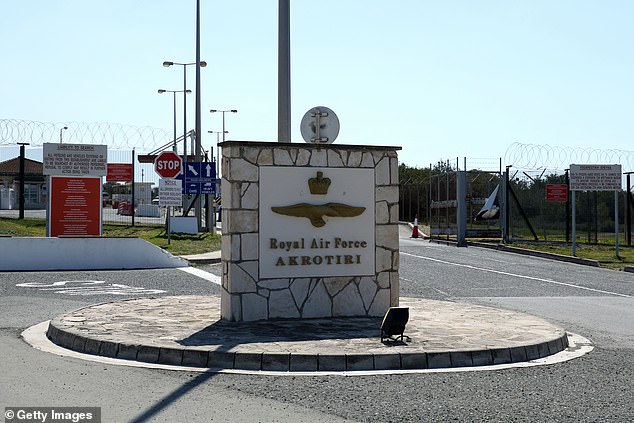
The entrance of RAF Akrotiri pictured on March 2, 2026 in Akrotiri, Cyprus
Earlier today, it was reported that Italian defence minister Guido Crosetto on Friday denied the US access to its Sigonella air base in Sicily.
Crosetto is said to have made the decision when he learned some US warplanes planned to land in Sigonella without consultation with the authorities.
As per treaties governing the use of US military installations in the country, permission must be granted from Rome’s military leadership.
But the decision to temporarily land the planes in Sicily before departing for the Middle East was only communicated with the relevant authorities once the bombers were already in flight.
‘Italy is certainly not considering going to war with Iran,’ Crosetto emphatically announced earlier in the March.
He continued: ‘I don’t think there will ever be Italian soldiers or planes capable of bombing Iran; this seems clear and obvious to me,’ before adding: ‘Not only is it constitutionally impossible, but there isn’t even the will.’
Washington would be able to use Italian bases ‘only after explaining what it intends to use them for and only after authorisation from the Italian government’, he said.
After initial checks established the American flights were not ‘normal or logistical’ ones, it was determined they would be denied access.
Italy’s right-wing prime minister Giorgia Meloni has already condemned the Israeli-US military operation as ‘outside the scope of international law,’ while also acknowledging the threat the Islamic Republic poses to regional security.
Her shift in tone was striking from a politician who has built a reputation as one of Europe’s most reliable US allies.
While centre-left opposition parties have urged the government to block the US use of bases in Italy to avoid involvement in the conflict, Meloni’s government has said it would seek parliamentary authorisation should any such requests be made.
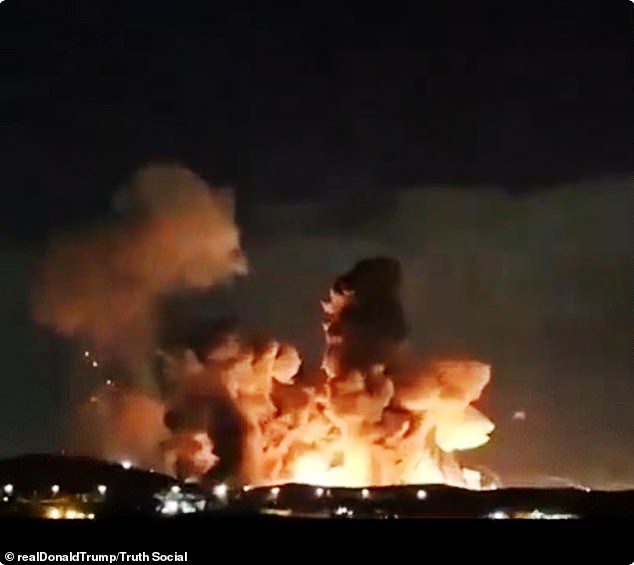
A video of a massive explosion shared without comment early today by President Donald Trump appears to be of a major strike conducted outside the central Iranian city of Isfahan
Today, Poland’s deputy prime minister denied that his nation would be sending Patriot missile batteries to the Middle East, following media reports that the US had engaged the nation in unofficial talks.
The Rzeczpospolita newspaper reported today that the US asked the European nation to temporarily lend one of its two Patriot missile batteries for deployment to the Middle East.
Hours later, deputy prime minister Władysław Kosiniak-Kamysz wrote on X: ‘Our Patriot batteries and their armament are used to protect Polish skies and NATO’s eastern flank.
‘Nothing is changing in this regard, and we are not planning to relocate them anywhere! Our allies know full well and understand how important the tasks we have here are. Poland’s security is an absolute priority’.
And just yesterday, Spain closed its airspace to US planes involved in attacks on Iran, a step beyond its previous denial of use of jointly-operated military bases.
Defence minister Margarita Robles said: ‘We don’t authorise either the use of military bases or the use of airspace for actions related to the war in Iran’.
The closure of the airspace forces military planes to bypass NATO member Spain en route to their targets in the Middle East, but it does not include emergency situations, El Pais reported.
‘This decision is part of the decision already made by the Spanish government not to participate in or contribute to a war which was initiated unilaterally and against international law,’ economy minister Carlos Cuerpo said, when asked if the decision to close Spain’s airspace could worsen relations with the United States.
Other European nations have also pushed back against the US’ demand for assistance.
Last week, Germany’s president Frank-Walter Steinmeier condemned the US’ war against Iran as illegal.
Steinmeier said: ‘This war violates international law. There is little doubt that, in any case, the justification of an imminent attack on the US does not hold water.’
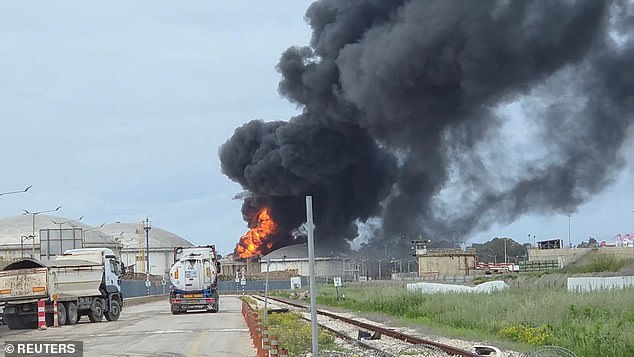
A blaze after Israel’s Fire and Rescue Service said that an industrial building and a fuel tanker at Israel’s oil refineries were hit by debris from an intercepted Iranian missile in Haifa yesterday
Earlier this month, France’s finance minister told CNBC that his nation is willing to support the US in securing the Strait of Hormuz, the key waterway that has been effectively bottlenecked by the ongoing war, but only when the security situation has calmed down.
Roland Lescure said: ‘We are willing to do something to free the Strait of Hormuz, provided that this is not a war situation anymore. Nobody wants to go across the Strait of Hormuz if there’s a risk of missiles or drones going on your head.
‘We need the conflict to de-escalate, and then we can imagine securing the Strait of Hormuz… We know how to do it, but you don’t do that in a war situation. You do that in a pacified situation in which people need to be secure and safe’.
Last week, the head of France’s armed forces held a videoconference with 35 nations to discuss restoring movement through the Strait of Hormuz, according to the nation’s defence ministry.
Though it did not name participants, the ministry said: ‘This initiative, independent of the ongoing military operations in the region, is strictly defensive in nature. Its purpose is to organise the resumption of shipping through the Strait of Hormuz once hostilities have ceased.’
France now appears to be bearing the brunt of this decision. The Jerusalem Post reported today that Israel has halted selling defence products to France.
Defence minister Israel Katz formally ordered the stop, following France’s changing attitudes towards the nation over the last few years.
One official told the Israeli newspaper that Macron’s decision to not allow US aircraft to pass through French airspace on its way to the Middle East was ‘the straw that broke the camel’s back’.