Holidaymaking Brits could find themselves facing queues of up to four hours at European airports as a new entry system comes into effect over the Easter break.
The entry/exit system (EES) has been slowly rolled out across Europe since October 2025, with 29 countries now bringing in a new biometric border control process.
Under the new rules, any non-EU nationals, including UK citizens, who enter the Schengen Area are required to register biometric details, including fingerprints and photographs.
They will also need to provide proof of accommodation, sufficient funds, medical insurance and a return ticket.
According to post-Brexit rules, Britons without the right to work or reside in the EU can only stay for 90 days in any 180-day period.
The EES will also automatically flag arrivals at risk of overstaying. It is due to be fully implemented at airports across Europe by April 10, with all third-country nationals required to register from today onwards.
EES will also be in force at Dover, Folkestone and London’s St Pancras station, where French border checks are carried out before people embark on cross-Channel journeys.
But there are fears the new system could cause mass disruption to travellers.
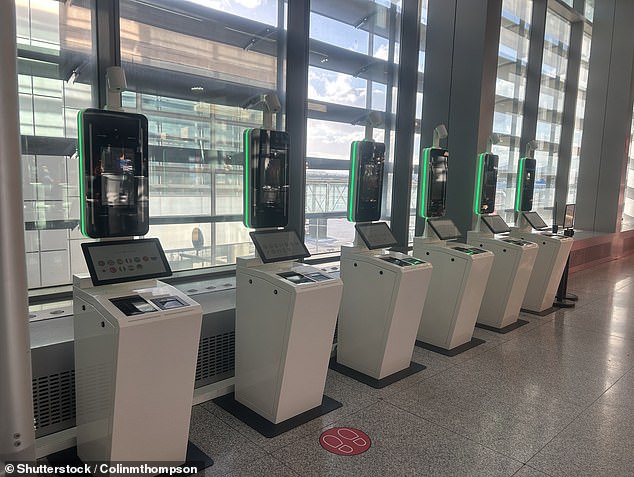
The new Entry-Exit System (EES) is set to be fully implemented this Easter – but critics have argued this could cause travel chaos across airports in Europe
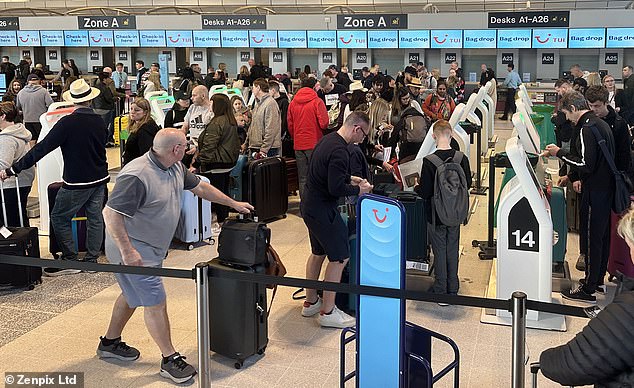
British holidaymakers could face long queues when travelling through European airports. Pictured: Crowds at Manchester Airport making their Easter getaway this morning
Airports Council International (ACI) said: ‘The latest data collected from airports across Europe shows a continued deterioration in waiting times at border crossing points located in airports.
‘Waiting times are now regularly reaching up to two hours at peak traffic times, with some airports reporting even longer queues.’
It added: ‘With the next critical milestones approaching – namely the requirement to register 100 per cent of third-country nationals as of 31 March, followed by the end of the transition period on 9 April – airports and airlines warn that the situation risks deteriorating further.
‘From that point onwards, member states will no longer be able to fully suspend the system in response to operational pressures, removing a key safeguard currently used to manage peak demand.’
Airlines and aviation trade bodies have also expressed their concerns over the delays and disruptions.
Olivier Jankovec, the director-general of ACI, and Ourania Georgoutsakou, the managing director of Airlines for Europe, said: ‘Passengers entering the Schengen area are likely to wait even longer at border control during Easter due to the persisting operational challenges around the EES rollout.’
ACI and Airlines for Europe leaders said: ‘We reiterate our call on the European Commission and Member States to extend the possibility to fully or partially suspend EES – where operationally necessary – during the entirety of the 2026 summer season.
‘This flexibility has proven vital in preventing catastrophic operational disruptions during the progressive rollout of the system.
‘If the technical and operational issues with EES are not resolved, this flexibility should remain available during future peak travel periods, such as winter 2026/2027.’
Under the new system, travellers will need to scan their passports at an automated self-service kiosk prior to crossing the border.
This will replace the current manual stamping of passports for visitors to Europe’s borderless Schengen area who are not nationals of EU or Schengen countries.
The system will register the person’s name, type of travel document, biometric data (such as fingerprints) and the date and place of entry and exit.
Airports Council International Europe recently revealed the EES system had increased waiting times at the border by up to 70 per cent, leading to three hour queues during peak travel periods.
Aviation bodies wrote to Magnus Brunner, the EU commissioner for internal affairs and migration, demanding the EU take immediate action to prevent ‘excessive’ delays as a result of the rollout.
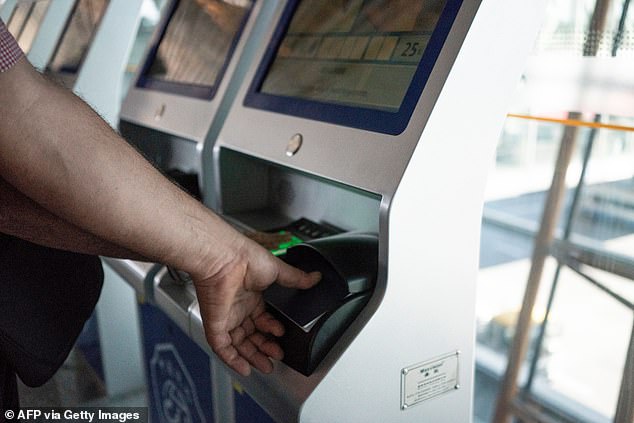
The biometric system requires fingerprints and photos from non-EU nationals, including UK citizens, entering Schengen Area countries
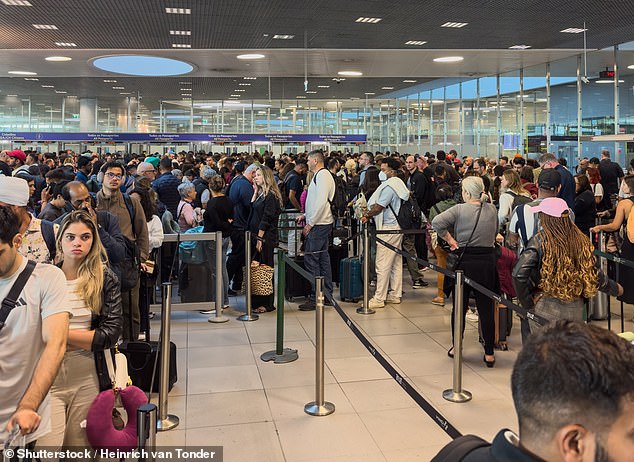
Airports across Europe have already faced long queues, including Lisbon Humberto Delgado Airport (pictured)
They warned: ‘Failing immediate action to provide sufficient flexibility, severe disruptions over the peak summer months are a real prospect, with queues potentially reaching four hours or more.’
In the joint statement, ACI Europe, lata, and A4E said: ‘There is a complete disconnect between the perception of the EU institutions that EES is working well, and the reality, which is that non‑EU travellers are experiencing massive delays and inconvenience.
‘This must come to an end immediately. We need to be realistic about what will happen during the peak summer months, when traffic at Europe’s airports doubles.’
To keep travel chaos at a minimum over the summer, advocates hope the EC will allow Schengen member states to partially or totally suspend EES until the end of October.
British holidaymakers are already facing travel chaos, with four-hour airport waits being reported this week.
The Home Office and holiday companies have warned of two to four-hour queues at some destinations over the bank holiday weekend, which begins on April 3.
Long, slow-moving queues have been reported at popular Schengen area airports, along with technical issues, such as crashing gates, as witnessed in Gran Canaria last month.
In some cases, passengers have missed flights amid 70 per cent longer processing times.
It comes after Lisbon airport was reinforced with soldiers trained as border guards to reduce waiting times.
In January, 24 members of the National Republican Guard were stationed in the arrivals area at Humberto Delgado Airport, a measure approved by the government, a news agency in Portugal reported.