On the ground in Ottawa, Ontario, and Washington, Canadian-American relations are the worst they’ve been since the War of 1812. But the two neighbors are getting ready to send a group of four astronauts beyond the moon and back to push the boundaries of space exploration.
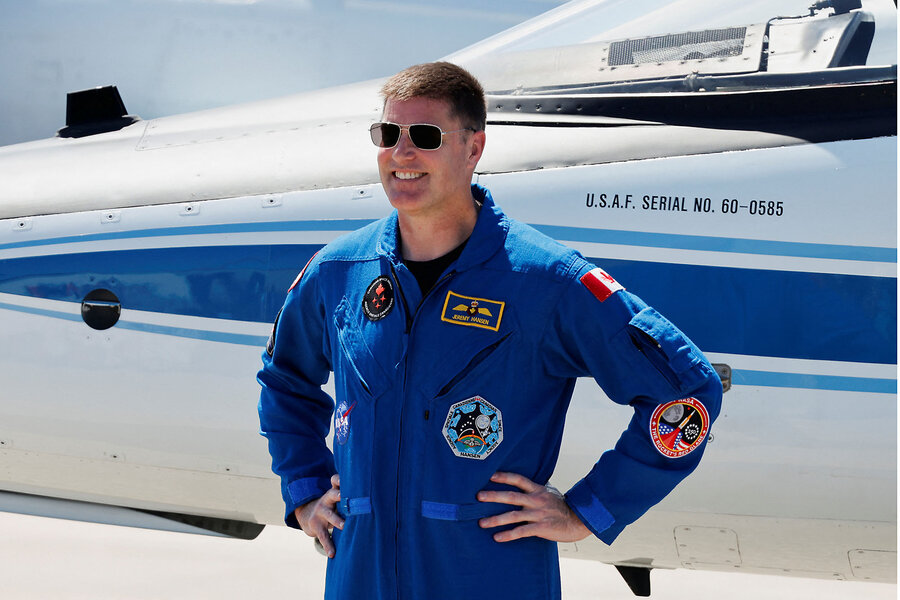
Canadian astronaut Jeremy Hansen is expected to join three American colleagues for the upcoming Artemis II mission, a major NASA milestone for moon exploration. Weather permitting, the launch could happen as soon as April 1. Mr. Hansen will be the first Canadian, and first non-American, to go on a mission around the moon.
The American-Canadian team will lift off at a time when the United States and Canada are caught up in a trade war, President Donald Trump has spent the past year threatening to annex Canada, and Prime Minister Mark Carney has become an advocate for “middle powers” establishing new global partnerships, from military to trade, that exclude the U.S.
Why We Wrote This
Geopolitics feels fraught these days, even between the closest of allies like Canada and the U.S. But the Artemis II moon launch is a reminder of how nations continue to work more closely together than ever.
But those rifts have not yet divided the space arena, where the two countries are together sending a crew to do what only 24 people have ever done before – leave low-Earth’s orbit. The 10-day mission, which is the first journey to the moon by astronauts since 1972, is a point of national pride for Canada, with its much smaller space program, and the U.S. At a time of contentious geopolitics, it is also a moment to celebrate the wonder of exploration and working together to do so. The crew will include the first woman and person of color to ever fly around the moon, too.
“It’s pushing a frontier, and that’s what we do in exploration and discovery and science and research in general,” says Julie Payette, veteran Canadian astronaut, engineer, and the former Governor General of Canada. “We push that frontier of whatever the known world is, and at the moment the frontier we have as humans, in terms of physics, is the moon.”
She adds: “They are doing it not solely for one nation or solely for one people. The entire Artemis crew is going out there for everybody on Earth.”

Shooting for the moon
Chris Hadfield, the first Canadian commander of the International Space Station (ISS) and the first Canadian to walk in space, says he is proud to see a Canadian flag on the shoulder of Mr. Hansen’s spacesuit among the other three American flags.
“It’s a really lovely proof of, gosh, 65 years of cooperation between Canada and the U.S,” he says.
The Canadian astronaut program was established in 1983, with the first Canadian astronaut – the late Marc Garneau – flying to space the following year. In total, 14 Canadians have been trained as astronauts and nine have taken part in missions to space. NASA lists more than 360 astronauts on its website, with more than 320 having been on at least one space flight.
In a promotional video for the Artemis mission, Mr. Hansen said that he is excited about getting to look back at Earth, just as the Apollo 8 astronauts did during their historic mission to the moon.
“This view that the Apollo 8 astronauts shared with the world will be seen by a Canadian for the first time,” he said in the video. “That makes me proud and excited for a new era of space exploration.”
Tim Hortons, the Canadian coffee brand, launched a limited edition box of “Moonbits,” named after their tiny donut Timbits, exclusively at select locations in London, Ontario, from where Mr. Hansen hails. And Canadian singer-songwriter Emm Gryner released a new song, “Touch the Sky,” to celebrate the mission. The Canadian Space Agency website also lists 10 watch parties across Canada for the public to attend. Even Mr. Carney has weighed in, appearing in a video wishing Mr. Hansen “good luck” on his mission.
While Canadians’ feelings about the mission are overwhelmingly positive, sentiment toward the U.S. right now is not. Jake Robins, Canadian host of the space podcast “Off-Nominal,” describes the mood as “very defensive.”
Still, Mr. Robins says he hopes that amid the frustration in Canada directed at its southern neighbor, the Artemis mission will offer a brief moment when people can “kind of stop and say, ‘This is a cool thing that we’re doing together and we’re exploring space together.’”
“It’s hard to cast that in a negative light,” he says.

Long-standing cooperation
Early cooperation between the Canadian Space Agency and NASA started in 1962 when NASA launched Canada’s first satellite, Alouette 1. Then, in 1974, the two signed an agreement to develop the Canadarm1, a robotic arm that attaches to space shuttles and was the first of a series of Canadarms. Canadarm2 is mounted on the ISS.
Space has long been a place of cooperation between the U.S. and other countries, even its on-the-ground foes. Just decades after the 20th century space race between the U.S. and the Soviet Union, the two countries worked together during the Cold War to launch the first crewed international human space flight in 1975. Today, the U.S. and Russia still communicate daily from ISS mission control centers in Houston and Moscow.
Ms. Payette, who flew on two NASA space shuttle missions and spent more than 25 days in space, says that relationship is an “example in the sky” of cooperation. “It’s like a beacon in the sky,” she says.
While Russia remains a critical partner in the ISS – a multinational laboratory in space – with the U.S. and 13 other countries, China is not a partner. Instead, it is rapidly developing its own space capabilities, including those that would send humans to the moon by the end of the decade.
“That adds an urgency and a really strong reason to build on our combined strengths and not to just try and think that going it alone, you know, is the right thing to do,” says Mr. Hadfield, who is also the author of the novel, “Final Orbit.”
“And so I think this flight, Artemis II, is a really good result and example of long-term cooperation.”
For now, the cooperation seems easier to find in orbit than on Earth.