Britain’s economy is especially exposed to an energy shock similar to that experienced in 2022 as turmoil in the Middle East deepens, the IMF has warned.
As oil prices surged again yesterday, the International Monetary Fund said in a blog post that in Europe the impact of the Iran war was ‘reviving the spectre of the 2021-22 gas crisis’.
That was when the build-up to and mobilisation of Russia’s full-scale invasion of Ukraine drove a previous surge in gas and oil prices, pushing UK inflation into double digits.
The IMF said: ‘The war in the Middle East is upending lives and livelihoods in the region and beyond.
‘It is also dimming the outlook for many economies that had only just shown signs of a sustained recovery from previous crises.’
And the organisation added that ‘countries such as Italy and the United Kingdom are especially exposed by their reliance on gas-fired power’.
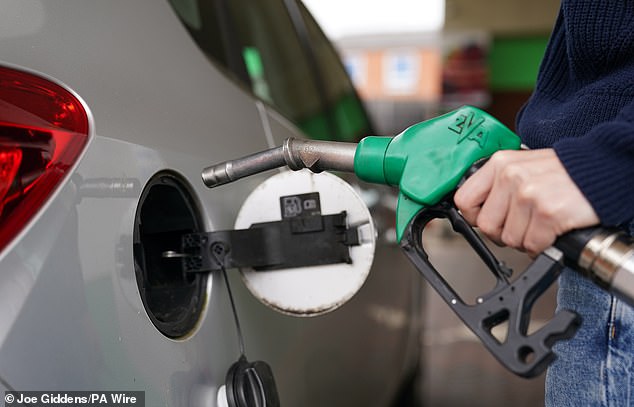
Filling up: Brent crude has reached nearly $117 a barrel as prices for petrol and diesel continue to climb amid fears of a repeat of the 2022 energy crisis
The warning came as UK borrowing costs were on course for their biggest monthly increase since Liz Truss’s disastrous mini-Budget sparked a major sell-off, also in 2022.
Yields on UK ten-year bonds, which rise as prices fall, have climbed by 16 per cent so far this month as war involving the US, Israel and Iran causes market mayhem.
Bonds – small parcels of debt issued by governments or companies to raise cash – have been caught up in the sell-off.
Investors fear that the surge in oil and gas prices due to the war will drive up inflation, forcing central banks to raise interest rates rather than cutting them.
Britain – which already has the highest borrowing costs in the G7 group of advanced economies – has been worse hit than some others.
It already has the highest inflation in the G7, and investors also fear it could embark on a borrowing splurge to protect households from surging energy bills.
Yesterday, there was little sign of respite as oil prices surged again, with Brent crude climbing to a high of almost $117 a barrel, before falling back.
However, UK borrowing costs did edge lower, to around 4.9 per cent, having topped 5.1 per cent last week as they hit the highest level since 2008.
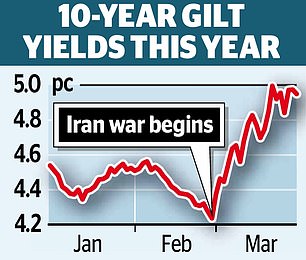
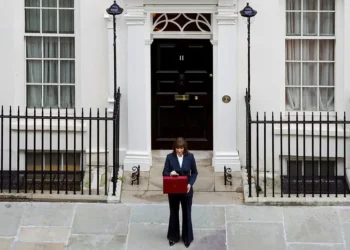
The increase in bond yields poses a major headache for Chancellor Rachel Reeves, knocking billions off her £23.6billion ‘headroom’ against meeting tax-and-spend rules.
Howard Davies, former chairman of NatWest, told the BBC: ‘The overall position of the UK – the financial markets are telling us – is not good.
Confidence in our borrowing has gone down and the costs of our borrowing have gone up, because people are concerned about our public finances.
The increase in interest rates that has happened for us means about £12billion a year of additional interest payments.’
That is ‘eating up a lot’ of the headroom, Davies said, and ‘any suggestion that the Government’s prepared to take the brakes off and splurge on public spending may result in an even further increase in interest rates, so you’ve got to be very careful here’.
US bond yields are up this month by a chunky 10 per cent, and Germany’s by 15 per cent. Japanese ten-year bonds are up by 11 per cent, and Canada’s have risen 12 per cent.
The sell-offs have been even more pronounced in France, where yields are up 17 per cent, and in Italy, where they have surged by 22 per cent.
DIY INVESTING PLATFORMS

AJ Bell
AJ Bell
Easy investing and ready-made portfolios

Hargreaves Lansdown
Hargreaves Lansdown
Free fund dealing and investment ideas

interactive investor
interactive investor
Flat-fee investing from £4.99 per month

Freetrade
Freetrade
Investing Isa now free on basic plan

Trading 212
Trading 212
Free share dealing and no account fee
Affiliate links: If you take out a product This is Money may earn a commission. These deals are chosen by our editorial team, as we think they are worth highlighting. This does not affect our editorial independence.