Elections are rapidly approaching for the Republic of Peru, which will go to the polls on April 12 to select its next government. The South American country has been languishing under a series of persistent challenges in recent years, including pervasive corruption, rampant crime, disappointing economic growth, and continuous political instability. The result has been a chaotic and unstable government: No Peruvian president has served out a full term since 2016. In the past four years, Peru has had four presidents, and since 2018 it has gone through eight heads of state.
The last elected president, Pedro Castillo, a left-wing rural schoolteacher with little governing experience, rose to office as an anti-establishment populist but quickly alienated supporters with his erratic style of rule and constant clashes with Congress. His frenetic administration ended in late 2022 with a pathetic attempt to preempt an impeachment vote by dissolving Congress and ruling by decree. The move collapsed within hours when the military, the courts, and even most of his own cabinet declined to back him. Castillo was removed, arrested, and imprisoned for the failed self-coup.
Castillo’s replacement, Vice President Dina Boluarte, inherited a legitimacy crisis and then compounded it. She presided over the beginning of a dramatic crime wave that has left Peru more dangerous than it has been for decades. Extortion, murder, drug-trafficking, and associated petty crime have skyrocketed—Peru’s homicide rate has more than doubled since 2022—but Boluarte proved more interested in filling her own pockets than in cracking down on criminals. She became known for her collection of Rolex watches, a collection that expanded and became increasingly expensive as her term continued. Congress finally removed her in October 2025 after the corruption and the mounting social and economic costs of insecurity became unsupportable.
Her successor, the congressional leader José Jerí, promised a “war on crime” but lasted only about four months before being ousted in February 2026 over yet another corruption scandal. Congress then elevated José María Balcázar as interim president, making him Peru’s eighth president in as many years and leaving him chiefly responsible for shepherding the country toward the April vote.
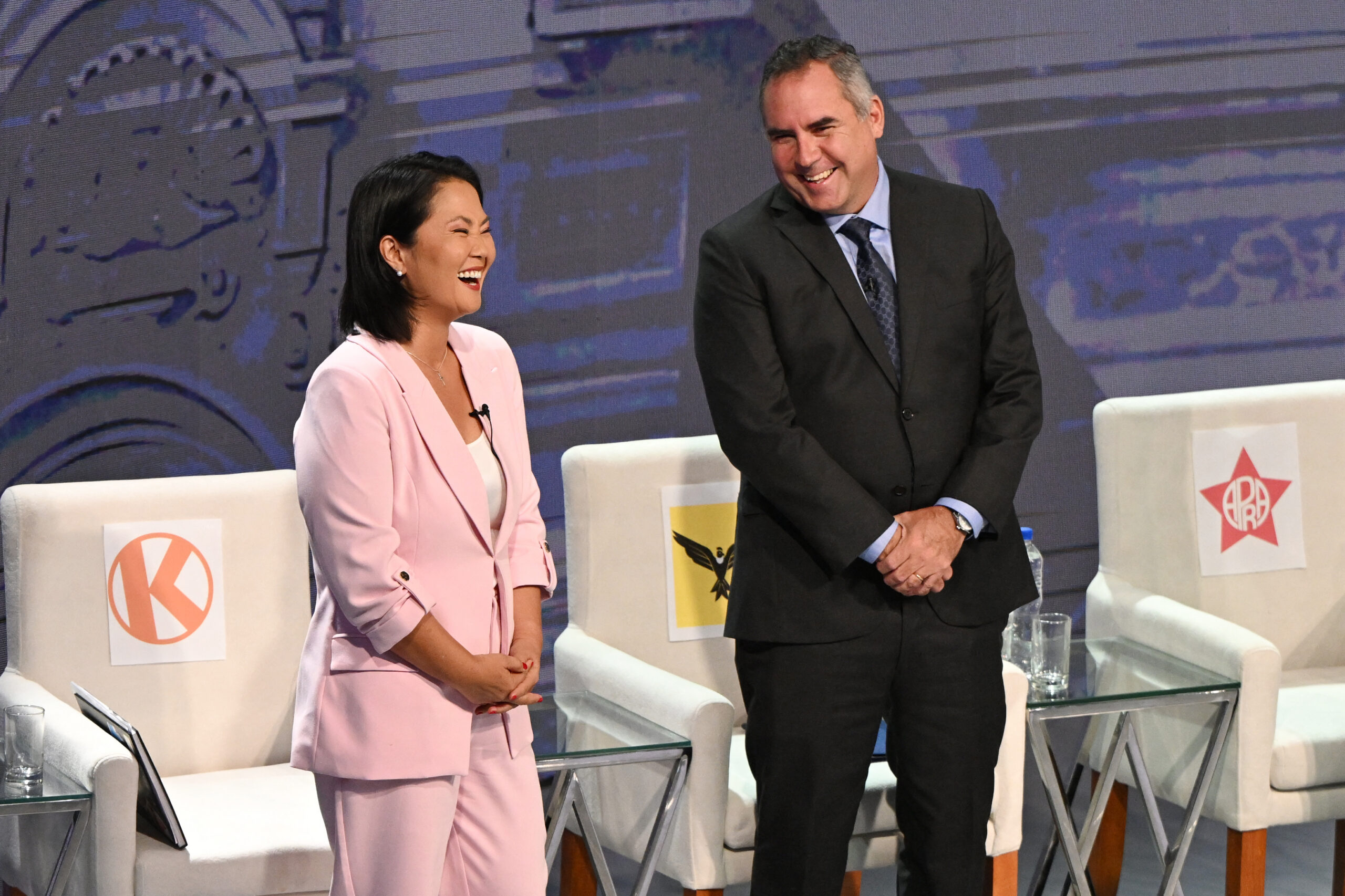
Complete disorder and exhaustion with that disorder have proven beneficial for the Peruvian right. Recent polls place two conservative candidates at the front of an extraordinarily fragmented field: Keiko Fujimori, polling roughly 11 percent, and Rafael López Aliaga, at about 10 percent. No other candidates crack the mid-single digits, but more than a third of voters are still undecided or refusing to back any candidate.
Fujimori is the more familiar figure. The daughter of the former president-cum-dictator Alberto Fujimori, she is making her fourth run for the presidency and remains one of the most polarizing politicians in Peru. Her appeal lies partly in nostalgia: For many Peruvians, especially conservative and business-minded voters, “Fujimorismo” signifies order, economic pragmatism, and a willingness to confront crime and insurgency with a firm hand—a platform that has left her with the largest party in the Peruvian legislature and brought her to within a hair’s breadth of the presidency twice (in the presidential elections of 2016 and 2021, she lost by less than 0.5 percent of the vote).
Subscribe Today
Get daily emails in your inbox
That reputation has renewed importance in a country where voters increasingly feel the state has lost control of the streets. But the Fujimori name also evokes intense opposition in other sectors of the Peruvian population. Though he restored economic stability to the country and established order by crushing the Marxist Shining Path, his methods were brutal and authoritarian, and his government succumbed to the familiar corruption that has dogged the country. Keiko herself has spent years under the shadow of corruption allegations and a money-laundering case that was only recently resolved.
López Aliaga represents a somewhat different right. A businessman and former mayor of Lima, he has styled himself as an outsider crusader against the establishment, though he is by now a major national figure. More openly combative and ideologically hard-edged than Fujimori, he has built his support on an unapologetic law-and-order message. López Aliaga has explicitly patterned himself on the El Salvadorian President Nayib Bukele, whose mano dura policies transformed what was once the most dangerous and violent Central American nation into a country safer than the United States.
With no candidate marshalling anything close to a majority, the presidential election will likely proceed to a June runoff. But the most likely result is that the contest will be a fight between two different factions of the Peruvian right, a result that would bring Peru in line with the general rightward shift in Latin America. The nearby countries Chile, Ecuador, Bolivia, and Argentina each have a new right-wing government.