Ben Crofts doesn’t join his family at the table for meal times; instead, he takes his plate to a quiet room and eats alone. The reason? He suffers from misophonia – an intolerance of sounds, where noises such as chewing and crunching trigger emotional or physiological responses.
The 50-year-old musician from Somerset has lived with it all his life – it has ruined relationships and caused him immense anxiety.
And he’s far from alone. Studies suggest 20 per cent of the population report symptoms resembling misophonia.
‘But it’s difficult to draw a line between everyday disliking, and the extreme disliking found in misophonia,’ explains Julia Simner, a professor of neuropsychology at the University of Sussex.
She estimates that 9 per cent of us, roughly six million Britons, suffer with serious debilitating misophonia.
‘Many people dislike the sound of someone slurping, for instance – but clinically significant misophonics will feel the extreme rage and disgust that makes living with it almost impossible.’
Eating sounds are the most common trigger for people with misophonia, adds Professor Simner.
‘Some dislike crunching while others dislike “wet” sounds, such as eating yoghurt. But we know there are other common triggers – such as ticking clocks or clicking keyboards.’

Ben Crofts suffers from misophonia – an intolerance of sounds, where noises such as chewing and crunching trigger emotional or physiological responses
A recent study of those with misophonia, led by Professor Simner, identified at least 39 different triggers.
Whatever the trigger it can have serious implications, as Professor Simner explains: ‘Even as children, people with misophonia had significantly poorer life satisfaction, quality of life, anxiety, depression, obsessive compulsive traits and emotion dysregulation [ie, feeling negative emotions sooner, deeper and for longer than other people].
‘It can affect everyday life in almost every way: leading to work avoidance, school avoidance, family conflict, loneliness, isolation, frustration.’
People with misophonia may find the actions of others, even loved ones, intolerable, she says. ‘This can drive wedges between friends and family members.’
Zara Kadir, a family psychotherapist at The Therapy Shed in Kingston upon Thames, says it is not uncommon to see misophonia put strain on relationships.
‘Misophonia can turn bonding experiences [such as shared meal times] into moments of stress and disconnect.
‘The triggered party can feel unsafe, guilty, overwhelmed and misunderstood – while the trigger [ie, the person making the offensive noise], feels overly criticised, rejected and controlled.’
She adds: ‘If it’s approached with understanding, small practical adjustments – maybe even humour – it can be overcome.’
Misophonia had been considered a form of anxiety disorder – but new research in the Annual Review of Clinical Psychology concluded that the anger, irritation and resentment that it triggers suggest otherwise.
There is research that shows that in people with misophonia, certain parts of the brain become switched on when they hear their ‘trigger’ sounds.
A 2017 study published in Current Biology based on scans of people with the condition found that a key ‘alarm system’ in the brain switched on far more strongly than in other people, explains Professor Simner. The brain areas involved are called the salience network.
‘This decides what’s important and demands attention,’ she explains. ‘In ancient times, it would have lit up in a human the moment they spotted a lion on the horizon because it signals “pay attention – take care”.
‘A crucial region in this network is the anterior insular cortex; it became especially overactive in people with misophonia. In other words, the misophonic brain reacts to these noises as if they’re as impossible to ignore as a lion.’
It’s unclear why some people develop misophonia, though it is partly genetic. And women seem to have stronger symptoms than men, says Professor Simner.
Ben was 12 when he first noticed feeling aggravated by the noise others made when eating.
He recalls: ‘I remember feeling really annoyed if someone chewed near me. But I had no way of explaining this, so I ignored it.’
But it got worse. Soon, tapping and clicking – common sounds in classrooms – began to aggravate him too. ‘It became outright rage – I’d have to remove myself from the room,’ says Ben.
‘Conflict was never far away, often resulting in being removed from a class. In the long run it negatively affected my results.’
Ben married young and had children in his 20s.
‘Children make noise and so this exacerbated it,’ he recalls. ‘Screaming could, at times, trigger me. High frequency and discordant sounds seem to be more powerful triggers.
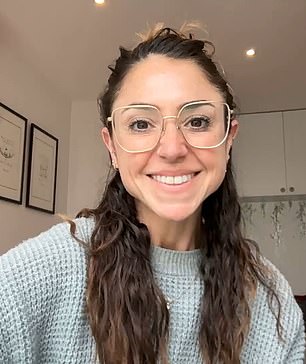
Zara Kadir, a family psychotherapist, says it is not uncommon to see misophonia put strain on relationships
‘By now, it was way past irritation and made me irrationally mad. I’d never get violent, but if I let myself I would turn a place over or tear someone apart – that’s how angry noises made me.’
It led to rows with his wife at the time, who he could not stand to be around when she was eating or making certain noises.
‘We divorced after five years,’ says Ben. ‘The constant fight-or-flight state I would be in made me far from pleasant to be around.’
It was around the time his marriage ended that Ben came across the term misophonia online.
‘It sounded just like me – so I went to my GP to get help,’ he says. But over the years he was told variously it was depression and ‘there was nothing they could do’ – or he was met with ‘blank stares or a smirk, no one seemed to know what it was’.
One GP even referred Ben – without his knowledge – to a dementia service. (‘They were as confused as I was and told me not to come!’ he recalls.)
Professor Simner says that treatment and referrals for misophonia can vary depending on whether your GP is sympathetic.
‘You may be referred to an audiology clinic,’ she says. ‘They may run an assessment to provide a diagnosis and rule out hyperacusis.’ (Here, ordinary sounds feel physically too loud or even painful – whereas misophonia involves how the brain interprets sound.)
Some experts suggest white noise or background music can ‘drown out’ triggering sounds.
Surprisingly, Ben finds his work as a musician peaceful.
‘While I’m making music it’s one of the few times I can relax knowing I won’t be triggered,’ he says.
In the studio, he is in control of the noise. Ben says: ‘In daily life, I can’t control someone crunching or rustling a packet – but in a studio, I control the sounds.’
Apart from a brief spell trying antidepressants in his 30s, Ben has had no help from doctors.
He says: ‘I’ve tried many times over the years to access help for misophonia – but there’s been no progress and it’s been a demoralising journey, resulting in a much adjusted way of life for me.’

Ben, a 50-year-old musician from Somerset, has lived with misophonia all his life – it has ruined relationships and caused him immense anxiety
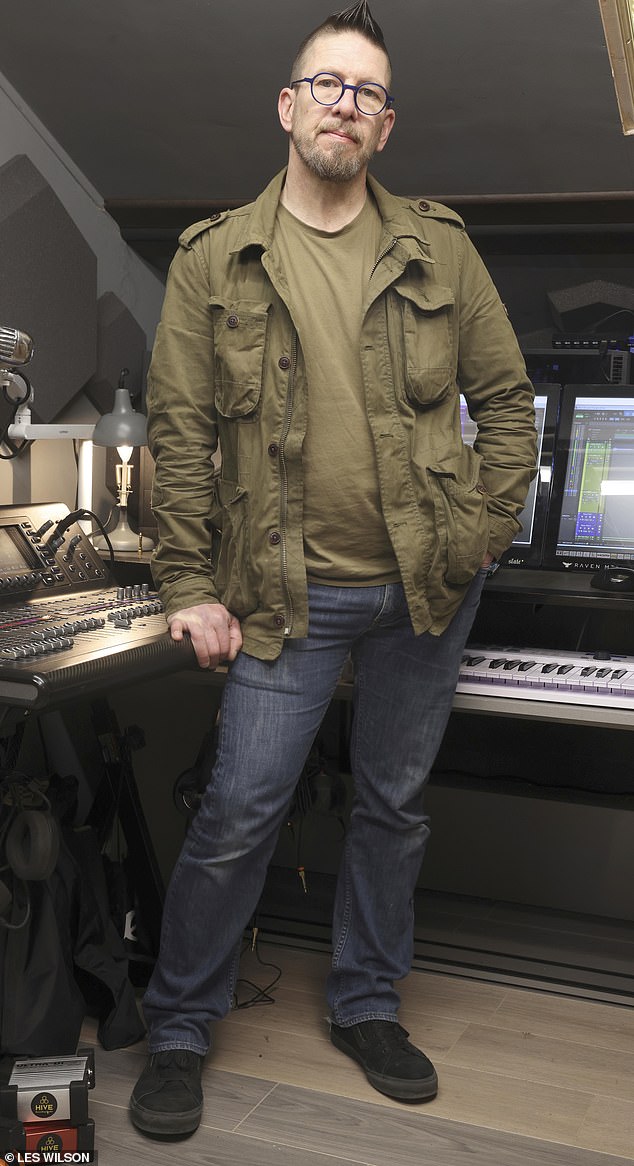
Some experts suggest white noise or background music can ‘drown out’ triggering sounds. Surprisingly, Ben finds his work as a musician peaceful. ‘While I’m making music it’s one of the few times I can relax knowing I won’t be triggered,’ he says
It has made new relationships difficult, for instance.
‘Partners felt unable to make me comfortable, or maybe didn’t feel it was their problem,’ says Ben. ‘It’s an unreasonable scenario for most to tolerate.’
Then, seven years ago, he met Jane, 46, a firefighter.
‘I told her from the offset that I had misophonia as so many relationships had failed before,’ says Ben. ‘She didn’t baulk and vowed to support me – and she has.’
Jane found charities and support groups for Ben to join, and adapted to his needs.
‘We cook together and then eat in separate rooms,’ he says. ‘It may not be family-friendly, but it works for us and gives me peace.’
Ben still regularly has to leave meals and social events if his misophonia flares up.
‘I don’t even excuse myself any more,’ he says. ‘If someone is crunching or rustling, I just get up and leave. The rage I feel otherwise is overwhelming.’
He adds: ‘I hope my story encourages GPs and medical professionals to learn more about misophonia. It wrecks relationships, careers and social lives.’
If you or someone you know may be affected by misophonia, visit misophonia-hub.org for support.