The nightclub at the centre of the meningitis outbreak in Kent will reopen this week – but party-goers have been warned to avoid kissing and intimate contact.
Club Chemistry in Canterbury has announced it will open its doors on Thursday, 18 days after it shut.
The venue was identified as the source of the meningitis outbreak which killed a 21-year-old University of Kent student and sixth-form pupil Juliette Kenny, aged just 19. A further 18 people were admitted to hospital.
Despite initial fears that the outbreak could spread beyond the south-east, not a single new case has been recorded since March 20.
The nightclub announced its return with a statement posted to its social media on Monday, urging clubbers to ensure the safety of themselves and others. One of the measures it highlighted was to avoid kissing.
The statement read: ‘Steps you can take to help keep yourself and others safe. Avoid sharing personal items such as vapes, cigarettes, lipsticks, drinks or anything that comes into contact with your mouth.
‘Be mindful about intimate contact, such as kissing. Be aware of the symptoms. If you notice any symptoms, seek medical advice.
‘If you are eligible and wish to do so, you can receive the MenB vaccine, which offers protection against the infection.

Club Chemistry, where the meningitis outbreak began, will reopen its doors this Thursday with a kissing warning
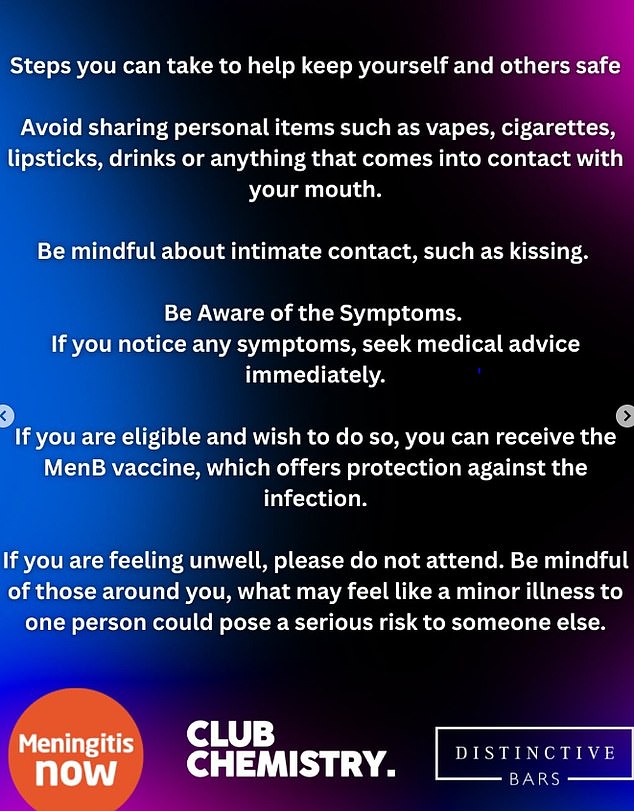
The nightclub posted a statement on its social media platforms on Monday urging clubbers to ensure the safety of themselves and others. One of the measures it highlighted was to avoid ‘kissing’
‘If you are feeling unwell, please do not attend. Be mindful of those around you, what may feel like a minor illness to one person could pose a serious risk to someone else.’
Alex Razas, 19, had blamed the four days he spent in hospital on a kiss he shared with a woman at Club Chemistry.
The economics student visited the establishment on Friday, March 13, but was admitted to hospital less than 48 hours later with a ‘really, really bad throat’.
He credited his friends for saving his life by insisting they take him to hospital as his condition was quickly getting worse.
Alex was ‘pumped’ full of antibiotics at the William Harvey Hospital as his mother watched on, fearing the worst when he took ‘minutes’ to wake up.
The student said: ‘Throughout the whole day, I just started getting more and more symptoms. I started getting a really high fever.
‘My muscles all over my body just started feeling really weak. Then my back started getting really sore and painful to the touch.
‘Then my neck started getting really stiff and painful to the touch. And then I was feeling really bad.’
Club Chemistry has since set up a COVID-like ‘track and trace’ system which will allow it to contact club-goers if further cases emerge.
Louise Jones-Roberts, the owner, said the venue also conducted ‘two thorough cleans’ and passed inspections by public health and environmental health officers while it was closed.
The first case of meningitis was reported by The Queen Elizabeth the Queen Mother Hospital in Margate on March 13 – but it has since been found that an NHS trust in Kent waited two days before raising alarm.

Juliette Kenny, 18, died just one day after first showing symptoms of meningitis
A patient had arrived in hospital on March 11 but the East Kent Hospitals NHS Trust waited until a formal diagnosis was confirmed before raising the alarm, BBC News reported.
Doctors have a legal duty to report cases of the disease to the UKHSA as soon as they are suspected.
Dr Des Holden, acting chief executive of East Kent Hospitals NHS Trust, said officials could have acted sooner.
He said: ‘We recognise there was an opportunity prior to diagnosis to notify UKHSA.
‘We cannot go into the detail of individual patients’ care, but the trust has been in close contact with UKHSA since Friday 13 March to discuss the management of patients presenting with suspected meningitis.’
The UKHSA said that an earlier report could have led to an investigation starting sooner and provided antibiotics to close contacts of the patient to prevent them from developing invasive meningitis.