This article is taken from the March 2026 issue of The Critic. To get the full magazine why not subscribe? Get five issues for just £25.
Years ago, the Sunday newspaper I worked for commissioned Melvyn Bragg to write a piece marking the 30th anniversary of his arts programme The South Bank Show. Bragg duly turned out 2,500 very entertaining words about his encounters with the great and the good. After the piece ran, he took my boss and me to lunch at the Wolseley on Piccadilly.
He proved a terrific table companion: interested in, and with a view on, everything. He was very well informed about the newspaper business and sought our opinions on whether this person would make a good editor of the Guardian or whether that person really was the monster they were purported to be. The Melvyn Bragg we saw on The South Bank Show or heard on In Our Time, knowledgeable but keen to learn more, is not a persona confected for the audience. It’s just how he is and, seemingly, always has been.
Bragg’s previous memoir, Back in the Day, covered his upbringing in the Cumbrian market town of Wigton. It stands alongside Flora Thompson’s Lark Rise and Laurie Lee’s Cider With Rosie as an affectionate, evocative and detailed portrait of a now vanished way of life. It ends with him, a clever grammar school boy who always has a book in his pocket, on the brink of going up to read Modern History at Wadham College.
The acceptance of a local boy to Oxford is an event sufficiently unusual as to warrant coverage in the Cumberland News, but Bragg is far from certain he wants to take up the offer. He loves his parents, his girlfriend Sarah, and his home town. The final passage of the book has him contemplating the glories of Wigton. The last line is: “I would go. But I would never leave.”
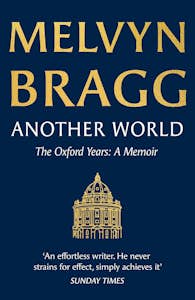
Go he did. Another World is about his time at university where, at first, he feels like an outsider. “That’s where the toffs go,” his publican father had observed of Oxford. Sure enough, Bragg, a working-class lad, finds himself “surrounded by wealth and privilege”. Most of his fellow students are either public schoolboys or have done National Service, which Bragg narrowly avoided because of a change in policy. At one point, he bumps into the future playwright Dennis Potter, who says: “They say there’s three real working-class men here. There’s me. And you. Where’s the other bugger?”
In his first year he shares his accommodation on Staircase Two with Gerald, who has bagged the bigger room and whose parents visit at weekends. Gerald is in his pyjamas by 10 every night and makes plain that there is to be no noise after that hour. It’s a far cry from Brideshead Revisited. However, Bragg quickly makes friends — good, lifelong friends — and, despite his homesickness, starts having fun.
He drifts into a cinema, attracted by a poster featuring an actress resembling his girlfriend. Ingmar Bergman’s Port of Call is the first subtitled movie Bragg has ever seen and he is “mesmerised”. He subsequently devours the work of Truffaut, Fellini, Kurosawa et al. and gets a gig writing film reviews for the university paper, Cherwell, the arts pages of which were edited by Michael Billington, later the doyen of theatre critics. (When Bragg started The South Bank Show, he badgered Bergman until he agreed to be interviewed. He charmingly admits to once drunkenly phoning the Swedish director at 3am, getting through to his answerphone and outlining the plot of what he imagined would be a cinematic masterpiece. Bergman left him a message saying simply, “Thank you.”)
Bragg makes what sounds like a terribly pretentious short film with future director Gavin Millar. All Together Boys stars him as a rebel who does the opposite of whatever everyone else does wherever he goes. It has a single screening, with a solo drummer offering loud musical accompaniment. The only copy has been lost — perhaps for the best.
When students take a production of The Tempest on a four-week tour of the German universities on the Rhine, Bragg plays Trinculo, the jester, and has a tremendous time until the end of the tour when he gets hammered in Heidelberg. He is staying with a German family and vomits all over his bedroom. His hostess is horrified, and he still feels the shame.
He enjoys his studies, and becomes particularly fascinated by the saints and scholars of the Post-Roman Celtic renaissance. He takes Sarah on holiday to Northumberland and drags her around a freezing Lindisfarne. She interrupts his reverie about monkish scribes by glumly pointing out that “Lynne and Dorothy have gone to Majorca.”
The Oxford he describes is as much another world to us now as it was to him then. When he goes up in 1958, the university is still almost exclusively a place for men.There are very few non-white students, and those there are wealthy. The arrival at Wadham of Jeppe May, a black South African student of modest means, is a source of pride for Bragg, an active member of the Joint Action Committee Against Racial Intolerance — a charity recently founded by students. The chapter in which he takes May to his parents’ new pub in Reading is one of the best in the book.
In his third year, he sometimes spends the night at a girlfriend’s place, he and Sarah having gone their separate ways. The strict landlady of his digs, who also works for his college, reports his absences to her employer. Bragg is summoned to see the college’s “moral tutor”, fined £15, and told to “Get your love life under control.” The position of “moral tutor” no longer exists, and one imagines that these days it would be the busybody landlady given the dressing down.
This is a lesser work than its predecessor. Shorter, and narrower in scope, it might have benefitted from a more rigorous edit. Nevertheless, I tore through it and hope it will eventually form part of a trilogy. Bragg has written in one of his autobiographical novels about the personal tragedy that lies ahead and might not want to revisit it, but I’d like to read about his career: the books, the broadcasting, some of the more surprising things he has done — co-writing the screenplay for Jesus Christ Superstar with celebrated film director Norman Jewison (In the Heat of the Night, Fiddler on the Roof), for instance.
There was a teasing line in that Mail on Sunday piece. “And Alec Guinness the strangest and most unnerving of them all … ” That was it. When editing his copy, I asked him to expand upon this cryptic reference, but he didn’t want to add anything. I asked again at lunch. He shook his head, smiling: “Saving that one for the memoir.” I look forward to reading it.