The French leader who steered his nation out of Nazi occupation and into the height of the Cold War was guided by a simple conviction.
“France cannot be France without greatness,” Charles de Gaulle wrote in the opening lines of his memoir.
For Mr. de Gaulle, the World War II general and French president from 1959 to 1969, greatness included Paris getting the bomb. He oversaw the country’s first nuclear test in 1960, making France the fourth nation on Earth to acquire nuclear weapons.
Why We Wrote This
For the first time in decades, France has updated its national policy on nuclear weapons, focused on “forward deterrence.” The change will have ramifications for an important U.S. ally, and for France’s neighbors in Europe.
Always wary about putting too much trust in his allies, Mr. de Gaulle’s objective was first to safeguard France. But he also described obtaining nuclear arms as “rendering a service to the balance of the world.”
Following in those footsteps, President Emmanuel Macron has announced the most significant update to France’s nuclear policy in decades. These changes include the expansion of the country’s atomic arsenal and the extension of French nuclear deterrence beyond its borders.
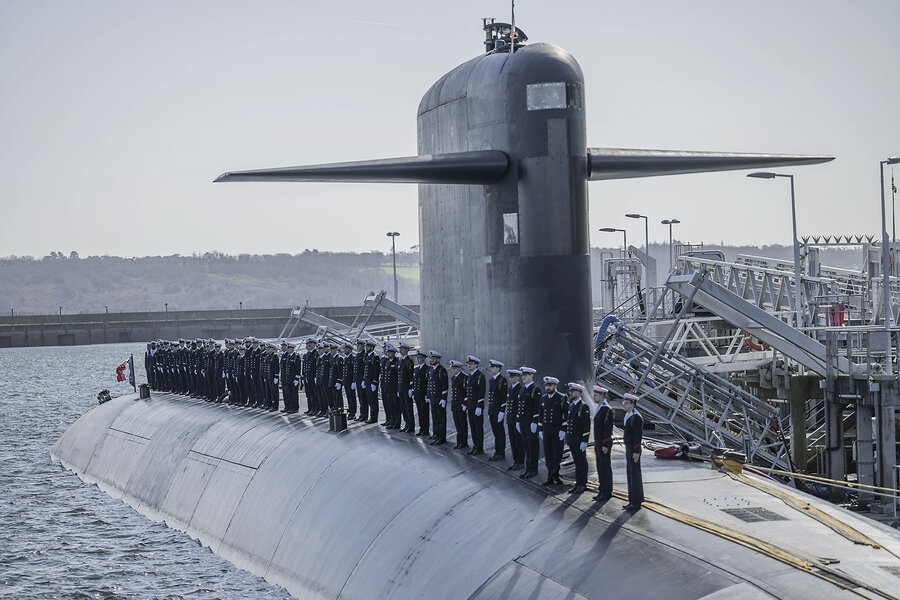
In a speech to French naval officers in Brittany on March 2, Mr. Macron talked about a new “forward deterrence” nuclear strategy, marking a pivotal moment for the defense of Europe. “To be powerful … is to be more united,” the president said, standing in front of a French nuclear-powered submarine called Le Téméraire (“the Daring One”), which carries nuclear-armed long-range ballistic missiles.
Today, as Russia’s war on Ukraine threatens Europe and the Trump administration casts doubt on U.S. commitments to NATO, French leaders say that they must contribute to regional security in new ways.
Since he returned to the White House, President Donald Trump has suspended aid to Ukraine, lifted sanctions on Russian oil sales, and warned NATO that it faced a “very bad future” if alliance members refused to help secure the Strait of Hormuz. The shipping lane for oil and natural gas through the Persian Gulf was blocked after the U.S. and Israel attacked Iran in late February.
There is now a growing sense in Europe that, if Russia were to carry out military aggression beyond Ukraine, the United States may not come to the rescue.
Still, there are limits to how far France will go. The country is believed to possess around 300 nuclear warheads, and that number is set to go up under Mr. Macron’s policy shift. The U.S. and Russia have more than 5,000 warheads each, together accounting for nearly 90% of the world’s nuclear weapons.

“French through and through”
However, France is vague about the precise number of warheads it has. That ambiguity, say observers, is a key part of its strategy to keep the continent safe and create a stronger, more independent Europe.
“The risk of a nuclear conflict is higher today than at any point since the end of the Cold War,” says Daryl G. Kimball, executive director of the Arms Control Association, an advocacy group based in Washington. “In the event of a major crisis, Europe needs to be able to stand up on its own.”
Make no mistake, France’s forward deterrence strategy is not a U.S.-style nuclear umbrella, in which France would guarantee the defense of non-nuclear states. Nor is it meant to replace NATO protections.
“It is a supplementary guarantee, to complement what already exists,” says Yannick Pincé, an associate history professor at the Sorbonne Nouvelle University. And despite some of the threatening rhetoric coming from U.S. officials toward their European allies, “officially, all the American guarantees [toward NATO] are upheld,” Mr. Pincé says.
France has said its updated defense policy may involve cooperation with European partners in future military exercises, or the possible deployment of French military forces on an ad hoc basis.
Defense experts say that could translate into the temporary or permanent stationing of nuclear-capable French military aircraft in allied countries, and may potentially even include French nuclear weapons. The policy shift could see France calling on partners to ready their air bases and storage facilities for French atomic weapons. Already, at least one of France’s armed ballistic missile submarines remains on deterrent patrol at all times.
But unlike the NATO model, in which a European plane may be equipped with a U.S. nuclear warhead, Paris’ strategy is “French through and through,” according to the French Ministry of Armed Forces.
“French nuclear deterrence will remain national, independent, autonomous and sovereign,” the ministry said in an email response to questions from the Monitor. “Its potential use will remain the exclusive prerogative of the President of the French Republic.”
Strategic ambiguity
In some ways, the French desire for nuclear sovereignty is nothing new. Since the presidency of Mr. de Gaulle, France has never fully embraced the U.S. approach to nuclear deterrence. Up until 2009, France refused to join NATO’s integrated military command. And it remains the only NATO member that is not part of the NATO Nuclear Planning Group, which works to enhance communication between member states on nuclear issues.
Under its new nuclear strategy, however, Paris is expected to cooperate with its European partners, initially through bilateral discussions. The French government has remained intentionally vague about who and what it intends to protect with its nuclear forces, only referring to its “vital interests.” Again, strategic ambiguity appears to be an important part of the plan.
While the French government plans to boost the size of its nuclear arsenal, it also intends to keep specifics about the number, location, and performance of its nuclear warheads more secret than before.
Already, the maps of France that appear on Google Earth are more sanitized than other nuclear-armed states, and a 2008 law intended to limit the spread of France’s nuclear information has made it difficult to independently verify specific elements of its nuclear program. A spokesperson for France’s Atomic Energy Commission (CEA) said it would “not be going public” with any new information about the country’s nuclear testing or preparedness.
This is all part of the psychological posture that Paris presents to its adversaries, says Gen. Bruno Clermont, a defense consultant and retired aeronautical security director within the Ministry of Armed Forces.
“But France is not alone on an island in the middle of the Pacific,” says Mr. Clermont. “From the birth of nuclear deterrence, it was clear that France’s vital interests were not linked solely to France itself, but to France within a wider whole.”
A new nuclear arms race?
Despite talking about extending nuclear deterrence, Mr. Macron denied entering a new nuclear arms race. France has been a signatory of the Treaty on the Non-Proliferation of Nuclear Weapons since 1992 and has complied with its provisions since 1968, when the treaty was signed by the U.S. and U.K. The French nuclear strategy focuses on the power of deterrence – not the use of nuclear weapons – in the event of foreign aggression, say defense experts.
“If there is a crisis, the decision to use a nuclear weapon will be the most significant decision in the 21st century,” says Mr. Kimball, the arms control expert.
Defense experts say the more likely scenario would be in the form of a conventional attack, most likely from Russia. That threat has led to leaders across Europe bolstering their traditional military programs. France, Germany, Croatia, and Romania have reinstated voluntary or mandatory national service this year, while Poland and Belgium are debating compulsory service.
Still, Russia has dramatically ramped up its nuclear threats against the West in recent years. That means nuclear deterrence remains a powerful tool in diminishing the chance of conflict with Russia, says Luigi Scazzieri, a senior policy analyst at the European Union Institute for Security Studies.
“Even a year ago, countries weren’t willing to even talk about it,” he says.
Others, however, say the escalating rhetoric on nuclear weapons could set a dangerous precedent.
“During the Cold War, we all feared nuclear war. But now we’re not afraid,” says Nikolai Sokov, senior fellow at the Vienna Center for Disarmament and Non-Proliferation. “When you stop fearing nuclear war or pursue policies to use it, you’re getting that much closer” to it becoming reality.