This article is taken from the April 2026 issue of The Critic. To get the full magazine why not subscribe? Get five issues for just £5.
How can an entrenched orthodoxy be successfully challenged? Can its proponents be argued out of their settled beliefs, or does the impertinence of the challenge just harden their attitude? Must it then take some shattering event or series of shocks to transform a decades-old consensus into a lost cause?
The case against the Corn Laws was well established and powerfully promoted long before 1846, but it took Ireland’s famine to push Westminster into repealing a price-fixing mechanism from which many landowning parliamentarians benefitted. Financial gravity, not J.M. Keynes’s closely argued contrarianism, took sterling off the Gold Standard in 1931.
Sixty-one years later, the Bank of England blew 40 per cent of its foreign exchange reserves sustaining sterling’s membership of the European Exchange Rate Mechanism before, within a matter of hours, abandoning this cornerstone of orthodoxy — support for which had until that moment been the club tie of sound judgement.
This century, billions of pounds have been committed to Britain’s path to Net Zero at a speed dictated by legislative decree rather than the natural processes of technology, economics and resource availability.
Inventions have more often been launched from expanding rather than atrophying economies
Indeed, one of the key arguments advanced is that the necessary breakthroughs will only happen if existing, more reliable, energy sources are first made prohibitively expensive. Beggaring ourselves will make us richer. Even if we don’t know how.
History does not, in fact, show that necessity is always the mother of invention. The railways were not laid because hay was in short supply, nor cars constructed because locomotives had run out of steam.
The cost of postage stamps did not spur the internet. There is no obvious causation between engineering scarcity and ensuring innovation.
If there is, tentatively, any persisting theme it is that inventions have more often been launched from expanding rather than atrophying economies.
Upon what reading of human nature are we to imagine that Britain, by taking a lead in destroying the remains of its industrial base through overbearing energy costs, will encourage the world’s largest carbon-emitting economies to follow down this path?
All Britain has provided is a case study in what not to do if you want to prosper — with the means of its transition typically mined and fabricated on its behalf in the major carbon-emitting countries, primarily China.
“The capitalists,” as Lenin allegedly hoped, “will sell us the rope with which we will hang them.” Worse, our sacrifice appeases no god, for it has done nothing to cool the climate. How could it, when Britain is responsible for just one per cent of carbon emissions?
The primary assumptions upon which Britain’s drive to Net Zero are based only rest upon a wind and a prayer. Yet, on the costly drive goes, like a grinding military offensive that once launched is too late to countermand.
What argument could possibly penetrate the Department for Energy Security and Net Zero, which — as its name makes clear — is a proselytising mission?
It fosters Byzantine levels of market intervention and price-boosting, regulatory overdrive and resource misallocation, all designed to stimulate investment in solutions that make Britain’s energy supply less secure.
It would be glib to note that such a command economy is run by Ed Miliband, whose father was a leading Marxist academic. But most of this interventionist superstructure was established and enhanced under the watch and advocacy of David Cameron, Theresa May and Boris Johnson.
Even optimistic estimates for the cost of achieving Net Zero exceed the entire GDP of the UK economy. These politicians went ahead regardless, submitting their ill-conceived grandstanding to trivial parliamentary scrutiny.
Will it take a crisis to change the groupthink? Well, we have a crisis upon us at the moment. The American intervention in Iran has sent oil and gas prices soaring.
Predictably, the British government’s response has been to draw precisely the wrong conclusion — that rising fossil fuel prices proves the case for more urgently moving national dependence onto wind and solar power.
This argument is so wrong-headed that it is hard to know where to begin.
But Chris Bayliss in this issue’s The Critic Essay makes a closely evidenced start. Britain has far from Europe’s greatest fossil fuel dependency, yet it has the continent’s highest commercial energy costs. Why so?
Our decision to promote wind and solar power makes us dependent on energy that is so intermittent that we must rely on gas back-up.
This means we saddle consumers with the cost of maintaining excess capacity without providing protection from global energy spikes. It does not help that we decided to abandon much of our gas storage facilities.
Yet even the latest gas price spike only approaches the point at which a gas power station running at median efficiency produces electricity at the same price recently awarded to new offshore wind developers.
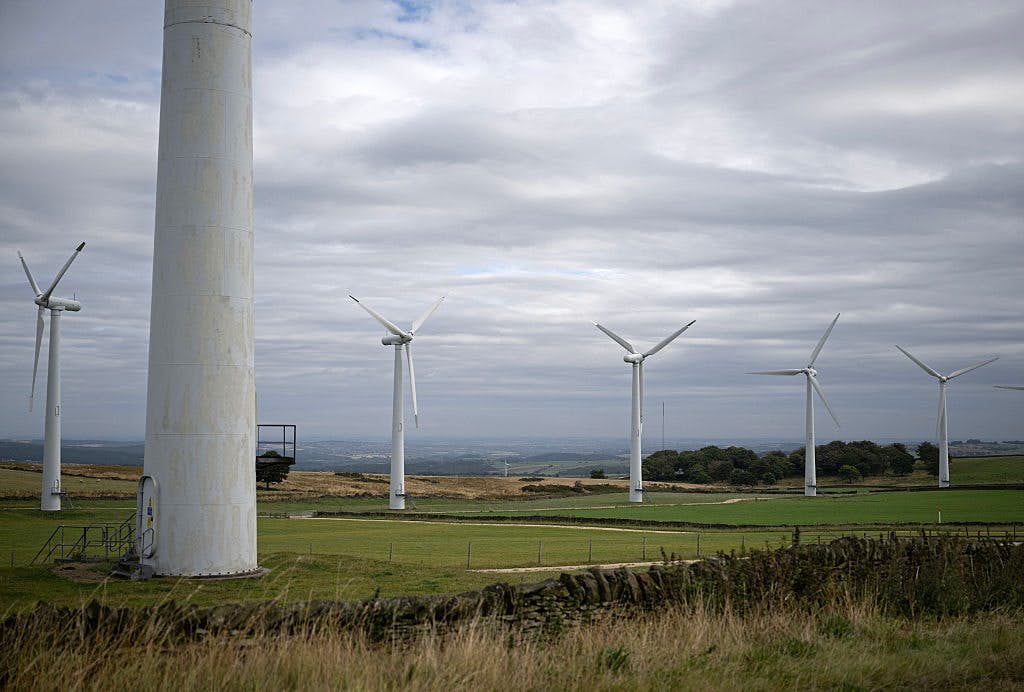
Constructing more wind farms will not solve this problem. A lack of wind creates as much energy from 10,000 turbines as it does from one.
Ears closed to argument and basic facts, the Net Zero bandwagon bequeaths us with the worst of all worlds: energy intermittency and a punishingly expensive mechanism for keeping the lights on.
As such, it secures our national impoverishment, without giving us the satisfaction of cooling the rest of the planet’s weather.