The message that changed Ann Littlewood’s life came last summer, while the 68-year-old grandmother was enjoying a bucket-and-spade holiday in Greece with her husband, Joe.
It was from her neighbour, Margaret. She brought news of a bizarre and distressing series of events unfolding outside their home in Astley, a former pit village roughly halfway between Wigan and Manchester.
Ann and Joe had moved into the detached, red-brick property nearly 40 years ago (‘I was expecting my youngest, Rory, who’s 38 now’) and some of their happiest memories were made within its four walls.
Among the things that had first attracted them to the newly built house was its location.
It sits on the end of a quiet cul-de-sac, a short walk from the village primary school. Directly opposite was farmland crossed by footpaths. In the spring, lambs gambolled at sunrise. In late summer, there was hay making.
Today, those views are no more. In fact, Ann will never again watch the sunrise from her front room.
To blame is Wigan Council, which in June 2024 gave a developer permission to turn the fields into ‘PLP Astley’, a ‘speculative logistics and warehousing development.’
Construction started a year later. And the impact has turned out to be beyond anyone’s wildest dream. Or, perhaps, nightmare.
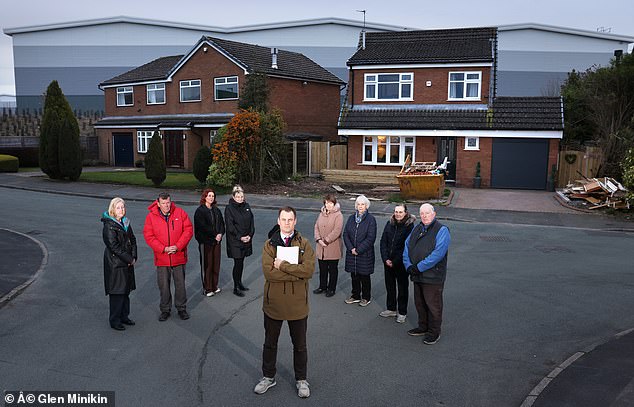
Guy Adams, front, with, from left, Ann Joe Littlewood, Paula Boardman, Dawn Hornby, Celia Spencer, Patricia Court, Jackie Peters and Steve Retford. The 60ft warehouse looms behind
‘Margaret sent us a photograph of the frame going up. We couldn’t believe how enormous it was, and how close to our home,’ she says.
When Ann returned from Greece, she burst into tears.
The vast metal warehouse you see on these pages was being thrown up, less than a hundred yards from her home. It already loomed over the street, blotting out half the sky.
‘You try to forget about it, but every time you turn the corner it’s just there,’ she tells me.
‘It’s unbelievable how close the thing is. When the workmen were doing pile driving, our whole house would vibrate. Everything was covered in dust, and we had to wipe the windows and sills clean every day.’
The Littlewoods are not alone. Their fate, alongside that of hundreds of neighbours, has since become a global news story.
At its centre lies some disturbing questions.
How, in a country that boasts some of the world’s most restrictive planning laws, can this dystopian monstrosity be legal? Why did planning officers endorse its construction? What possessed the Labour-controlled council’s planning committee to agree?
Who, more to the point, is now going to roll up their sleeves and put this grotesque injustice right?
What we do know, thanks to endless TV bulletins and viral social media videos dedicated to the carbuncle, and the benighted residents who live in its shadow, is that ‘PLP Astley’ now encompasses four vast mega-warehouses, each of them 60ft tall, covering a total of 350,000 square feet.
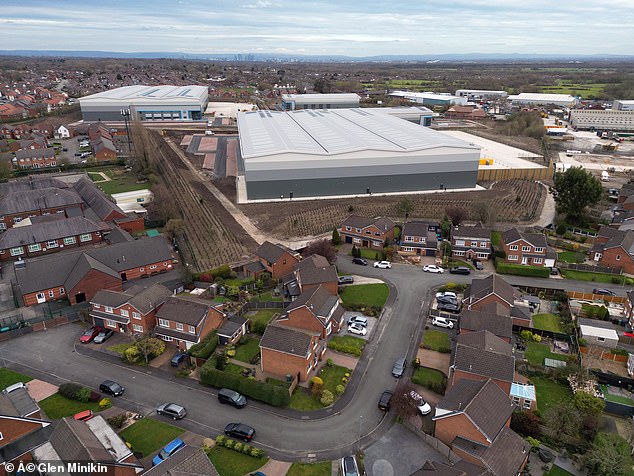
‘PLP Astley’ now encompasses four vast mega-warehouses in Wigan, each of them 60ft tall, covering a total of 350,000 square feet
They are frequently compared to cruise liners. But when I stand next to these hulking monstrosities, I instead feel myself thinking about that monolithic grey Royal Navy ship that has set off for the Mediterranean. Both are, in different ways, symptomatic of our national decline.
Until you visit, it’s impossible to fully appreciate how intrusive the warehouses are, too. Their floodlit walls are, in some cases, a mere 100ft from the nearest back garden. All that separates them from people’s lawns is a small mound of landscaped mud, covered with litter, rubble, and a pathetic smattering of tree saplings.
To live next to this industrial hellscape is to endure endless noise and light pollution.
Residents talk about ‘atrocious’ flooding incidents caused by an alleged failure to install proper drainage on the site. Tens of thousands of pounds – often life-changing sums – have been knocked off their property values.
Needless to say, no-one has yet been offered so much as a penny in compensation.
Everyone I meet offers surreal videos illustrating their plight. I see images of a garden underneath more than a foot of water. It was like that for most of the winter, destroying flower beds the owner had spent years tending.
There’s footage of a canoeist paddling down submerged footpaths and mothers pushing prams through shin-deep water outside the local school.
A dog walker tells how walking around the perimeter of the site can trigger sinister late-night alarms that announce ‘you are being monitored’ and set off flashing blue lights.
‘It’s like the Doctor Who Tardis has landed,’ I’m told.
Then there is noise pollution. At 10.30am one weekday last month, locals measured the commotion. It averaged 77 decibels, over a 23-second period with a maximum level of 82.9 decibels. Put another way, a vacuum cleaner makes 80 decibels of noise.
To put that in context, Health and Safety guidelines suggest levels should not exceed 75 decibels.
One resident, retired policeman Steve Retford, shows me pictures taken from his patio on the night that floodlights outside a loading bay were, for the first time, switched on after dark.
‘It looked like the runway at Manchester airport, shining straight into our windows,’ he says, adding that planning documents are supposed to require the lighting to be ‘as unobtrusive as possible,’ and comply with dark-sky regulations. ‘Dark sky? What a joke!’ All this before the facility has actually opened for business.
And with ‘PLP Astley’s’ first tenant, parcel firm Whistl, having recently applied to keep 65 HGVs and 95 trailers at the facility, operating 24 hours a day, seven days a week, disruption is only going to get worse.
‘There are people with mortgages, families who can’t sell their homes. All because of a mess caused by utter incompetence,’ adds Mr Retford. ‘You only have to stand here to realise this should never have been allowed. It’s a complete scandal, at every level. But no-one will take the blame.’
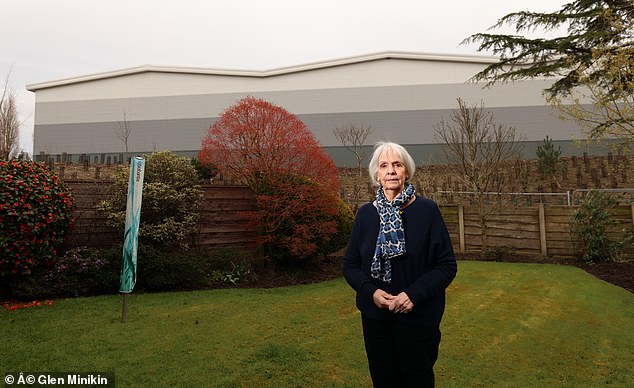
Patricia Court stands in front of the warehouses, that have been built by developer PLP, at the bottom of her garden
Last week, Wigan Council took the extraordinary step of sending a letter to the Astley Warehouse Action Group, a Mr Bates-style coalition of residents, threatening to sue them over content critical about the development that has been posted the campaigners’ Facebook and TikTok accounts.
The Labour-run authority is apparently ‘considering what options it has to protect itself as a public authority against libel or slander’ because it thinks that various videos detailing its role in the planning disaster ‘include factually incorrect statements and misleading versions of the truth’. The aggressive letter did not actually say what these alleged inaccuracies are, or identify the supposedly defamatory videos in question.
Neither does it explain how the council intends to ‘protect itself’ against libel or slander, given that UK law prohibits public authorities from pursuing such cases.
Instead, the bossy three-page note told the organisation to ‘consider their next steps’ and refrain from making ‘attacks on officers and members’ of the council.
Perhaps understandably, this has achieved the exact opposite of its desired effect. ‘The council is saying we threatened people,’ continues Mr Retford. ‘They don’t provide actual examples because there aren’t any. We’ve not said anything untoward. They just don’t like being held to account. It’s pathetic.
‘Blaming the victims. Because there are only one set of people here who are victims, and it’s the locals who have each lost tens of thousands of pounds.’
Craig Davies, the Action Group’s spokesman, tells me: ‘It’s clearly designed to shut us up, to frighten people. I call it gaslighting.’
Their ordeal began in 2015, when Wigan Council’s planning committee approved outline proposals for a ‘mixed development’ on the site.
This was to consist of a tranche of new-build homes next to low-rise warehouses. They were to be unobtrusive, and only operate from Monday to Friday, due to planners finding ‘due to its close proximity to residential usage,’ the site was unsuitable for ‘24/7 usage’. Developers swiftly threw up all the new homes. But they never built the warehouses, and that part of the planning approval was allowed to lapse. Fast forward to 2024, and a fresh application for commercial use was submitted to Wigan Council. This one proposed an astonishingly large development: four 60ft-tall warehouses operating 24 hours a day, 365 days a year.
At this point, things started to go awry.
Given the impact it would have on the local area, one might expect the council to have gone out of its way to alert local residents about the proposals. But the exact opposite appears to have been true: it instead did the bare minimum, sending letters to a mere 99 nearby houses.
The developer, a firm called Peel Logistics Management Limited, claims to have sent out roughly 200 more missives.
Be that as it may, several locals I spoke to – including people living within 100 yards of the proposed site – say they never received them. And were therefore blissfully unaware of the threat.
‘We live right opposite. We never got a consultation letter,’ says Jackie Peters, a retired teacher.
‘The first I knew about what was planned was in early summer last year, when they started building the thing.’
‘I never saw one,’ said Dave Gerrard, a builder whose garden borders the site’s northern perimeter. ‘They say they sent them out, but maybe [they] were addressed “to occupier”, which is a good way to make sure that they looked like junk mail so got chucked in the bin.’
All of which at least partly explains why, when the proposed mega-warehouse development came before the council’s planning committee, there were a mere 96 objections.
Despite its staggering size, and proximity to homes, not to mention 2015 advice describing the site as unsuitable for a 24/7 facility, the mega-warehouse proposal was also supported by the council planning officer. Members of the committee did not even bother to hold a site visit. Instead, the catastrophic development was, essentially, nodded through. One of the few voices of dissent, during the meeting, was James Grundy, local MP prior to the 2024 election, who submitted a well-crafted letter opposing the whole thing. ‘It made no difference,’ says a witness. ‘This is a Labour council, and he’s a Tory, so they just sniggered and ignored it.’
Since almost no one whose lives would be ruined by the subsequent development was properly aware of its scale, a six-week period in which a judicial review could have been sought came and went.
‘Like almost everyone else, we didn’t get a planning notice,’ says Ann Littlewood.
‘If we’d known what was happening, we’d have done absolutely anything to stop it. But we didn’t realise till the building started.’
By then, of course, it was too late. The Action Group, which was formed late last year, submitted a petition signed by 10,000 people calling for work to be stopped. But it was rejected by the council. Supporters sent a delegation to Wigan Town Hall to meet the planners (who refused to see them). Before Christmas, the council belatedly agreed to an ‘audit’ of the process that led to the planning approval being granted. It was published in January and contained some forthright criticism: residents were given ‘no meaningful opportunity’ to engage with proposals, while the ‘developer pre-application consultation with local residents was wholly inadequate’.
But it did not find the authority had breached legal minimums. Wigan Council said in response: ‘As a learning organisation, there are a number of actions that we will take in future.’ That position now seems to have evolved. In an apparent attempt to re-write history which might have been plucked from the pages of a George Orwell novel, last week’s threatening letter to campaigners contains a baffling paragraph which contends that the audit: ‘did not state that the consultation was “wholly inadequate”’.
Quite how the council squares that with the words ‘wholly inadequate’ on page 17 of the report is anyone’s guess.
Those whose financial futures have been endangered by this affair are appalled.
Take Dave Gerrard, the aforementioned builder. He bought his home in 2019, via the Government’s ‘help to buy’ scheme, using every penny of his life savings in the hope that it would provide him with a secure retirement. That dream has gone up in smoke.
‘I started working as a bricklayer when I was 16. I’ve put all my money into bricks and mortar.
‘I’m now 46 and have three kids, so the plan was to stay ten years, until they’d grown up, then sell and move into a bungalow. Now I will never be able to sell.
‘I have been absolutely shafted by the council. It sticks in my craw that every month I am paying them tax.’
When he first got wind of the size of the warehouses, Mr Edwards was told they would be screened by 10ft-high ‘bunds’ (embankments) covered in trees.
‘I got talking to the site manager and he said “don’t worry about it”.
‘We’re going to put bunds all around, so you’ll only see the roof from your bedroom windows.
‘They told loads of people the same thing. It’s a total lie. The bund isn’t even the height of my garden fence. And most of the trees they stuck on it for screening aren’t evergreen. So, in winter they’ll be useless.’
Peel Logistics Management Limited, who so cannily gained planning permission to build these vast metal sheds, said in a statement that it is a ‘responsible developer’ which in addition to reaching out to 200 residents met local stakeholders.
‘Furthermore, our approach to engagement with the local community was agreed in advance with Wigan Council.’
No doubt. But PLP will be laughing all the way to the bank. They are owned by Macquarie, the Australian finance house known as the ‘Vampire Kangaroo’ which is best known, in the UK, for extracting billions from Thames Water, which it owned in the 2010s.
Buried in the paperwork, I chance upon another happy beneficiary of this eyesore: Wigan Council, who can expect to make around £280,000 a year in business rates from its tenants.
A recent FOI request further reveals that a pension fund which serves the council’s bureaucrats ‘has provided a £33.3million development loan directly for the development of this site’.
Council workers can, in other words, look forward to a prosperous retirement. Unlike the poor residents who live beneath Britain’s most notorious eyesore.