Free expression thrives on human frailty, debate, and tradition—not on utopian zeal or moral legislation.
It was recently suggested to me that the Right Wing is currently the biggest threat to free expression.
Let’s start by defining right wing. As a Burkean conservative and anti-contractualist, I do not see the social contract as a voluntary agreement between individuals creating government. Rather society is constituted not only between those who are alive in the present, but also between those who are dead and those who are to be born. Rather than a contract, society should be thought of as a trust where each generation are trustees preserving the legacy of our ancestors and passing it on to future generations. Therefore social obligations are not purely matters of rational self-interest. Moreover, I am anti-revolutionary because it is easier to destroy a culture then to build it up and I am and anti-utopian. I do not believe in the perfectibility of mankind: this is based on a Christian conviction that human nature is flawed. As Scruton said “politics is the religion of the godless man”, however, and the zeal of the Utopian leftist can have appalling consequences. It’s no accident that’s the greatest horrors of the last century were created by utopian politics: whether you look at the Communist Party of China, the Soviet Union, Ceaușescu in Romania or Pol Pot; even the National Socialist German Workers’ party used the utopian language of a “Third Reich”. Free speech requires the organic tradition of liberty that we have enjoyed in this country for many centuries. Freedom of expression is better protected by a corresponding sense of human frailty.
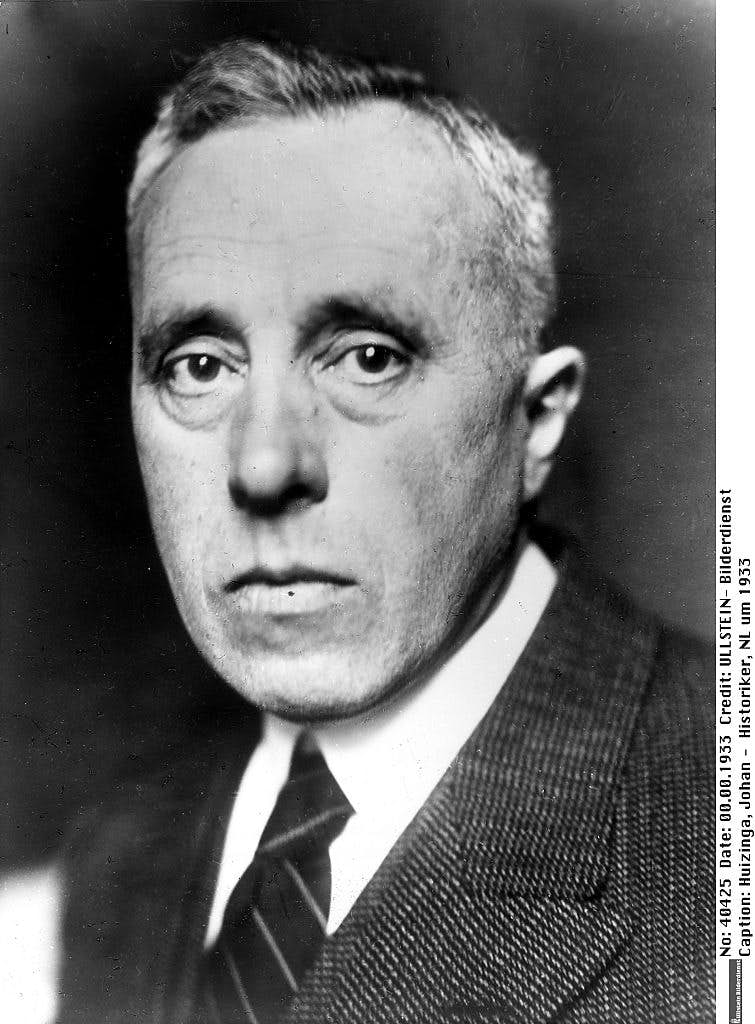
Let us consider a great book of the last century, Homo Ludens (Man the Player) by the Dutch historian Johan Huizinga in 1938. A great Anglophile, his book was written at time when all the great European powers were totalitarian, with the exception of France and Britain. It is a defence of the spirit of play of an older conservative Europe as opposed to the repressive regimes of fascism and communism. Like Burke, he admired the spirit of chivalry and wit and detested the bureaucratic rigidity of contemporary totalitarian Germany or Russia. He also was conscious of the agonistic side of play. This adjective is derived from the Greek word for contest: contest and competition is a key part of play and this often serves to regulate and defuse violence. Huizinga admired the emphasis in British parliamentary democracy upon persuasion rather than force. He applauded the “to and fro” of Parliament in the apex of its age of oratory. Sadly, such eloquence is rarely heard today.
Let us turn to a particular idea employed by the left that threatens free expression: “Hate Speech”, and with it the underlying idea that words are violence. We have had many instances of the arrests and imprisonment. Hate speech is, I suggest, a highly questionable notion, and is properly viewed as a perversion of the English Philosopher J.S. Mill’s Harm Principle. The Harm principle, as proposed by J.S. Mill, claims that people should be at liberty to follow their interests unless causing harm to others. The idea of hate speech is a dangerous modification of Mill’s principle that one is at liberty for actions but not to thereby inflict harm on others by redefining harm as extending to the use of words. Evidently, the pen can be mightier than the sword, and words can, of course, inflict pain. However, the potential for abuse of this principle, however well meaning, is evident. Hatred is part of the human psyche. Our aversions and antipathies are as much a part of our nature as our inclinations and loves.
This is reinforced by the left through their stress upon claim rights as opposed to negative rights. Freedom of speech is a typical negative right- it is a right to non interference – such as protection from theft or violence. But the left habitually insists on positive or claim rights. This has sometimes been referred to as rights inflation, including rights to non-discrimination or group rights.
The key problem is that left is inclined to legislate morality. Yet we need to distinguish between law and morality. There are acts that are illegal and yet perfectly moral: I consider fox hunting belongs to this category. There are acts that are legal but immoral: Euthanasia may become an instance. The law is a blunt instrument and using it to change ethical attitudes is often problematic, sometimes draconian. Combine this unfortunate and dangerous doctrine of hate speech with highly ambiguous and muddled terms like ‘Islamophobia’, and the results are dismal. Hence the government’s recent blasphemy laws. Firstly, take the nature of Islam. It is not, unlike Judaism or Hinduism an ethnic religion. You are born of Jewish or Hindu stock; this is not true of Islam. Islamophobia is an incoherent term, whereas anti-Semitism is not!
One might also note here the bizarre tendency on the left to “police” language, and to probe the most innocent and apparently harmless expressions or terms for their sexist, racist or otherwise alarming implications. From the damnatio memoriae of notables (tearing down statues, removing paintings) to the revision of language and terminology, the cultural revolution of avant-garde is intent upon purging the tongue of inherited evils. The presiding idea here seems to be that of the human being as Rousseau’s noble savage. Naturally empathetic and egalitarian, it is only through the corruption by wicked traditions, reinforcing sexist, racist, and generally xenophobic attitudes, that myriad evils abide.
The contemporary university is good example of the dangers of the left wing attack on free speech. With the Gramscian “long march through the institutions”, senior common rooms are largely inhabited by Guardian-reading progressives. Meanwhile, we have had the cancelling of senior academics like David Starkey, Nigel Biggar or Kathleen Stock.
The difference between respect and tolerance is decisive for an intellectual community. No-one can expect me to respect the schoolboy Marxism of a Michel Foucault or an Edward Said. Yet, I accept that there is a Said prize in the English Faculty of my University, even though I consider Said’s Orientalism to be the work of a charlatan; and I recognise that Foucault is one of the most influential thinkers in the Western academy even if I consider his arguments absurd. Requisite for free expression is the properly agonistic or competitive dimension of debate in a university. Long may it continue!