The right’s refusal to confront political Islam has helped entrench it in Britain
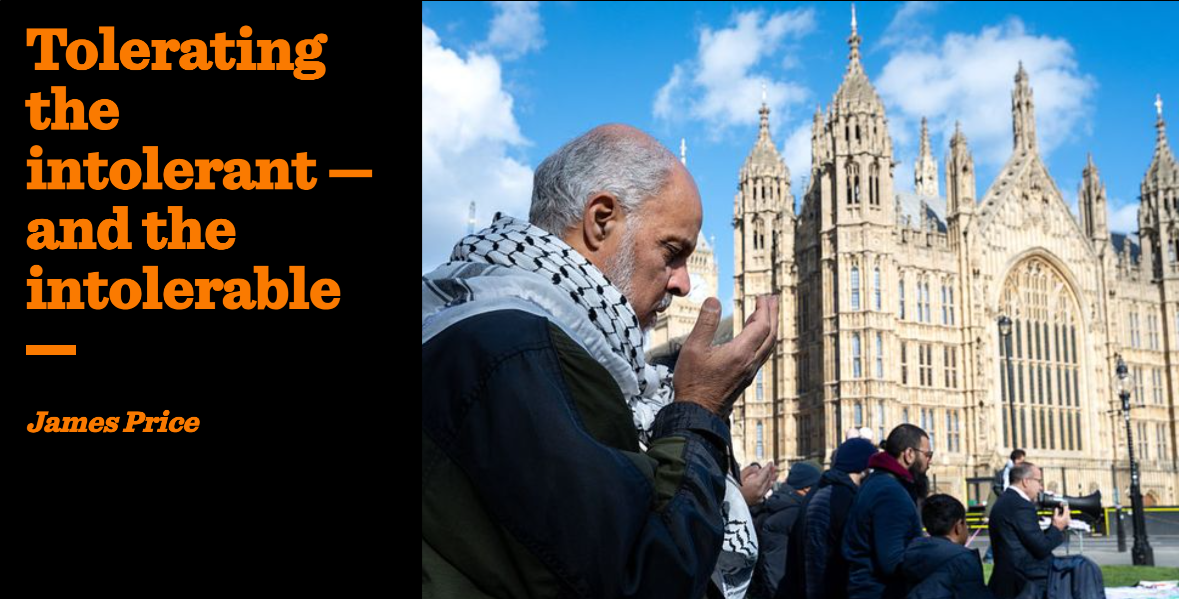
The row over whether the large-scale Islamic prayer event in Trafalgar Square represented a form of cultural domination fittingly continues to dominate debate in Britain. Everyone from Anglican bishops to Labour cabinet ministers have lined up to say that concerns about Islam in Britain are unfounded, bigoted, and just downright racist. Meanwhile, a new Islamic terrorist group, Harakat Ashab al-Yamin al-Islamia, has claimed responsibility for setting fire to four Jewish volunteer ambulances in Golders Green early on Monday morning.
Meanwhile, one commentator, a former Conservative Party candidate called Has Ahmed, has argued that the Conservative Party has a specific and disproportionate problem with Islam. He has suggested that the Conservative Party believes that “Islam is not simply another religion subject to critique. It is treated as a uniquely suspect force: politically charged, culturally incompatible, and persistently framed as a threat.”
Mr Ahmed was once attacked, whilst out campaigning and wearing a Conservative rosette, by a man in Islamic dress who called him “a fucking idiot” for voting Conservative. He was told to go to a “fucking white country”. The interaction took place in London.
This follows other criticism from former Conservatives. Former Attorney-General Dominic Grieve, once considered a hardliner on certain issues of integration, now leads the call to define Islamophobia in law. And who can forget Baroness Warsi? Her relentless condemnation of the Conservative Party is her way of showing her gratitude for being made a peer at 36 after losing an election, being made Chairman of the Party, and then having another senior ministerial role invented for her after she failed in CCHQ.
She resigned the Conservative whip in September 2024 before she could be stripped of it, after congratulating Palestine protesters for calling Rishi Sunak and Suella Braverman “coconuts” – a racist term alluding to the fact that coconuts are dark on the outside, but white on the inside.
These criticisms may be well intentioned, or they or others like them may be an effort to suppress the absolutely essential conversation that Britain must have about Islam. But the attempts to prevent that reckoning are weakening. Kemi Badenoch rightly backed Nick Timothy; Nigel Farage and Robert Jenrick lent him Reform’s support as well.
Even if this risks the issue becoming once split on left-right dividing lines, this is an enormously encouraging sign from a party that has, I am ashamed to say, played a part in making this conversation more difficult over recent decades by failing to address it when still much more nascent.
When Bradford Headmaster Ray Honeyford was hounded out of public life for arguing that Muslims needed to integrate, Margaret Thatcher invited him to Downing Street. She didn’t comment publicly on the case or intervene: Mr Honeyford’s public life was ruined.
In 1989, the Ayatollah Khomeini called for a fatwa against Salman Rushdie for his writing about the prophet Mohammad in his novel The Satanic Verses. 20,000 Muslims marched through central London, with police guarding bookshops that lined the route from attacks. A report from the time said: “They waved banners that read, ‘Burn, Rushdie, burn’ and ‘Hang him high’. A bloody effigy of Rushdie swung beneath a makeshift gallows. ‘He will die for Khomeini,’ one protestor shouted.” A total of 101 protesters were arrested, including at least 15 on charges of assaulting police.
Thatcher responded in a classically liberal way. She was given a petition from the “British Moslem Action Front” that called for the book to be banned, and also faced calls for them to change Britain’s blasphemy laws to include punishments against criticism of Islam.
She refused these calls, saying that “great religions can handle criticism” (although she said she, too, found the book offensive, not least because it also criticised her government and British society more broadly). But the canary in the coalmine had succumbed to death by fatwa, and the British state did absolutely nothing to recognise the growing sectarianism in its midst.
By the 1990s the Major government had let so many Islamist radicals into the country that former Hizb Ut-Tahrir member Maajid Nawaz, recalled being told to “operate like street gangs and we did, prowling London, fighting Indian Sikhs in the west and African Christians in the east. We intimidated Muslim women until they wore the hijab and we thought we were invincible.”
The leader of this group, Omar Bakri Mohammad, eventually founded Al-Muhajiroun in London. At his “Rally for Islam” — held, of course, at Trafalgar Square — he implored John Major and the Queen to convert to Islam. Al-Muhajiroun were connected to the 1995 bombings in Paris which led French officials to first coin the now-notorious far-right phrase “Londonistan”. Still, the Tories looked the other way.
When David Cameron became Tory leader, he was desperate to court votes from the rapidly growing Muslim population, and bent over backwards to appeal to them. Cameron wrote in the Guardian: “It is mainstream Britain which needs to integrate more with the British Asian way of life, not the other way around.”
Fast forward through recent years and the obvious failures with grooming gangs, Islamist terrorism and broader sectarianism, as well as the innumerable iftar events held by successive Conservative Prime Ministers, social media post welcoming Eid, senior Muslim Conservatives holding some of the grandest and most powerful roles in the country.
When I worked for Nadhim Zahawi, born in the Muslim world, who made it all the way to Number 11 and organised the Queen’s funeral, he would tell me that on some ministerial community visits to mosques, members would assume he was much more sympathetic to the plight of the umma, as they saw things, than was in fact the case. Upon realising that he was pro-Israel, pro-the UAE and, crucially, pro-Britain, attitudes would change markedly. It is eye-opening to hear how quickly attitudes changed once the penny dropped.
Zahawi has since been welcomed into that even more supposedly anti-Muslim Party Reform, alongside their Muslim Shadow Home Secretary and London Mayoral candidate. So spare me the idea that the Conservative Party or Reform have a unique problem with Islam or Muslims. There have long been signs that political Islam, and the often-unintegrated communities that have enabled it for decades, have been becoming a deep and dangerous problem in the body politic. By trying to tolerate the intolerant and intolerable, the centre-right has contributed to the growth of a problem that is second-to-none in its potential to tear the social fabric. The right finally seems ready to take it as seriously as it warrants.