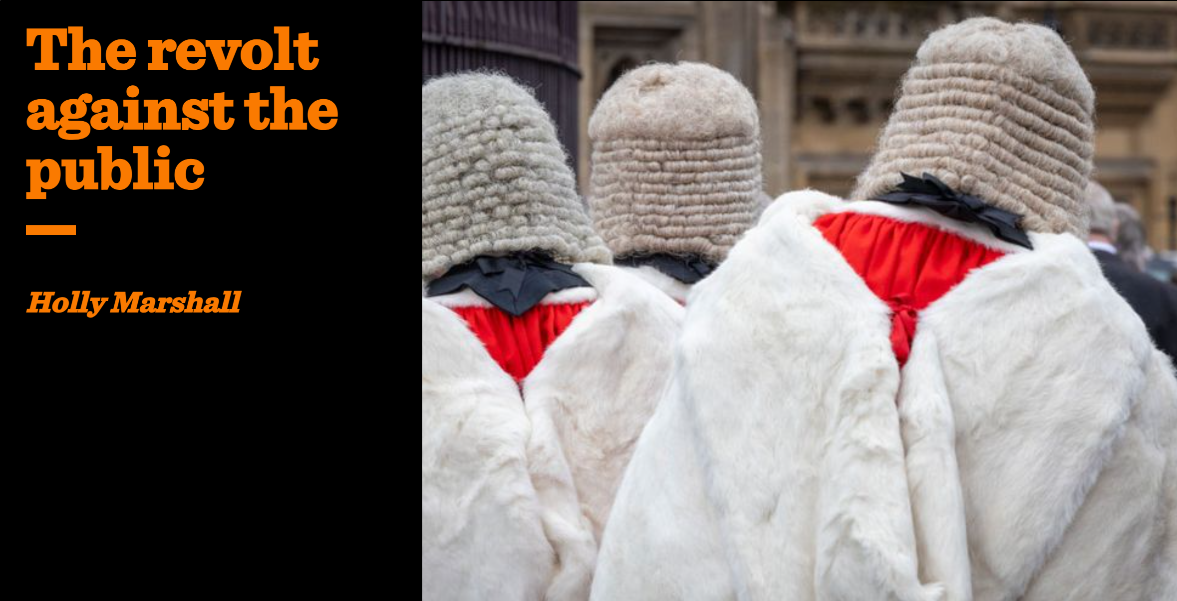
Both England and Scotland have recently pursued criminal justice reforms which would limit the role of juries, providing important insight into how British governing elites view the public. In Scotland, failed proposals to address poor conviction rates in cases of sexual assault sought to substitute juries with trauma-informed single judges. In response to an overwhelming case backlog in England, ministers are pressing ahead with their own proposals to replace juries with magistrates for a range of non-serious offences.
These proposals differ in both rationale and scope, so it should give us pause that lay judgment in both cases is what the state has been most eager to dispense with. This suggests that a set of shared assumptions are guiding solutions to what are otherwise quite distinct problems — if not determining what those problems are taken to be.
In that case, the real issue is neither backlogs nor conviction rates but juries themselves, and by extension the public. For one thing, in posing their interventions as technical or administrative reforms, the jury is treated as a problem variable rather than a constituent element of justice or a democratic institution. Juries are interpreted as a mere legal mechanism for producing verdicts, and if those verdicts can be reached more efficiently, or indeed, more agreeable verdicts reached, then juries should be removed.
Underlying that, I suggest, is a much more deep-seated anxiety which both sets of reforms express — that ordinary people cannot be trusted to judge. In the Scottish case this was explicit. Low conviction rates in cases of sexual assault, the Scottish government claimed, were a result of juror prejudice, specifically the influence of rape myths. The Scottish public was simply too biased to fairly adjudicate a sensitive case like rape.
In the English case it is rather implied. Once judgment is viewed as an “output” and tied to efficiency, a squabbling public can only introduce risk, distortion, and procedural drag. It really does not matter, then, as others have shown, that the time saved by abolishing juries would be negligible. What matters is that the whole business of judgment be professionalised and contained in pursuit of uniform results. England wants orderly verdicts; Scotland wanted guilty verdicts.
Changes in outcome give this away. In England, defendants convicted under the reforms will lose their automatic right of appeal, as if the professional magistrate brings discipline and certainty. In Scotland, the successful abolition of the historically exceptional “not proven” verdict is equally revealing. A device uniquely suited to adjudicating what is perhaps the most difficult allegation to prove — sexual assault with no evidentiary basis beyond testimony — the verdict gave juries the means to credit a complainant’s account whilst acknowledging that the evidentiary thresholds necessary to convict had not been met.
The jury’s embrace of this third verdict necessarily came at the expense of decisive convictions. What its abolition therefore exposes about the mindset of Scottish reformers is an inability to deal with nuance. This same lack is discernible in the English reforms, notorious before the fact for doing away with juries for a range of speech offences. Having proven themselves much more judicious than magistrates in assessing meaning, intent, and harm when it comes to the words people say, English juries have shown themselves equally capable of resisting the state’s urge to classify and contain.
Most of all these examples expose a profound fear of jury agency, for they show that once jurors are allowed to exercise judgment on their own terms — acknowledging doubt, resisting false clarity, declining meanings fixed by the state — they cease to be manageable instruments of policy and become something altogether more dangerous: independent actors in the democratic sphere.
The problem with juries, then, is not that they cannot judge. Rather, it is that they judge only too freely and well, if we understand judgment, as I think we should, not as a rarefied skill or instrument for generating outputs, but as an innate capacity for navigating uncertainty and ambiguity. Political theorist Hannah Arendt, perhaps the thinker who has done most to advance our understanding of judgment, conceived of it in just these terms: judgment is needed most when easy answers fail, and all are equally capable of it when given the chance. A chance is what juries provide.
It is not only the jury that is up for grabs, but every sphere in which ordinary citizens might claim a governing role
With that in mind, one of the most remarkable things about the Scottish government’s tarring of the Scottish public as uniquely prejudicial is that it rested on evidence in which the public was never placed in a position to judge at all. The proposals instead relied on a single mock jury study composed entirely of Scottish students. Are we to believe that this sample of students held especially illiberal views on rape? Or are we to believe with Arendt that there is something significant about setting jurors to the task of shared and difficult decision-making under real conditions of responsibility — conditions that force them to examine what they think and that a mock study could never capture?
What both sets of proposals disclose, then, is not the limits of juries as intended, but the limits of a political imagination that has stopped trusting the public to judge, either out of a misunderstanding of what judgment entails, as in the Scottish case, or through an uneasy recognition of its independence, and corresponding desire to contain it, as is the case for the English. This should worry us far beyond the courtroom, for both betray a weakly articulated vision of citizenship in which the public is a problem to be managed out of public life – and out of the very situations in which judgment becomes salient. Whether citizens are cast as unfit to judge the most normatively fraught questions or imagined as redundant in a broad class of ordinary cases, the premise that public judgment is suspicious and ultimately expendable always remains the same. At that point, it is not only the jury that is up for grabs, but every sphere in which ordinary citizens might claim a governing role.