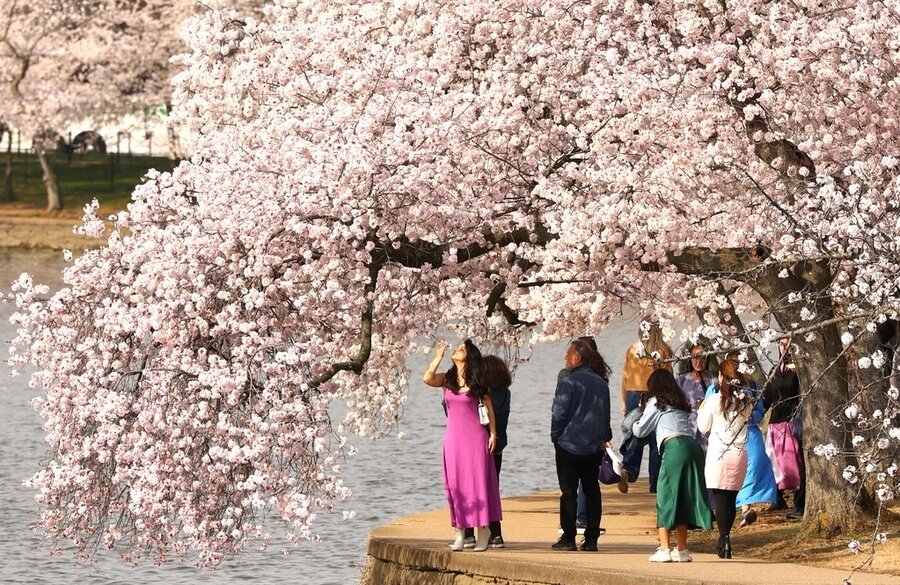
Politics in Washington might be downbeat and divided, but nothing unites the U.S. capital – and many thousands of tourists – in a spirit of optimism and anticipation like the spring blossoms of the city’s iconic cherry trees. “PEAK BLOOM! PEAK BLOOM! PEAK BLOOM! It’s official!” the National Park Service gleefully announced Thursday.
The news confirmed that the last weekend of March would be the best time to visit the Tidal Basin and National Mall, joining in conversation and contemplation along the pink-hued and perfumed walkways lined with more than 3,000 Japanese cherry trees given as a gift by the city of Tokyo in 1912.
“The first cherry trees helped crystallize an image of what Washington could look like,” Thomas Luebke, secretary of the U.S. Commission of Fine Arts, said on the centenary of the gift that helped transform and soften the landscape of the United States’ seat of power.
For students of history and culture, the cherry trees’ delicate flowers and gnarled trunks speak to the enduring soft power of global goodwill, culture, and faith in a better future to overcome division, including wartime enmity and destruction. After Japan bombed Pearl Harbor in 1941, the cherry trees in Washington were occasionally vandalized. But in 1952, as the U.S. shepherded post-World War II reconstruction, budwood from the Washington trees was transferred to Tokyo to restore the damaged original parent grove. This year, an additional 250 cherry trees sent by Japan to commemorate the 250th anniversary of U.S. independence will be planted in Washington.
Beyond political gestures, cherry blossom celebrations point to near-universal interpretations of springtime as a season of renewal and fresh beginnings. The Japanese practice of hanami – gathering with family and friends to view the blossoms, share conversation, and enjoy leisurely picnics – has spread around the U.S. as well as to cities including London, Paris, and Stockholm.
In an international context that currently feels fragile or fractured, and alongside increasing isolation especially among urban populations, this spring tradition spreads a priceless joy and connection. The Washington Post last year highlighted a couple who have held a sunrise picnic during cherry blossom time for more than 25 years – and are now regularly recognized and greeted by passersby.
As Japanese poet Kobayashi Issa expressed in a classic haiku some 200 years ago:
Under the cherry blossoms
strangers are not
really strangers