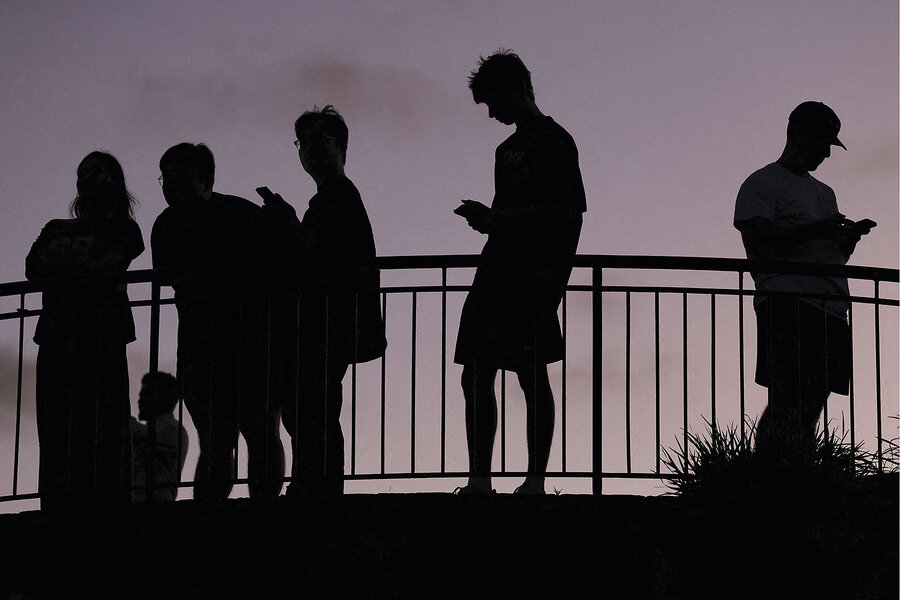
Jimmy Kakanis surprised his Australian classroom with an unusual pop quiz. He posed a single yes-or-no question to his teenage students: Are you still using social media?
In December, the Australian Parliament banned popular apps such as TikTok, X, and Instagram from hosting users under the age of 16. It was the first such law in the world. Legislative bodies in Africa, Asia, Europe, and the Americas are now actively pursuing similar action.
But in the shire town of Murwillumbah, just a kangaroo hop from the Gold Coast on Australia’s eastern edge, Mr. Kakanis’ students had shrugged off the social media ban. Only three teens out of 25 had any of their accounts disabled. Two were on Snapchat and the other was on Instagram.
Why We Wrote This
Lawmakers around the world want to ban social media apps for children. What’s not clear is how well this approach is working.
“The rest had found workarounds,” says Mr. Kakanis, a proponent of the ban, via email. “The students who had their accounts disabled waited a while, then made new accounts with ease.”
News reports suggest that this particular group of 14- and 15-year-olds are hardly the only ones to rebel.
Even so, Australia’s social media ban kicked off a domino effect, starting a widening regulatory push to restrict social media access for minors.
Polls show broad support from parents. Jonathan Haidt’s 2024 bestseller “The Anxious Generation,” which has been translated into 44 languages, has convinced many readers that social media is “rewiring childhood” in harmful ways. Rather than a “play-based childhood,” he argues in the book, children have moved to an unregulated and addictive “phone-based childhood.” Citing a number of international and national studies, he argues that excessive screen time diminishes children’s imagination, teaches them to expect constant stimulation, and creates harmful social environments, among other ills.
The issue is also showing up in high-profile court cases.
In Los Angeles, a 20-year-old woman sued YouTube and Meta, which owns Instagram. The plaintiff claimed that she became addicted to their feeds as a child and that this was a significant factor with her mental health. On Wednesday, a jury ruled in her favor. In another landmark lawsuit, the state of New Mexico alleged that Meta violated consumer protection laws by misleading users about the safety of its platforms, thereby enabling child exploitation. The state won that case on Tuesday.
For politicians, the bans are a vote-winning proposition. Yet Australia’s experience reveals that it is difficult to make such measures work in practice. It has also fueled debates over whether a technocratic fix is adequate to address something as complex as the mental health and safety of children.
“Governments are moving faster probably than they have the evidence to support that age-gating works,” says Ramsha Jahangir, a senior editor at Tech Policy Press, who helped compile a Global Social Media Age Restriction Tracker. It which found more than 40 countries moving toward regulatory approaches.
A kaleidoscope craze?
The move to blame social media for teens’ woes has been widespread, with those like Mr. Haidt positing that online platforms are too dangerous for many kids. He has more recently pointed to Meta’s internal research, made publicly available through lawsuits, as proof of Instagram’s deleterious effects on teens.
It was Mr. Haidt’s book that influenced a powerful politician in Australia to kick-start the country’s ban on social media for teens.
Critics of “The Anxious Generation” argue that, in trying to make the case that social media harms teens, it mistakes correlation for causation. “The data wasn’t that good,” says Will Dobud, co-author of “Kids These Days: Understanding and Supporting Youth Mental Health.”
“The way it was presented was pretty cherry picked,” he says.
This isn’t the first time parents have feared that children were addicted to scrolling on a handheld device. In the early 1800s, a kaleidoscope craze took hold. Adults fretted that children were so entranced looking into the new tubular invention that they were walking into buildings. Later generations feared losing children to comic books and video games. Mr. Dobud says Mr. Haidt’s book is fueling a moral panic about smartphone apps.
A 2024 report issued by the Washington D.C.-based National Academies of Sciences, Engineering, and Medicine, called for better research to clarify the links between social media and mental health. In its conclusion, the report recommends “a judicious approach to protect youth mental health” rather than broad-based bans. It also said that the benefits of social media to teens shouldn’t be overlooked.
Amanda Third, a children’s and families expert adviser to YouTube, seconds the idea that the conversation around teenage use of social media should be less fraught and more nuanced.
“There are risks of harm associated with being online, but what we know is that the most vulnerable young people online are the most vulnerable young people offline,” says Ms. Third, a research fellow in digital social and cultural research at Western Sydney University.
“You have to self-regulate”
Whatever their effect, tech platforms have long been required to include protections for minors. In recent months, though, some apps have been making headlines for hosting age-inappropriate content.
Unsealed documents from 2015 reveal that Instagram – where the minimum age for users is 13 – was aware that 4 million children below that age were using the platform. The tech company’s CEO, Mark Zuckerberg, admitted that policing age restrictions is difficult, but Meta has pushed back against the claim that its product is deliberately addictive.
Tech companies are also on the defensive on the political front. Indonesia recently implemented a ban similar to Australia’s. Brazil is introducing new age-based internet access laws this month. When Spain’s Prime Minister Pedro Sánchez proposed online age-verification laws, he described social media as a realm of addiction, abuse, pornography, manipulation, and violence. “We will protect [children] from the digital Wild West,” Mr. Sánchez said in February.
The French National Assembly overwhelmingly voted in January to ban social media for anyone under age 15. It still needs to pass the Senate. During an AI summit in Mumbai on Feb. 19, French President Emmanuel Macron invited India to “join the club” of nations seeking to protect teens from unfettered access to these online platforms.
Indian journalist Sunny Simran hails Australia’s law for sounding an alarm. But he also poses the question of whether every moral value needs to be enforced by legislation.
“There are certain principles in this world where you have to self-regulate,” says Mr. Simran in a Zoom interview.
Mr. Simran believes India’s phone-tethered parents are failing to model restraint, balance, and responsibility. India’s family systems have traditionally imparted those virtues. The journalist also worries that Australia’s laws were passed in haste. Seat belt laws and smoking bans resulted from behavioral change that was a marathon, not a sprint, he says.
Brooke Shannon, founder of Wait Until 8th, a pledge movement based in the United States that advocates delaying smartphone use until the end of 8th grade, is enthusiastic about the international momentum. But she offers a caveat.
“In terms of effectiveness, age-based guardrails can help reset social norms and provide structural support to families,” Ms. Shannon says in an email. “However … laws work best when they complement parental oversight, rather than replace it.”
Potential pitfalls
Some see significant downsides to such laws, even if well-intended. When age gates are implemented, everyone who accesses a social media platform has to enter through them.
“The information that you’re submitting in order to prove your age – whether that’s biometric information or documentation or some type of token that’s on your device – is then going to be shared with several layers of intermediaries that collect and process your information,” says David Greene, senior counsel for the Electronic Frontier Foundation. “That raises very serious privacy and speech concerns both for young people and for adults.”
Another issue is the use of virtual private networks to fool social media platforms about the location of the user. Some of these new legislative proposals include VPN bans. But VPNs are widely used around the world as online safety tools against hackers and surveillance.
Others see a threat to the freedom of expression that applies as much to children as it does adults. That’s why John Ruddick, president of the Digital Freedom Project, is helping two teenagers challenge Australia’s social media ban in court.
“The law is unconstitutional,” says Mr. Ruddick, who is also a Libertarian member of the New South Wales Parliament. For decades, he says, Australia has had “an established implied freedom of political communication. That has been upheld on multiple, multiple High Court matters.”
“What do we want for our kids?”
Whatever happens with the law, Australian mental health expert Will Dobud suggests a helpful thought experiment for its proponents: If elves stole all our internet technology tonight, what would parents do tomorrow? They need to learn how to have conversations with their children. And they can start with a rule of “no phones” at the dinner table.
“But there had better be some good dialogue,” says Mr. Dobud. “Otherwise, ‘no phones’ is going to be equated to boredom.”
Ms. Third, the adviser to YouTube, says that a better approach would be to pressure technology companies to redesign their platforms to mitigate potential harms.
To that end, she says that she would like to see officials from the European Union and Association of Southeast Asian Nations working together, perhaps in alliance with the Global Online Safety Regulators Network.
“We need to identify those harmful features. We need to identify the aspirations, right? What do we want for our kids?” says Ms. Third. “And then around that, we need to design some international standards that can be legislated in different jurisdictions.”