Every year, the annual Peanut Festival in Brooklet, Georgia, features the ultimate Southern fair competition. With a regional pace that matches its laconic drawl, the “slow tractor race” hands first prize to the driver who crosses the finish line last.
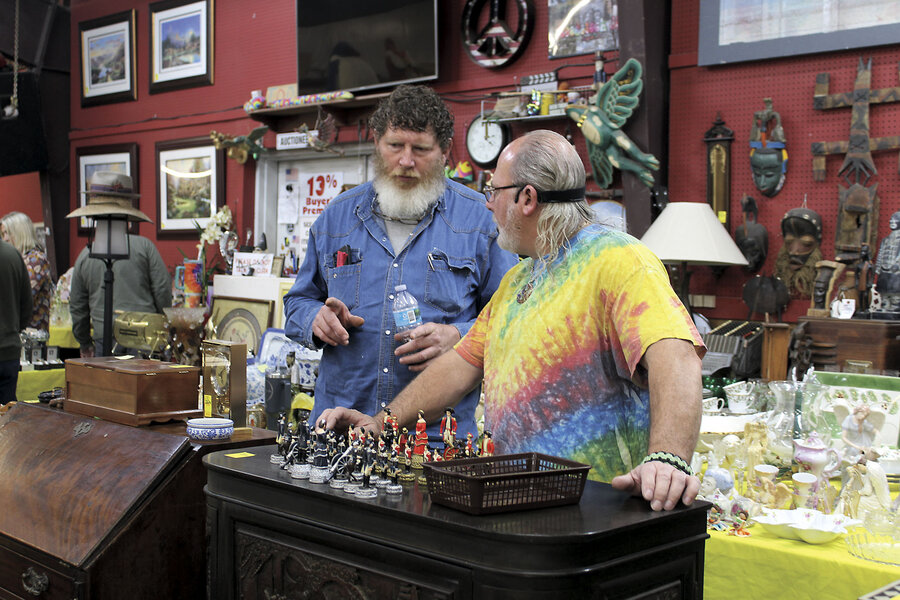
Resident Cristy Malott, who helps her husband, Tony, run Southeastern Trade & Auction, knows Brooklet as a leisurely place where she can pick her own strawberries and buy pork from a local farm. She also says that its Southern pace is picking up.
And nowhere are the changes more evident than in the thinning out of the region’s accent and dialect, one of the most recognizable in the world. “Hey y’all,’’ will signal the American South quicker’n a cat on a hot tin roof.
Why We Wrote This
The South’s increasing clout as a political, economic, and cultural force comes at a cost. The lower taxes, gentler winters, and affordable housing are drawing newcomers, often Midwesterners, changing how locals speak and live.
When the most recent shift began
Like many remote small towns throughout the country, Brooklet’s population had dwindled well into the 1990s as businesses closed and children left for school or better-paying city jobs.
But over the past 20 years, the U.S. Census reports double-digit growth here. A new Korean auto plant nearby is part of it, but so is a growing migration trend across the country, aided by accessible internet, remote work options, lower taxes, and more moderate weather. All of which has led to the dramatic tipping southward of the nation’s demographic center.
The change may highlight the South’s assets and opportunities. But it also hints at danger for its unique and salient features – including “that gorgeous Southern drawl,” as one local calls it.
In grocery stores and back-to-school nights, the sounds of harder “r’s” and “t’s” and clipped, fast phrasing of newcomers from other U.S. regions are noticeable.
“There’s a lot of change going on, so you have to be open and welcoming to that – it’s progress,” says Ms. Malott as she readies knick-knacks for auction. “But a mesh of all the accents? No.”
The ascendancy of the South, and its increasing clout as a growing political, economic, and cultural force, is coming with a price. Census numbers show that the South was the only U.S. region with both positive net domestic and significant net international migration in recent years. Its accent and colloquialisms – in some ways synonymous with its identity – are fading.
Atlanta has become a hotbed of California expatriates in the state’s booming film business. Many of Nashville’s new country singers come from Oklahoma. (One favorite resident, Taylor Swift, is from Pennsylvania). Raleigh spills over with New Yorkers drawn by tech jobs and starter homes. Midwesterners flock to South Carolina, the nation’s fastest-growing state last year.
For the South as a whole and Brooklet writ small, it’s a promising, but disorienting journey. And the fade of the Southern accent – often a self-imposed muting to avoid stereotyping – poses challenges for the South itself, for its values, history, and even future.
“When I came to North Carolina, it’s a state that loves itself, loves its landscape, its singers, its writers, its poets, its performers,” says Walt Wolfram, a Philadelphia-born linguist at North Carolina State University, in Raleigh. “But I always wonder: Why don’t you love your language?”
Language and dialect are often cured and curated in both physical and social isolation. That could be the unique Gullah language on the Sea Islands of the South. Or the cultural islands of American cities, where block-by-block racial and ethnic segregation allows dialects to form and remain unchanged.
Physical migration changes local speech patterns naturally. But social mixing and class marking do, too, linguists say. Indeed, classic brogues in Chicago and New York are fading as speakers face the same forces wearing down the Southern accent: Younger generations sometimes step away from their parents’ way of talking, perhaps to create distance from the older generation’s circumstances or values.
Taking their place is a pan-regional dialect first discovered in California in the 1980s. The “low back merger shift” (referring to how vowel sounds form in a speaker’s mouth) has subsumed local dialects from Chicago to New York, even parts of Canada.
And nowhere is the California accent more evident than in the Carolinas, Georgia, Tennessee, Alabama, Mississippi, and northern Florida, where increasingly bland city accents contrast sharply with the twangs and sayings still heard out in the countryside.
“The connection to the past or to local culture … that is transmitted through dialect is fraying,” says Peggy Renwick, a linguist at Johns Hopkins University who has researched Southern dialects.
When the shift began
The classic Southern accent likely peaked in the mid-1960s, then began its slow fade with Generation X, which began to question the interplay of accent and the South’s complicated history.
“Southern accents generally rate high on dimensions of friendliness, solidarity, and hospitality, but in terms of prestige on the national stage, it doesn’t rank so high,” says Professor Wolfram, referring to post-Civil War, civil rights era, and rural stereotypes. “Practically everybody who came up pretty Southern in their home is corrected not to be so Southern because it doesn’t sound smart.”
That so-called dialect leveling has translated to building tension in Southern communities.
“The ones born and raised here that’s older, they’re going to keep [the accent],” says Mark Grimes, an auction attendee. “Now … I don’t want to talk about the younger generation. They’re going to hogwash. That’s a nice way to say it.”
Today, people born in Raleigh, North Carolina, where IBM helped the Research Triangle draw academics beginning in the late 1950s, may still speak with a whiff of a Southern accent, like the hint of magnolia over a fence. But 10 miles out of town, the drawl twists and turns, thick as kudzu.
“Your speech is kind of like your clothes: It sends information about who you want to be and how you see yourself and how you fit into society,” says Lelia Glass, a linguist at the Georgia Institute of Technology. But, she adds, “homogenization and standardization sometimes go in the direction of people who have more power.”
That dynamic is playing out in the Deep South. In Statesboro, Georgia, named for states’ rights, a founding ideal of the Confederacy during the Civil War, the Georgia Southern University campus brims with foreign students and urbanites on state scholarships.
Pace Jenkins, a self-help author and Amazon delivery driver, is on campus for a visit, reading on a bench. His unmistakable twang is a geographical happenstance – he grew up on the edge of Statesboro, on a dialect border.
“Like Johnny Cash, I walk the line,” he laughs. But even here, “you really have to listen hard to hear the accent,” he says. “And the people who still sound that way are consciously holding on to it.”
“Real Southern, real quick”
One of the most characteristic features of a Southern accent is the “i” sound, which dates back to the Civil War. The elongated vowel, pronounced “ahhh,’’ can be heard in words like “why” and “fire.” Some Southerners lump words together. One example: “Momanem.” Say what? “Momanem. Mom and them.”
The various Southern accents and dialects are also malleable.
“You have some people who really ham it up, put [the accent] on more. In fact, if you get me mad enough, I can be real Southern, real quick,” says Ms. Malott, the auctioneer’s assistant in Brooklet. “I can also smile and be sweet as sugar pie and insult you in a hot second, and it’ll be so nice,” she says, dragging out “sooo naahss.”
But for many Southerners, the changing accent represents the conflict between progress and tradition, between growing demographic and economic power, and the gauzy gentility and family-centric nature of the traditional American South.
“This society here is just changing,” says David Whitten, who runs the auction’s barbecue pit. “People are less friendly. But our whole society is turning that way anyway, where nobody trusts anybody anymore. It’s becoming less Southern, I guess, is one way to put it.”
The question is whether those shifts are irreparably changing the South or whether the drawl might be poised for a renaissance.
Each year at the North Carolina State Fair, Dr. Wolfram hands out 7,000 “dialect buttons” with phrases such as “Bless your heart” and “All y’all.”
“People want to be from some place,” he says. “We don’t want to be the voice of nowhere.”