In Greek epics, no one listens and no one gets along,” says Harlow Donne, the protagonist of “Son of Nobody,” the latest book from Booker Prize winner and “Life of Pi” author Yann Martel.
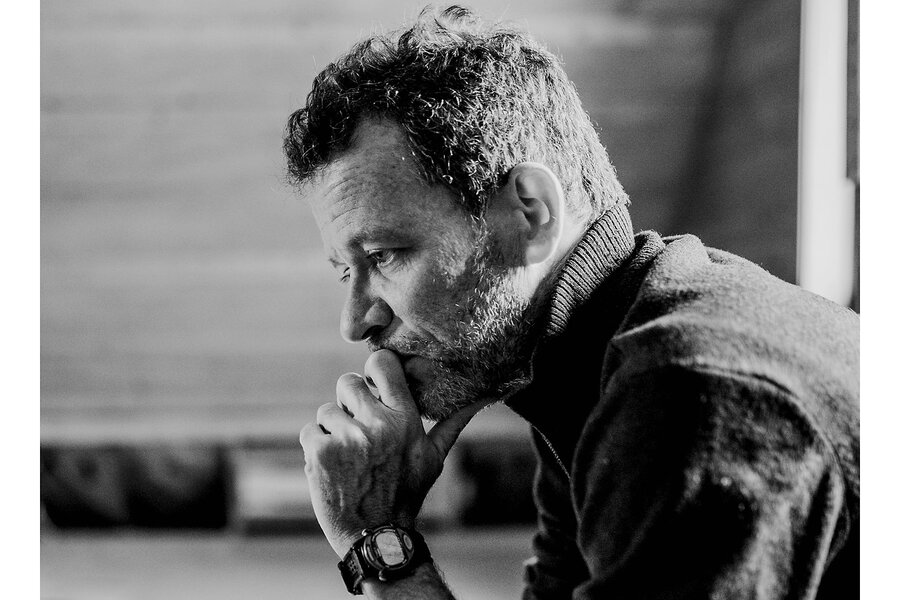
It’s fitting that the principal character of the novel is someone steeped in the sometimes arcane world of academia. In conversation, Martel has the air of an eccentric philosophy professor, lecturing his students on the secrets of the universe – or maybe a brilliant mystic who has emerged from a long meditation. And it has been a long time since Martel has come out with a new novel: nearly 10 years.
“It’s been exactly 10 years,” he corrects me, “since the release of ‘The High Mountains of Portugal.’”
Why We Wrote This
Yann Martel rose to prominence with the success of “Life of Pi.” Now, in “Son of Nobody,” he takes on the Trojan War, a scholar’s drive, and a commoner’s yearning. Our contributor recently interviewed the bestselling author.
Martel rose to prominence due to the success of “Life of Pi,” his third published book. That story, about a young man who spends a surreal 227 days lost at sea in a life raft with a hyena, a tiger, and other zoo animals spread rapidly through the collective cultural imagination.
“Life of Pi” not only won him the prestigious Booker Prize, but it also spent more than a year on The New York Times Best Seller list and was adapted into a lauded film. It grossed over $600 million at the box office, then won a Golden Globe and four Academy Awards in 2013. Later, he released a book collecting his one-way correspondence with then-Canadian Prime Minister Stephen Harper, titled “101 Letters to a Prime Minister,” and two more novels, “Beatrice and Virgil” and the aforementioned “The High Mountains of Portugal.”

His new novel, “Son of Nobody,” features a twin narrative. One belongs to Harlow Donne, a Ph.D. student in classics who leaves his family behind in Canada to pursue a prestigious Greek translation fellowship at Oxford University. The other follows Psoas, a rank-and-file Greek soldier who is the titular character of “The Psoad,” a lost Greek epic recounting the events of the Trojan War from a commoner’s perspective. Harlow discovers this Iliad alternative in fragments of ancient pottery and scraps of paper discovered in hidden caches, pieced together from his nearly manic travels across the former-Hellenic world.
As Harlow’s relationship with his family grows more fraught, so does Psoas’ growing unease with the war that he signed up for, but has no real stake in. Each protagonist has gone to foreign lands to seek their fortune – one to England and the other to Troy – leaving their families behind. And both mourn a particular kind of loss: the lost time spent with their children.
I asked Martel about the mirroring of these characters’ conflicts, one in love and the other in war. “Most Westerners haven’t been in a war in a long time,” Martel tells me. “So what accurately reflects a war in an individual’s life in the 21st century? A relationship.”
And there is a lot of anger in the novel. Harlow and his wife are at each other’s throats from the very beginning. Psoas’ family doesn’t appear in the novel, but he has another kind of anger: a steady, growing rage toward those in authority during the Trojan War – legendary figures like Odysseus and Agamemnon, who degrade and belittle the everyday Greek soldiers they command.
“The first word of ‘The Iliad,’ famously, means wrath,” Martel says. “The first book ever written down, at least in the West, was all about anger.”
While “The Psoad” is written in free verse instead of dactylic hexameter, the form used by Homer in “The Iliad” (Harlow claims that he doesn’t have the poetic chops to translate the form from Ancient Greek to English), the poetry feels like a Greek epic. Though one from a slightly skewed perspective, from a previously unknown storyteller. Martel has clearly done an extraordinary amount of research in order to construct Psoas’ narrative, and because of it, the meter shines.
That research was part of why “Son of Nobody” took so long to finish; it was work Martel conducted when he wasn’t caring for his four children. To do that research, he immersed himself in the Greek epics and ancient history, flying to Turkey and Greece to dive ever deeper into the project. Slowly, inexorably, he brought the pieces together.
In our conversation, Martel seemed reluctant to discuss Harlow’s part of the novel, and only touched on it when pushed. When Martel described his own visit to where Troy once stood, there was a clue.
“It’s this little dumpy archaeological site,” he says. “There’s some modest walls. Then there’s these sort of mounds. There’s nothing.”
Harlow has a similar observation when he goes to Troy, remarking, “The dolled-up remains of Troy earn no more than a quick, indifferent gander, eliciting from the average visitor no deeper reaction than ‘Really? Is that it?’”
Many times in our conversation, Martel’s thoughts paralleled Harlow’s, sometimes nearly down to the letter, at least when it came to the ancient world. As “Son of Nobody” progresses, the mirroring between Psoas and Harlow becomes so smooth that it becomes unclear whether the narrative of “The Psoad” is real or a projection of Harlow’s mind.
When asked about “The Psoad’s” reality or unreality within the narrative, or if that dichotomy matters to him, Martel had another surprising answer. “It doesn’t,” he said. Then he continued: “It doesn’t in the sense that we have no evidence for the Trojan War. If you go, it’s not even called Troy anymore.”
While Harlow is contemplative and verbose, Psoas is less so. For someone that has an epic named after him, well, he doesn’t speak all that often.
“After all, he’s a commoner,” Martel replies when asked. “He’s not supposed to speak.”
I had a strange moment, where the conversation seemed to warp reality slightly, not unlike the experience of a character in one of Martel’s novels. Because commoners don’t speak in Greek epics, neither did Psoas. The author spoke with such conviction, seemingly not as the creator of these two characters, but as a discoverer of something that already existed, that for the briefest moment, I found myself wondering: Did Yann Martel, celebrated novelist, actually find fragments of a lost Greek epic? Is he Harlow?
But then, a much more likely, though equally odd notion replaced it. Did the author want to write a Greek epic, but knew that it wouldn’t be marketable, so instead wound it tight with the trappings of contemporary literary fiction? Was Harlow’s life, with its many tragedies, just a vehicle to publish Martel’s own Greek epic?
Either way, “Son of Nobody” touches on many contemporary concerns, even with its roots in classical storytelling and mythology. The ancient world was ruled by elites, a sentiment that is shared by many about our contemporary world. How do we as people take on the great machinery of politics? Who are we in the face of that?
“In ‘The Iliad,’ there’s only one commoner who speaks,” Martel tells me. “He’s the only one who says something that seems totally commonsensical: Why are we here? What are we getting from this?”
How does one live life within the confines of such a system? Through Harlow and Psoas, readers see many threads wound together in a Gordian knot: grief and rage, both personal and political – and the yearning for justice, for love, and, always, for more time.