How could a long-haired, greasy-bearded, belching peasant from a small village beyond the Urals have gained power over the Russian imperial family, and thus over Russia itself?
For many of us whose knowledge about Rasputin begins and ends with the lyrics of the song of that name by Boney M, Antony Beevor’s superb book fills in the gaps.
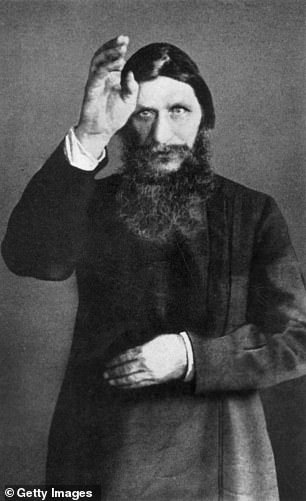
Grigori Rasputin
It tells the story of this quasi-monk and certified lecher, whose spell over Tsar Nicholas II’s wife, the Empress Alexandra, would be a catalyst in the Romanovs’ fall.
Born a lowly farmer’s son in 1869, Grigori Rasputin decided early on to set off from his village and marriage to become a wandering pilgrim. Intoxicated by religiosity, he started dispensing his holy wisdom and healing powers to the ladies of St Petersburg, who lapped up his every word. He held salons, to which high-born women flocked. One was so mesmerised by his shimmering eyes that seemed to see right into her soul that she tied his half-eaten food onto her belt, and kept fish bones she’d saved from his plate as holy relics.
Women volunteered to cut his fingernails so they could keep the clippings as sacred talismans to sew into their dresses.
‘When a society and political order is about to disintegrate,’ one academician commented, ‘rulers always seek the support of the supernatural’. Rasputin’s most ardent disciple was the Empress Alexandra.
In one letter to him, which would later be used as evidence against her, the Empress wrote, ‘How tiring it is for me without you. I can rest only when you, my teacher, are seated next to me and I kiss your hands and lay my head on your blessed shoulders.’
Beevor does not imply they were having an affair, but Rasputin was certainly lecherous. He liked to sit on the beds of the Grand Duchesses (her daughters), and it was said he seduced or raped the nursery maid.
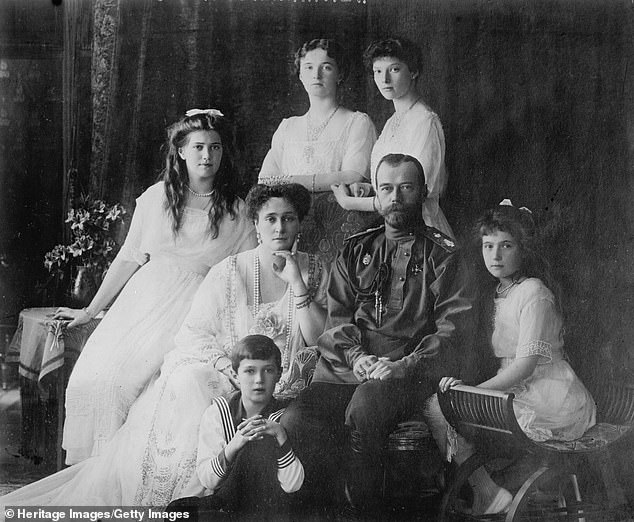
The family of Tsar Nicholas II who would all be brutally murdered at Ekaterinburg
The Empress was particularly susceptible to his power because her only son and heir, Tsarevich Alexei, was a haemophiliac. Every time Alexei was ill, Rasputin miraculously healed him.
She started relying on him not only for the health of her son but for advice on governing. Her unconfident husband was far too easily led by her political machinations. By 1915 she was shamelessly firing ministers who didn’t like Rasputin.
After the First World War broke out, Rasputin’s power became even more insidious. Women implored him to use his influence over the Tsar to excuse their husbands and sons from fighting. He demanded sexual favours in return.
To one such petitioner, he said she must either obey his sexual commands or never show up again. She wept and pleaded, ‘and he took her by force, even though there were people in the room next door’.
S omething had to be done. And the men to do it were not revolutionary thugs, but high-born noblemen, Prince Felix Yusupov, Grand Duke Dmitry, and the Right-wing monarchist Vladimir Purishkevich.
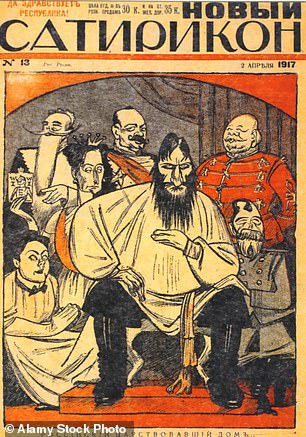
Contemporary satirical cartoon of Rasputin with Tsar and generals by his side
They lured their victim to Yusupov’s parents’ palace in St Petersburg with the promise of meeting Yusupov’s attractive wife Irina.
They laid out a plate of cakes for him, laced with cyanide.
Rasputin put on his most slinky outfit: velvet trousers, a blue satin shirt embroidered in gold, a red silk cummerbund with two pompoms, and high boots.
A fire was crackling in the grate of the basement apartment when he arrived. A polar-bear rug was sprawled on the floor. The gramophone was playing the prince’s only record, Yankee Doodle Dandy.
But the guest refused to eat the cakes. ‘Can you imagine!’, Yusupov spluttered to his co-conspirators waiting upstairs, ‘the brute refuses to eat or drink’.
Dmitry urged him to try again. By the time Yusopov went back downstairs, Rasputin, now restless waiting for Irina to appear, had eaten a couple of the cakes, washed down with poisoned Madeira wine.
He was showing no ill effects.
It didn’t occur to the assassins that the cyanide might have lost its strength through age – or that the sugar in the cakes might have rendered the poison harmless.
After another quick conflab, Yusupov took Dmitry’s pistol, went back downstairs, said to Rasputin, ‘You would do well to study that crucifix and say a prayer,’ and fired at his chest.
Rasputin collapsed, spasms shook his body, and he appeared to expire. The assassins congratulated themselves, and prepared for the next part of the plan: to load the body into a car and dump it through a hole in the icy river, weighed down with chains.
Suddenly, they heard noises downstairs. ‘He’s still alive!’ shouted Yusupov. ‘Rasputin slowly opened one eye,’ he later recalled, ‘then the other, and gave me a look of indescribable hatred.’ Then he stumbled out through the snow towards the gates. Purishkevich fired his pistol twice and missed.
The third shot struck Rasputin in the back. He really was dead now.
To confuse the police about the origin of the blood in the snow, they got Yusupov’s borzoi wolfhound and shot him on the spot.
Leon Trotsky remarked the assassination was so tacky that ‘it was a moving picture designed for people with bad taste’.
The farce continued with the disposal of the body. The men just threw the chains on top of it, praying the body would be swept out into the Baltic.
But it was discovered three days later, autopsied and the assassins found guilty. They each received mild punishment.
Far from rescuing the monarchy, as they’d hoped, the assassination of Rasputin marked the beginning of the end.
Three months later, after protests about food shortages sparked the February Revolution of 1917, the Tsar would abdicate, and the royal family would find themselves prisoners in their own palace: the first step on their journey to massacre in Ekaterinburg in 1918.
After the murder, the Empress kept Rasputin’s blood-soaked blue satin shirt as a holy relic.
The next year, on the way to Ekaterinburg, the imperial family passed through Rasputin’s village. The Empress’s daughter Maria began a sketch of his house until a Red Guard tapped her on the shoulder with his rifle.
The juxtaposition of the doomed imperial family on the road to death, and the birthplace of the peasant Rasputin, is just one of the many unforgettable scenes in this macabre story.