
In 1999, while artistic director of the National Theatre, Trevor Nunn directed a staging of Gorky’s hitherto neglected 1904 play Summerfolk that was widely acclaimed as one of the greatest things ever staged at the National. Featuring an absurdly star-studded cast that included Roger Allam, Simon Russell Beale, Jennifer Ehle, Henry Goodman and Patricia Hodge, it brought a previously little-known Russian drama into full, glorious life. It looked likely that it would eventually return to the canon, although the demands of its vast cast and huge panoramic setting meant that it was not, perhaps, likely to become a staple of amateur rep.
Nonetheless, for its first revival since then, it comes as a faint surprise that it has been so entirely absent from British stages. Chekhov, after all, is near-ubiquitous in productions (and translations) of varying fidelity and quality, and Gorky owes a great deal to Russia’s greatest playwright. It is no coincidence that Summerfolk, which explores the moneyed indolence of a group of bourgeoisie who are summering in a country house, or dacha, far from the major cities, alludes to Chekhov’s death — which occurred the same year that the play was first staged — and, consciously or otherwise in Moses and Nina Raine’s nimble, demotic new translation, there are many references to Chekhov’s plays, from The Cherry Orchard and The Seagull (lots of jokes about the vanity of actors and writers) to Uncle Vanya (desperately lovelorn characters suddenly coming to terms with the essential futility of their lives).
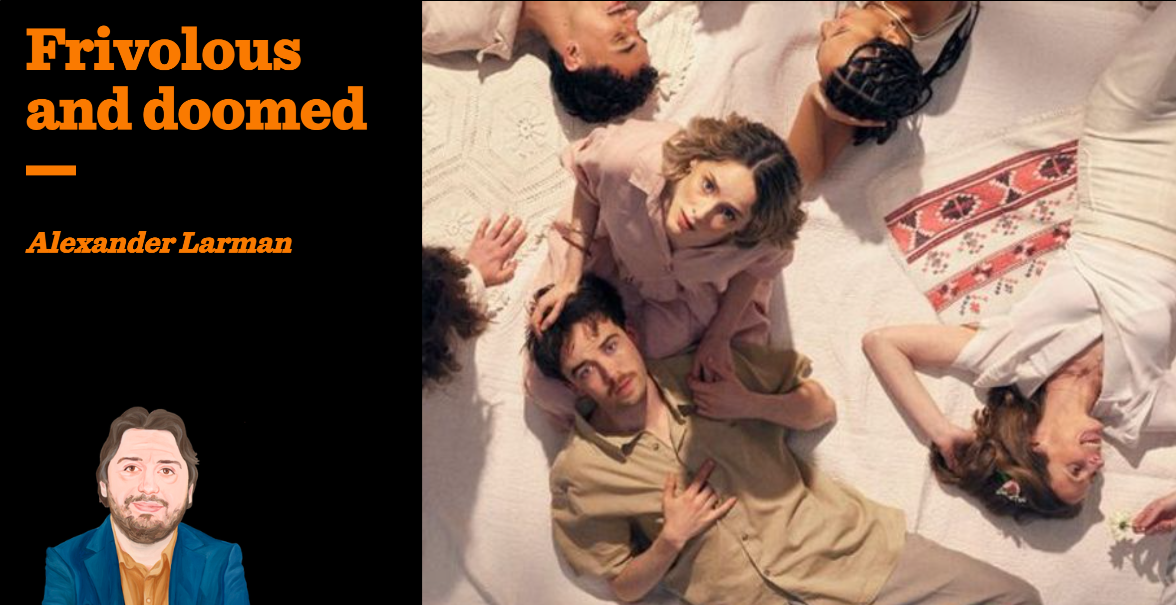
The difference between Chekhov and Gorky, alas, is that the latter simply isn’t as good. This is not immediately obvious on a scene-by-scene level, thanks to Robert Hastie’s assured and even cinematic direction and largely excellent work by a fine cast. Instead, it’s frustrating that the first half of a three-hour play doesn’t really have any plot or storyline to speak of. A group of characters are introduced, in small groups, and interpersonal dynamics established. Paul Ready’s Bassov, channelling Robert Lindsay, is a brutish self-made man, unhappily married to Sophie Rundle’s Varvara; their childless marriage is a source of frustration to him, if not necessarily to her. Bassov employs Varvara’s younger brother, Alex Lawther’s feckless, ragged Vlass, as a clerk, and he in turn conceives of a tendresse for Justine Mitchell’s older Maria. Throw in a rogue’s gallery of plutocrats (most enjoyably Peter Forbes’s louche Semyon, who refers to frustrated youth as “the wanking years” and brings the house down in the process), aspirant poets, dilettantes and sardonic, knowing servants, and you have a rich slice of Mother Russia.
Virtually all of them, you sense, will be swept away in a few years
Although the four-letter words and diverse casting will not appeal to everyone, this is considerably more traditional than Hastie’s bold but decidedly flawed recent Hamlet, and I felt that it was a peace offering from the National’s artistic director Indhu Rubasingham to audiences who had largely eschewed the Olivier theatre, where this is staged, during her predecessor Rufus Norris’s regime. Thanks to Peter McKintosh’s set design, which ably depicts everything from a woodland picnic scene to the interior of a dacha, this feels solidly traditional, even if its themes of social unrest and the emancipation of women — both, admittedly, anticipated by Gorky — feel somewhat over-emphasised in the Raines’ translation. Knowing what we know now about the imminent Russian Revolution and subsequent rise of Stalinism makes the over-deliberate indolence and self-indulgence of the characters seem both frivolous and doomed. Virtually all of them, you sense, will be swept away in a few years, and it is no coincidence that Hastie’s production ends with dark shadows and the sound of machine guns.
The problem, however, with such a sprawling panorama is that it is very hard to get a handle on the individual characters. Some make a greater impression than others, largely due to the excellence of the acting. Lawther skilfully conveys shrugging fecklessness and youthful passion, and the ever-superb Mitchell, whose theatrical CV is a thing of wonder, is both hilarious and moving as a middle-aged woman who is waking up to love, like a giddy teenager, for the first time in her life. And Ready and Rundle manage to bring an unhappy, troubled marriage to the stage with delicacy and nuance. Yet others come and go and I could not help wondering, heretically, whether some of the characters could not have been excised altogether or combined with one another, such as Daniel Lapaine’s vain, preening writer and Pip Carter’s would-be suitor for Varvara. This is hardly a faithful translation, and a little more infidelity would not have gone amiss.
Set against this, Summerfolk is the kind of play that has been absent from the National’s stages for a while, a bold and ambitious — if undeniably flawed — drama that makes for an expansive and often fascinating evening at the theatre. After the experimental Bacchae, Hamlet and Man and Boy, it proves that classicism (if not conservatism) has its place here, too, and if it is a success, fingers crossed for the top-flight Chekhov revivals that this theatre used to do so well.