“Prioritizing the American empire over American citizens and then claiming this would somehow redound to their benefit, hollowing out the Heartland to stitch global markets together, giving more attention to upholding abstract principles on the other side of the world than to helping families make ends meet—these are the kinds of tradeoffs that the American elite embraced”, Oren Cass complains. “There is another tree, far from the online swamp of identity politics and ethnic hatreds, where most Americans sit, uninterested in empire and yearning to live in a republic with representatives focused on the interests of their fellow citizens.” That is all very good. But blaming neocons or “elites”, for issues which are partially a matter of political choice, is saying “a car hit bystanders” while describing terrorist attacks, or “all men are abusive” instead of grooming gangs.
As the recent CBS polls suggest, a whopping 80 per cent of the republicans support Trump, with most ingroup support coming from “whites with no college degree” (see page 24, question 16), also the most evangelical and low-church protestant population in the United States, and often, overwhelmingly working class and non-college educated. In short, essentially the core right wing populist base whom Oren Cass defends against globalist avarice; and incidentally, also the core population groups who also initially supported the Iraq War.
“The reason we go to war always matters”, Matt Damon’s character said in Green Zone. There are of course structural causes of this war, ranging from unipolarity to proximity, distance to the direct conflict zone and lack of retaliation to the homeland, and of course foreign lobbies. The conflict has also moved into a much more serious phase. Iranians ramping up strikes on Haifa, Dimona, and Arad, in response to earlier attacks on Pars and Natanz, show that the escalation ladder is wide open.
Iran isn’t an autocracy similar to Russia, or fanatical and suicidal like the ISIS. Rather, the ruling elite in Iran, are middle class and rational actors, and while weaker compared to the US firepower, isn’t a pushover like other Middle Eastern states. Instead, it is now starting to look like a direct and open exchange between two middle powers (with America seeking an off ramp) whereby both Iranians and Israelis are willing to take risks. Israeli officials and their supporters have described Iran’s actions as war crimes and portrayed them as irrational, while pursuing what could be characterised as a Lebensraum in southern Lebanon and West Bank.
What is different this time is that Israel, for the first time in over twenty years, is facing an actual middle power both capable and willing to continue this war. Iran’s military reach, geographical isolation, core demographical advantage, and willingness to sustain a prolonged punishment make this a more difficult, costly, and unpredictable confrontation, rather than a quick or controlled operation as both Israel and the US intended. At a broader level, the conflict is shaped by even deeper structural factors. The United States’ strong and consistent support for Israel reduces limits on unilateral Israeli escalation while increasing the risk of being chain-ganged into the conflict itself. The Israelis of course have no incentive to stop, when there are unconditional pledges from the US to defend Israel.
But while structural factors are important, there is also a sociological angle: the reason the US, the only great power repeatedly and continuously engaged in what might be considered a thirty years crusade in the Middle East, is significantly due to the political and religious choices that enjoys a considerable support of a chunk of American population, including the current Secretary of War, the current US ambassador to Israel, and other current and former officials, Senators and public alike. It’s not the overall majority, but it is a voluminous minority. And a lot of them are populists.
Populist movements often rest on a repeated claim that most people are naturally against foreign intervention, which is simply not a historical fact. In fact, every single war of choice, in the last thirty years — Iraq in 2003, Libya in 2011, and now Iran — enjoyed overwhelming public support of the constituents of the ruling party, at the time of initiation. Some of that dynamic is tribal support in a two party system. But a lot of that is a reflection of a “civilizational” undercurrent; a classic example was the 2003 book In Defense of Internment: The Case for Racial Profiling in World War II and the War on Terror, using the same civilizational arguments that one gets to hear now over Iran.
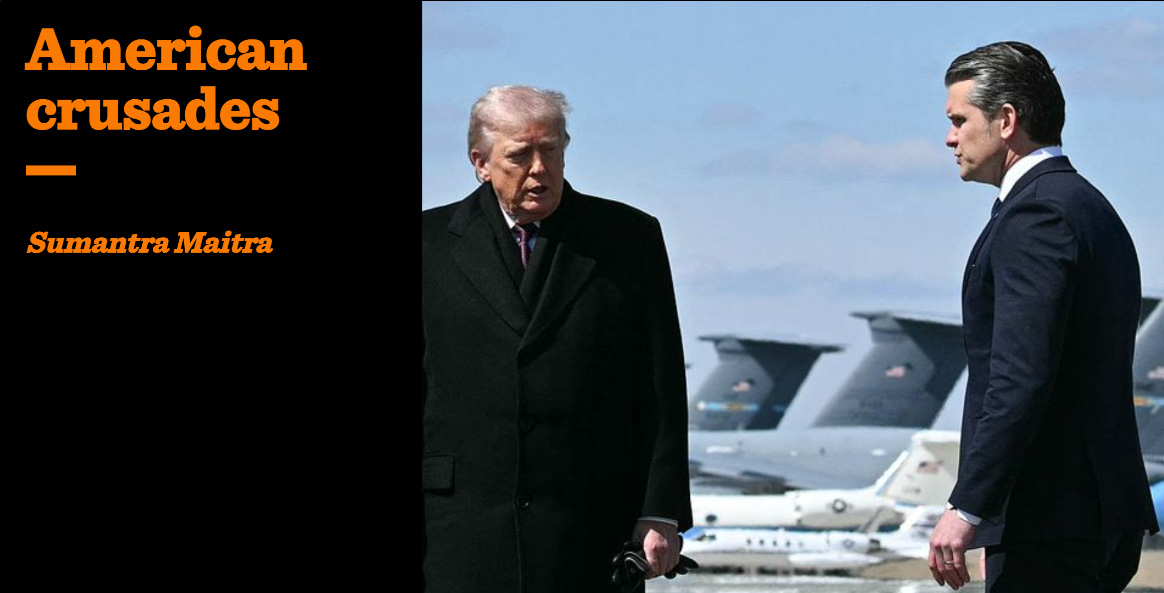
Trump is essentially giving voice to the same crusading instinct that hides deep within democratic America
It is striking to imagine how historians two centuries from now might interpret the period from 2003 to the present, as the age of American Crusades, in which the world’s most powerful state repeatedly engaged in distant conflicts shaped, at least in part, by religious, ideological, and civilizational narratives far removed from its own shores, being the only great power and external actor, materially involved in middle eastern religious wars, which does not at all affect US homeland, way of life or culture, where all the other major players, from Europe, to Russia and China are at best tangentially interested. Europe is different, a rapidly secularising continent, where foreign policy is still significantly elite in practice and perception. But in the US, Trump is essentially giving voice to the same crusading instinct that hides deep within democratic America. Ignoring that as a causal variable, is simply bad history, and bad social science and does no favour to those who genuinely seek a restrained and realist foreign policy.
Historically, among the medieval crusaders, the elite were almost always driven by a mix of spiritual promise, personal glory, and geopolitical realities, while the peasants often joined for far more prosaic and material concerns, quick riches and lands. But there were of course a section of fanatics, who simply joined for bloodlust making diplomacy difficult, as the Church eventually found out dealing with the Templars. Seen from that lens, the American 21st century crusades make some sense, as does the difference between intra-Christian denominations in the US. The motivations appear more diffuse and abstract, often less the product of direct national necessity than a mix of religious commitments, alliance obligations, and entanglements with reckless protectorates that pull the larger power into conflicts not entirely of its own making. But it is foolish to ignore the main variable, working class populism is susceptible to foreign lobbies as well as civilizational and crusading rhetoric. The materials for the design itself are flawed.
This, déclassé-Right, for lack of a better definition, will continue to be an important factor. No other factor can adequately explain why a random congressman and a champion of the working class populist right, from one of the poorest states of the Republic, regards the welfare of Catholics in Nigeria as his pet project. Contrast that to the following: “As the government of the United States of America is not in any sense founded on the Christian Religion, as it has in itself no character of enmity against the laws, religion or tranquility of Musselmen, and as the said States never have entered into any war or act of hostility against any Mehomitan nation, it is declared by the parties that no pretext arising from religious opinions shall ever produce an interruption of the harmony existing between the two countries”, the Treaty of Tripoli declared in 1797. The American founding fathers, patrician high-church protestant Englishmen and detached foreign policy realists to the core, would have been befuddled and scandalised with this absurd crusading impulse among a portion of their republic in its 250th year.
The American right wing populists demand that they need to form a counter-elite. The problem is that they are far too democratic, far too easily swayed by propaganda, and far less deferential to any form of elitism, prudence, propriety and restraint, as governing principles. A detached Kissingerian realism is incompatible with social media, mass public opinion, civilizational crusades and Huntingtonian populism.