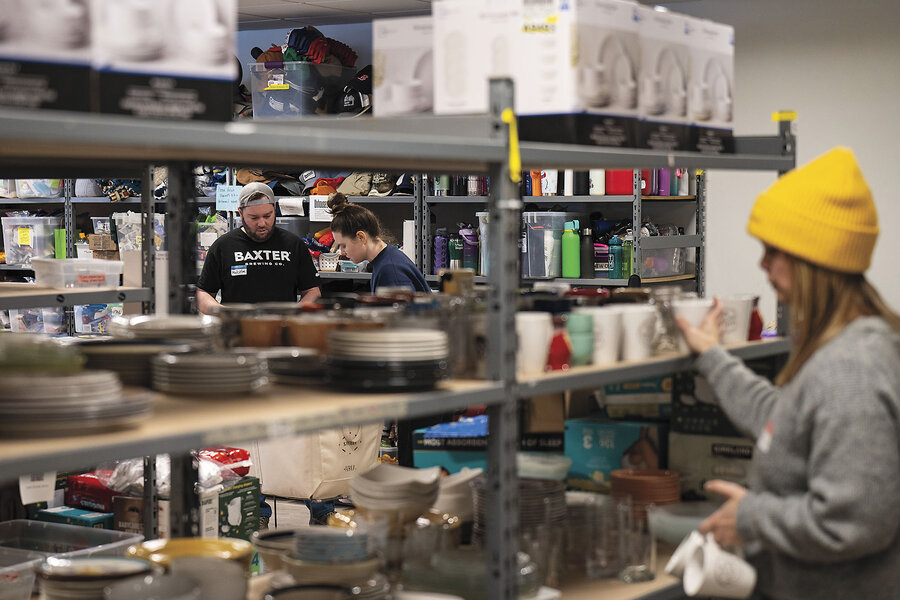
On a blustery afternoon, volunteers and staff members at Maine Needs, a nonprofit on the outskirts of Portland, hustle between shelves stacked high with toilet paper, cookware, and spray bottles filled with cleaner. Wielding clipboards, they jot down notes and organize mountains of donations that will soon be piled into blue bags for distribution to families who need them.
For many Mainers, basic personal care and household items are too expensive. When faced with a choice between good breath or a full stomach, many have to choose the latter.
Angela Stone, founder and executive director of Maine Needs, hopes to solve that problem. What began in 2019 as a Facebook group has grown into a statewide powerhouse that provides essential goods to any Mainer in need. Last year, Ms. Stone says, the organization reached some 77,000 people across the state.
Why We Wrote This
Some 40% of households in Maine struggled to afford essentials in 2023, according to the ALICE report. Taking care of whoever needs it, without stigma, is a driving principle for the Maine Needs organization.
“We all wake up needing the same basic things,” she says. “If we can really start to see one another and lean into that in actionable ways, we’re unstoppable.”
Some 40% of households in Maine struggled to afford essentials in 2023, according to the ALICE report, a project by United Way that measures hardship. That figure includes not only those below the federal poverty threshold, but also almost 178,000 households who earn too much to be officially considered poor but not enough to feel secure.
Federal initiatives such as the Supplemental Nutrition Assistance Program, better known as SNAP or food stamps, can help families afford groceries. But these benefits can’t be used for nonfood essentials, including feminine hygiene products and soap. The average price of personal care products rose 12% between March 2020 and January 2026.
“We’ve had mothers burst into tears because this is what they were asking for,” Ms. Stone says. “A way to clean their clothing, their bedding, wash their dishes – clean their space.”

Ms. Stone’s staff members and volunteers dole out bags of clothes, diapers, and other supplies to make achieving such tasks possible. Volunteers put together “mini warmth kits” for homeless people, replete with hand warmers, lotion, lip balm, and Dunkin’ gift cards. They also assemble gift kits for mothers, who Ms. Stone says need “a little bit of joy.”
“It’s really quite extraordinary what she has created,” says Sarah Borgeson, a Portland resident who runs St. Elizabeth’s Jubilee Center, a pantry that gives out essential goods. “They have figured out how to identify, throughout the state of Maine, where the pockets of needs are.”
No stigma
Standing in what’s dubbed the overflow room – housing clothes and other donations that staff and volunteers can’t immediately find homes for – Ms. Stone says she never planned to take on a project of this scale. It began as a much smaller effort to help asylum-seeking mothers settle into their new lives in the United States.
In 2018, while Ms. Stone and her family were living in Chicago, the Trump administration announced it would separate children from their families if they crossed the border illegally. The administration billed it as a “zero tolerance” policy to deter unauthorized immigration.
As she moved her family to her home state of Maine, Ms. Stone started calling nonprofits to see how she could help. An interior designer, she figured that she could offer her services to immigrant-owned businesses or aid newly arrived immigrants as they settled into their homes.

She found a different kind of want. About a third of immigrants in Maine earn less than 200% of the federal poverty level – the cutoff for being considered “low income” for many government programs – compared with 24% of native-born Mainers. Ms. Stone started collecting supplies through Facebook and delivered them. In 2020, she incorporated the group into a nonprofit distributing essentials to anyone in Maine.
Taking care of whoever needs it, without stigma, is a driving principle for the organization. Unlike many government programs, Maine Needs doesn’t ask for proof of income. Instead, it relies on a network of some 550 people – including social workers, teachers, and nurses – in every county in the state. They identify people in need, coordinate with Maine Needs staff, and help give out supplies.
“You can take care of everybody at the same time,” Ms. Stone says. “I don’t think one baby deserves diapers more than the other.”
“Doing good for people”
Maine Needs also builds a sense of community among its workers. On a Friday in February, volunteers and staff members mill throughout the headquarters, where bookcases are full of donated children’s books and rooms are stocked with diapers and toiletries.
Doreen Jamieson, who has volunteered with Maine Needs since its doors opened, has watched the organization grow and change. What has stayed the same is its purpose. She tried out a few volunteer gigs after she retired to the Pine Tree State. But her first visit to Maine Needs stood out.
“It just felt like you were doing good for people,” she says by phone. “You get emails from caseworkers with real people, and … it just really touches your heart.”
Demand for volunteering spots at Maine Needs has surged recently, Ms. Stone says. It takes some three months to get a shift. Last year, about 7,000 people volunteered.
Maine Needs has also grown quickly on social media. Every month, the organization gets between 4 million and 7 million page views across its platforms, Ms. Stone says. Last year, the staff relocated to a headquarters about four times larger than its old one.
Mainers seem eager to help Maine Needs grow.
Ms. Stone stands next to a pile of donated clothes that are yet to be sorted. Soon the garments will be hung on racks or neatly folded into bags for distribution. This particular mound reaches to about knee level.
That’s nothing, Ms. Stone says. Often, the piles tower far higher. To demonstrate, she raises a flat hand to about eye level, then smiles.