The backlash to my new book, Suicide Of A Nation: Immigration, Islam, Identity, has been nothing short of frenzied. While rocketing straight into the bestseller charts on Amazon as their sixth most sold book in Britain this week, and sparking enormous debate in the Press and online, the book (and I) have come under a wave of extraordinary, almost unhinged criticism from the Left.
Few of my critics have addressed my arguments specifically. Most, instead, have preferred to seize on what they claim are inconsistencies, inaccuracies and even the absurd categorically untrue notion that the book was somehow ‘written by AI’.
Others have feebly sought to weaponise the fact that I decided not to release the book with a mainstream publisher. Well, having written seven previous books with establishment publishers – these days a staunchly woke industry – I know for a fact they would try to censor and dilute a book that tackled the topics I did.
For example, I strongly suspected the demographic projections I make in the book, which are all based on official census data using the same methods adopted by the Office for National Statistics, would have likely fallen foul of a traditional publisher, with their ‘sensitivity readers’ designed to swerve anything controversial.
And yet these projections form the core of my argument. In the book I show how, unless we urgently change course, the White British will become a minority by the year 2063: a historic turning point that will come much sooner among the under-40s, potentially as early as the year 2050.

I strongly suspected the demographic projections I make in the book, would have likely fallen foul of a traditional publisher, says Matt Goodwin
Meanwhile, people who were born overseas – ‘foreign-born’, to use the official terminology – and their children will go from constituting 19 per cent of Britain today to more than 60 per cent by the 2070s. And by the end of the century, the share of people following Islam in Britain will rocket from roughly one in every 17 people to roughly one in every four, including potentially as many as one in every three young people.
I take no joy in sharing these numbers. And I suspect millions of Britons will find them as alarming as I do. Yet my critics, instead of addressing these issues head-on, are instead working overtime to try and discredit a book they disagree with on political grounds.
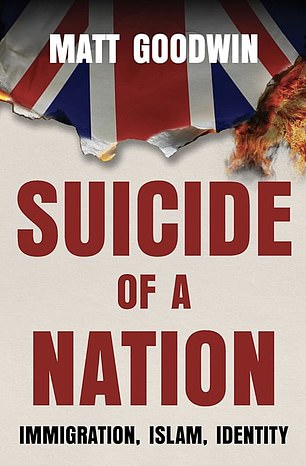
The backlash to my new book, Suicide of a Nation: Immigration, Islam, Identity, has been nothing short of frenzied
They are so incensed that, as I write, they are bombarding the book’s Amazon page with one-star reviews, trying to put people off from reading the truth about what is happening.
Others, predictably, have claimed the book is ‘racist’, ‘incendiary’, ‘divisive’ and ‘toxic’ when, in reality, it is none of those things. Calling for an end to mass migration and to control our borders are policies that might be loathed by the chattering classes who attend literary festivals, but they remain firmly popular among the hard-working majority – and plenty of Daily Mail readers.
But let me drill down into one or two of the specific claims being made against me. Some critics have alleged that Suicide of a Nation contains ‘factual errors’, some of them supposedly obtained from artificial intelligence.
But actually this is true – and the official school census data prove it. In Leicester last year 56 per cent of children spoke a language ‘known or believed to be other than English’. In secondary schools, it’s 53 per cent; in primary schools it’s a scarcely believable 59 per cent.
Or look at Slough, where close to 60 per cent of children in state primary schools do not speak English as their main language, according to the census.
While my critics would prefer to ignore these statistics, many people – like me – look at them with a sense of dread. What, they will quietly ask, are our politicians doing to the country we love?
While I am happy to confirm that I obtained some of these figures after making AI searches, I also checked them against the official datasets. I included a reference to AI in the book’s footnotes for this reason – ignorantly leapt upon by my critics – so I have nothing to hide.
In fact, I go much further in the book: those same official datasets, such as the latest census, also tell us that there are now at least a million people in England who cannot speak English well or at all. One million!
Aside from the fact British people are now forced to spend tens of millions of pounds annually on ‘translation and interpretation services’ in the NHS and elsewhere as a result of this influx, the simple truth is that a nation cannot be held together without a shared language, which supports a shared culture, identity and way of life. And, like millions of other people, I worry we are losing these crucial things.
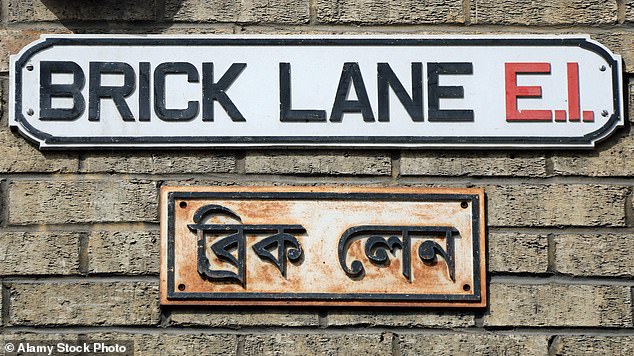
There are now at least a million people in England who cannot speak English well or at all, as signs in east London including at Brick Lane now have Urdu as well as English
My critics have further claimed this week that I was somehow overstating the case when I pointed out that, in some Bradford schools, a vanishingly small number of children mainly speak English. Yet once again, the data backs me up. It is a fact, reported in otherwise fawning BBC articles as far back as 2018, that in at least one Bradford primary school, ‘more than 98 per cent of pupils speak English as an additional language’. Again, I find this deeply alarming. Don’t you?
One prominent Left-wing critic, whom I have agreed to debate this week on GB News, claims that schools in which dozens of different languages are spoken tend to achieve good exam results. But the evidence shows it is not that simple and the debate is far from settled.
Much depends, as the Bell Foundation has shown, on the level of English proficiency among the rapidly growing number of children in our schools who speak different languages, and at what point they arrive at school.
And what, I might add, about the native English children who – unlike their predecessors stretching back centuries – suddenly have to navigate classrooms that may be filled with pupils from around the world speaking different languages, clinging to different cultures and with whom they may have vanishingly little in common? Are we not allowed to consider them?
Official reports, submitted to parliamentary committees, also make clear that ‘teaching and support staff are less confident in working in multilingual classrooms’, suggesting many teachers feel overwhelmed by the way mass migration is impacting their classrooms.
Now have a small number of historical references in the book, such as what the Roman statesmen Cicero and Livy said 2,000 years ago, turned out to be imperfect? Yes. And where that’s the case, those quotations will be corrected. For instance, it appears I was incorrect to suggest that Cicero once said the state should begin ‘with the people closest to us’. What he said, among other things, was Salus populi suprema est lex, which means the good of the people should be the supreme law of the land. If only we had politicians today who felt the same way.
But let’s be clear about what’s happening: my critics would rather nit-pick over interpretations of Latin than deal with the evidence-based arguments I put forward. And these can be summarised in just five words: we are losing our country.
Our leaders, by doubling down on mass immigration, broken borders and a two-tier policy of multiculturalism that prioritises minorities over the majority, are pushing us towards national suicide. My critics’ biggest fear is that more and more people in this country will recognise this simple fact.
That is why their strategy is to attack those who dare to speak it.
The problem for them? I’m going nowhere. For as long as I am living and breathing, I will continue to tell the people the truth about what is happening to our country.
Matt Goodwin is the author of Suicide of a Nation: Immigration, Islam, Identity