The downgrades to the UK economy by the OECD are nothing short of a humiliation for Sir Keir Starmer and Rachel Reeves.
The Paris-based economic watchdog warns Britain will be the hardest hit of all the G7 nations by the conflict in the Middle East – with growth sharply lower and inflation painfully higher.
Instead of being the fastest growing economy in the group, as Labour promised, the UK is becoming a laggard mired in stagflation.
The second slowest growth of the major developed nations and second highest inflation is the worst of both worlds and exposes just how vulnerable Ms Reeves and energy secretary Ed Miliband have left us.
The response from the Chancellor was, once again, delusional.
‘In an uncertain world we have the right economic plan,’ she declared. ‘The decisions we have taken have put us in a better position to protect the country’s finances and family finances from global instability.’
Nothing could be further from the truth.
Britain entered this crisis on its knees – and is suffering a bigger hit than its peers.
Labour and its supporters will of course point to 14 years of Tory rule.
Yet, Ms Reeves has been Chancellor for 630 days and in that time the economy has gone backwards.
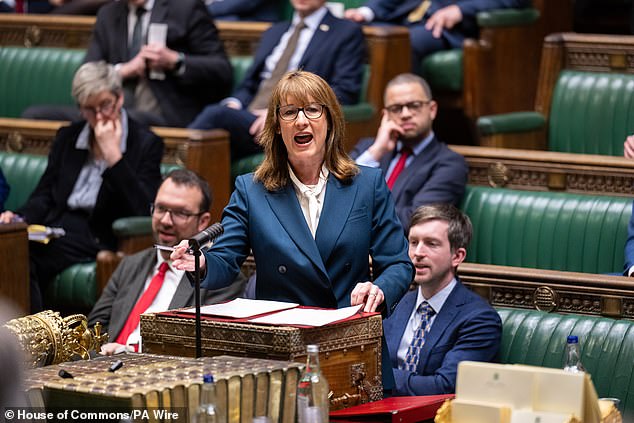
Vulnerable: Britain faces the threat of stagflation under Rachel Reeves
Far from being in a ‘better position’ as the war broke out, the UK economy flatlined at the start of this year and is no bigger than it was in June last year.
That’s more than six months of stagnation before the latest shock.
The malaise is reflected in the moribund jobs market where unemployment has raced from 4.2 per cent when Labour came to power to a five-year high of 5.2 per cent now.
Even worse, youth unemployment is at an 11-year high of 14.5 per cent.
While Britain is not immune to global events – from Donald Trump’s tariffs to geopolitical tensions even before the US and Israel started bombing Iran – the surge in unemployment is of the Chancellor’s own making.
Her £25billion national insurance tax raid, soaring business rates bills, an attack on family firms and farms and inflation-busting increases in the minimum wage have had, and continue to have, a chilling effect on jobs and investment.
All this as business is lumbered with the nightmare that is Labour’s workers’ rights bill alongside other strands of red tape.
No wonder so many firms have slammed the brakes on hiring, particularly of the young, and instead turned to automation and artificial intelligence.
The higher costs that have been layered onto business have also led to higher prices – as seen in the inflation figures.
When Labour came to power, inflation was back at the 2 per cent target, having finally fallen from the 11.1 per cent reached after the end of Covid lockdowns and invasion of Ukraine.
By last month it was back up at 3 per cent – the highest in the G7 – and that was before soaring oil and gas prices started pushing up the cost of everything from food to petrol prices.
All this as Miliband holds the country to ransom by pursuing his dream of clean power whatever the cost rather than the cheaper power needed to drive national prosperity now and in a greener future.
So not only is Britain facing the biggest hit of any G7 nation from the conflict, but we already have the highest rate of inflation, driven up by Labour’s own policies.
The bleak G7 comparisons don’t end there, sadly.
The UK government also must pay more to borrow than any other nation in the group, with ten-year gilt yields topping 5 per cent for the first time since the Great Financial Crisis of 2008.
For global investors, Italy is seen as a safer bet. So too are Portugal, Ireland, Greece and Spain.
These five countries made up the so-called PIIGS during the eurozone debt crisis as international investors baulked a lending to them.
All can now borrow at cheaper rates than Britain.
That is a damning indictment, reflecting missteps of recent years, including the Liz Truss mini-Budget, but also Labour’s priorities that see out of control borrowing and record taxes fund the already bloated public sector and ever-expanding welfare state.
Far from preparing us from this latest global shock, this debt and tax-fuelled spending splurge has weakened rather than strengthened the economy, leaving us more vulnerable than any other major developed nation to the crisis unfolding in the Arabian Gulf.
DIY INVESTING PLATFORMS
AJ Bell
AJ Bell
Easy investing and ready-made portfolios
Hargreaves Lansdown
Hargreaves Lansdown
Free fund dealing and investment ideas

interactive investor
interactive investor
Flat-fee investing from £4.99 per month
Freetrade
Freetrade
Investing Isa now free on basic plan

Trading 212
Trading 212
Free share dealing and no account fee
Affiliate links: If you take out a product This is Money may earn a commission. These deals are chosen by our editorial team, as we think they are worth highlighting. This does not affect our editorial independence.