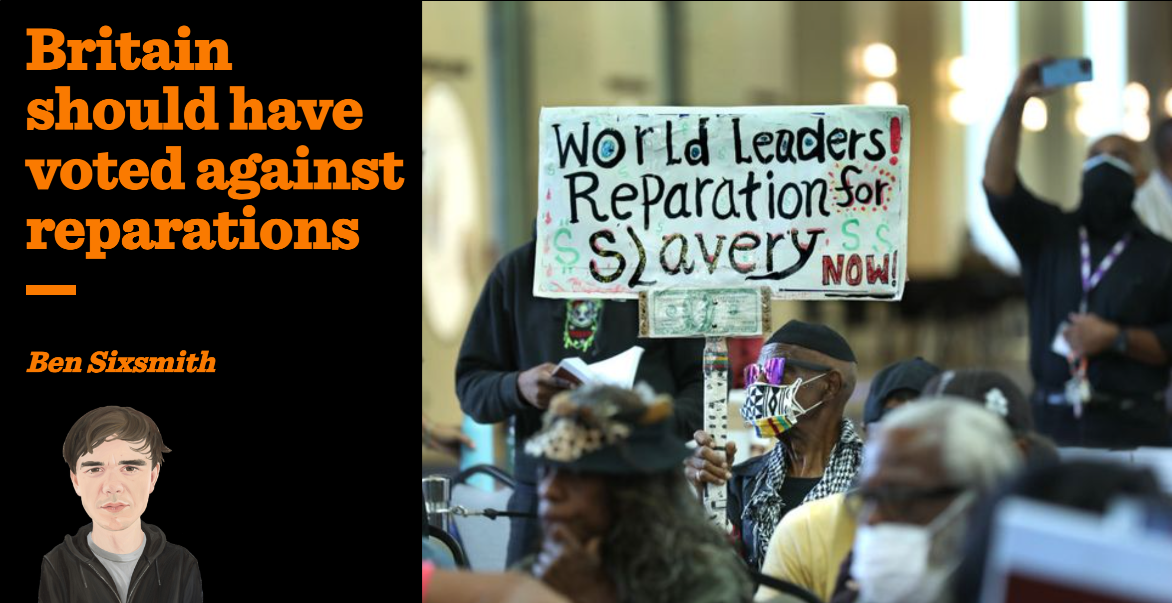

The UK has abstained from a UN vote on whether European states like Britain owe reparations for the transatlantic slave trade. This sort of moral clarity and political backbone should resolve this issue once and for all.
The UK, and other European states, should reject demands for reparations absolutely and completely. This is not, of course, to deny that enslavement was, is and will always be evil — it is monumentally evil. But the case for reparations, as I see it, must rest on at least one of two premises: that X has actually been responsible for crimes or that X is benefiting from crimes. Clearly, Britons are not responsible for the crimes of their distant ancestors. Nor, as Kristian Niemitz explained in 2024, has British wealth depended on slavery.
But the problems with this week’s UN vote on “historical wrongs affecting Africans and people of the diaspora” do not end here. Its focus is only on the transatlantic slave trade. This is despite the fact that the Arab slave trade was comparable in scale and actually lasted longer. Some of the nations which have endorsed this week’s UN resolution are farcically hypocritical. For example, Mauritania voted in favour despite slavery persisting there today.
This is not to acquit slave traders of moral responsibility. “You do it too” is the logic of a child. But it does acquit them of exceptional responsibility.
The difference, of course, is that the descendants of the architects of the Arab slave trade are not doing as well as the descendants of the architects of the transatlantic slave trade. The resolution has less to do with historical injustice than it has to do with modern inequality. But that inequality is not necessarily unjust.
What would be unjust would be to bleed European taxpayers dry over the sins of their fathers (or, to be more precise, their great-great-great grandfathers). Now that’s an injustice.
But I have one more issue with reparations — and perhaps it is broad enough that I can escape the charge of partisanship. I am fortunate enough to live in Poland, where politicians often call for reparations from Germany to compensate for its crimes in World War Two. Now, the Polish case for reparations from Germany seems stronger than the case which has been discussed in the UN. Firstly, the crimes are far more recent. Secondly, the bloodshed — with the Germans killing between 2 and 3 million Poles — was more intense.
Still, if Polish politicians wanted advice from me — which, to be clear, I am very much aware that they do not — I think I would challenge the case for compensation. If nothing else, Poland has been doing very well without it. It has its problems, of course — which I’ll leave to Poles to discuss and debate — but its economy is growing (it recently entered the world’s top 20 economies), its military is the largest in Europe and its tech and manufacturing sectors are prospering.
With this in mind, I’m not sure it should look to the past. Of course, we should remember the struggles and sacrifices of our ancestors. Without them, we would be nothing (literally nothing). But to relitigate historical injustices seems like a distraction from contemporary progress. The fight for reparations is essentially backwards-looking and zero-sum, while Poland has been making exceptional strides through its innovation and its productivity. Of course, I can’t and won’t tell Polish politicians what to do. But it does at least seem like something to consider.
To reduce slavery to one period, and to hold one people responsible, is morally and intellectually wrong
A lot of the governments which voted in favour of the UN resolution are quite simply appalling. To be fair, that is not always true. Ghana’s John Dramani Mahama tabled the resolution, and my limited understanding is that he is a fairly popular and effective president. But look at some of its backers — not just Vladimir Putin, who owes untold reparations today, but the likes of the comically corrupt Equatoguinean regime of Teodoro Obiang Nguema Mbasogo or the blood-drenched Eritrean tyrant Isaias Afwerki. Of course the governments of men like this, or even less egregiously atrocious leaders, want to focus on historical wrongs. They can accomplish nothing good today. Dwelling on the past, and trying to take from other people’s success, is much easier than being successful themselves.
Again, this is not to avoid acknowledging the horrors of enslavement and slave trading. To reduce a human being to a mere commodity is fundamentally appalling even before one gets to additional horrors like drowning, in the case of the transatlantic slave trade, and castration, in the case of the Arab slave trade. We should remember how cruel man can be to man. But to reduce slavery to one period, and to hold one people responsible, is morally and intellectually wrong. The British government should not have abstained — it should have voted no.