Donald Trump told his fellow Republicans that the US and Israel ‘cut out the cancer‘ of Iran‘s nuclear program as insiders claim he’s privately seeking to end the war within weeks.
The president declared victory over Iran’s nuclear threat while speaking to the National Republican Congressional Committee Wednesday and said the US military was ready to deliver the knockout blow.
‘It’s short term. What we had to do is get rid of the cancer. We had to cut out the cancer. The cancer was Iran with a nuclear weapon,’ he said.
‘We’ve cut it out. Now we’re going to finish it off.’
Meanwhile, Trump privately told allies and cabinet members that he doesn’t want the war to be drawn out much longer.
Trump had initially outlined a four to six-week timeline at the beginning of the war and he wants to stick to that goal.
The Wall Street Journal reported that the White House hopes to have the war concluded by the time Trump with Chinese leader Xi Jinping in Beijing hold a scheduled meeting in mid-May.
‘President Trump is extraordinarily skilled at multi-tasking and works on multiple challenges at the same time,’ White House press secretary Karoline Leavitt said.
‘The President is laser focused on fully achieving the military objectives against the terrorist Iranian regime. The president’s sole focus is always victory.’
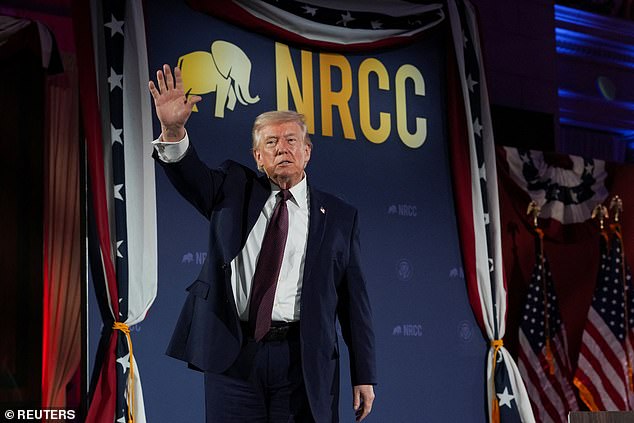
Donald Trump told his fellow Republicans that the US and Israel ‘cut out the cancer’ of Iran’s nuclear plan, while privately wanting the war to end sooner rather than later
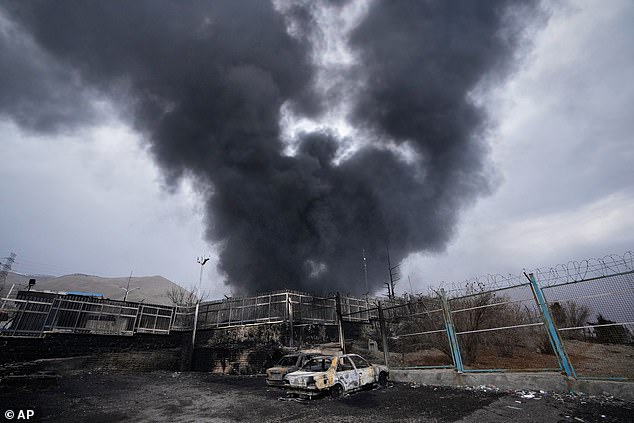
Trump has reportedly been telling his allies and cabinet members that he doesn’t want the war to be drawn out much longer
A source told WSJ that Trump has said the war is distracting from his other priorities, including the SAVE America Act, potentially pursuing regime change in Cuba and even the upcoming midterms.
Trump remains reluctant to put boots on the ground and send soldiers into Iran, with 13 Americans already dead and nearly 300 more wounded, and remains more focused on a deal to end the fighting.
However, sources said Trump has some advisors telling him achieving regime change in Iran would mean great things for his legacy and have said he should lean into the war even further.
Iran on Wednesday dismissed an American plan to pause the war in the Middle East and launched more attacks on Israel and Gulf Arab countries, including strikes that hit a fuel tank at Kuwait International Airport, sparking a fire.
Trump, speaking at a fundraiser Wednesday night in Washington, insisted that Iran still wants to cut a deal.
‘They are negotiating, by the way, and they want to make a deal so badly, but they’re afraid to say it because they figure they’ll be killed by their own people,’ said Trump, who added: ‘They’re also afraid they’ll be killed by us.’
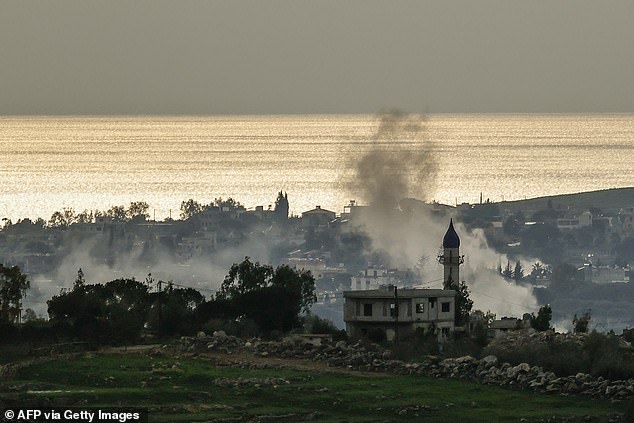
A photograph taken from the southern Lebanese area of Marjeyoun shows smoke as it rises from a site targeted by Israeli artillery in the village of Zawtar El Charkiyeh
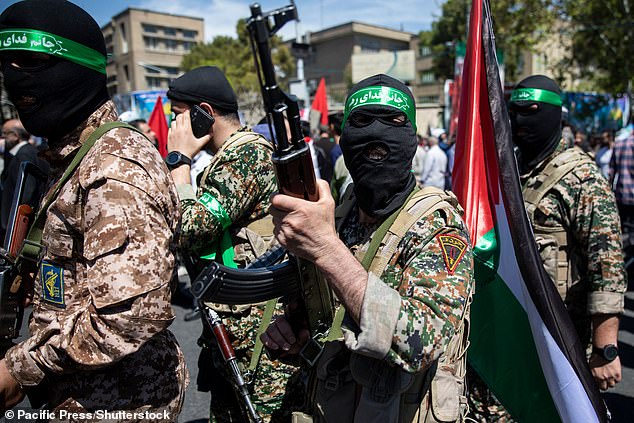
member of the Islamic Revolution Guard Corps shows his AK47 weapon during an annual rally to mark Quds Day, or Jerusalem Day, in support of Palestinians
The US has both deployed more troops to Iran while signaled a willingness to negotiate with Tehran in recent days.
Trump has told advisors that he wants the US to have access to Iranian oil as part of any deal to end the war.
The Daily Mail has reached out to the White House for further comment.
Mediators are pushing for possible in-person talks between the Iranians and the Americans, perhaps as soon as Friday in Pakistan, the Egyptian and Pakistani officials said.
Trump has said the US is ‘in negotiations right now’ and that the participants include special envoy Steve Witkoff, Trump’s son-in-law Jared Kushner, Secretary of State Marco Rubio and Vice President JD Vance.
Trump has not identified anyone from Iran taking part.
Press TV, the English-language broadcaster on Iranian state television, cited an Iranian five-point proposal that includes a halt to killings of its officials, safeguards against future attacks on Iran, reparations for the war, the end of hostilities and Iran’s ‘exercise of sovereignty over the Strait of Hormuz.’
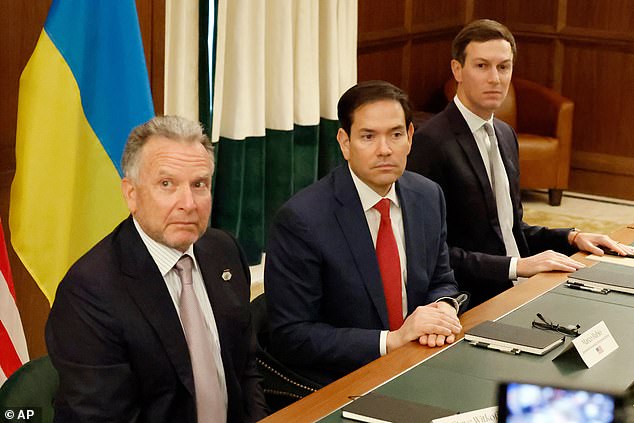
Trump has said the US is ‘in negotiations right now’ and that the participants include special envoy Steve Witkoff (pictured left), Trump’s son-in-law Jared Kushner (pictured right), Secretary of State Marco Rubio (pictured center) and Vice President JD Vance
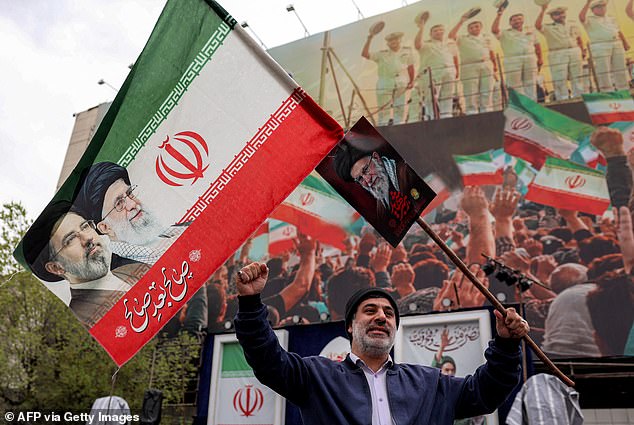
A man holds an Iranian flag showing the faces of Iran’s late and new Supreme Leaders Ali and Mojtaba Khamenei
Those measures, particularly reparations and its continued chokehold over the Strait of Hormuz, likely will be unacceptable to the White House.
While Iran and Oman both have territory in the strait, its narrow shipping channels are viewed as international waters through which all ships can travel.
Any talks between the US and Iran would face monumental challenges. It’s not clear who in Iran’s government has the authority and willingness to negotiate .
Iran remains highly suspicious of the United States, which twice under the Trump administration has attacked during high-level diplomatic talks, including when the war began on February 28.
Tehran’s defiance against the US deal came as Israel launched airstrikes on Tehran and as the United States deployed paratroopers and more Marines to the region.
Foreign Minister Abbas Araghchi said in an interview on state TV that his government has not engaged in talks to end the war, ‘and we do not plan on any negotiations.’
That followed a report from Iranian state TV’s English-language broadcaster quoting an anonymous official as saying Iran rejected America’s ceasefire proposal and has its own demands to end the fighting.
Earlier, two officials from Pakistan, which transmitted the US plan to Iran, described the 15-point proposal broadly, saying it addressed sanctions relief, a rollback of Iran’s nuclear program, limits on missiles and reopening the Strait of Hormuz, through which a fifth of the world’s oil is shipped.
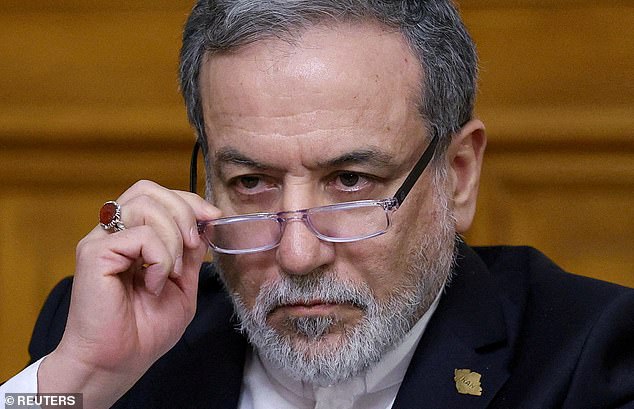
Foreign Minister Abbas Araghchi said in an interview on state TV that his government has not engaged in talks to end the war, ‘and we do not plan on any negotiations’
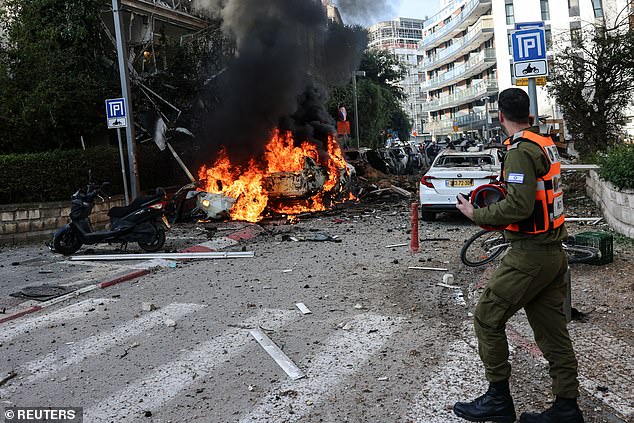
An emergency worker walks at a site following Iranian missile barrages in central Israel
An Egyptian official involved in the mediation efforts said the proposal also includes restrictions on Iran’s support for armed groups. The officials spoke on condition of anonymity to discuss details not yet released.
Iran has long insisted it won’t discuss its ballistic missile program or its support of regional militias, which it views as key to its security.
And its ability to control passage through the Strait of Hormuz represents one of its biggest strategic advantages.
Iran’s attacks on regional energy infrastructure, along with its restrictions on the strait, have sent oil prices skyrocketing, putting pressure on the US to find a way to end the chokehold and calm markets.
At least 1,000 troops from the 82nd Airborne Division will be sent to the Mideast in the coming days, three people with knowledge of the plans told The Associated Press. They spoke on condition of anonymity to discuss sensitive military plans.
The paratroopers are trained to jump into hostile or contested areas to secure key territory and airfields.
The Pentagon is also sending about 5,000 more Marines trained in amphibious assaults and thousands of sailors to the region.
The news of potential negotiations drove down the price of oil. Brent crude oil, the international standard, was trading around $100 a barrel Wednesday, after nearing as high as $120 earlier last week.
That’s still up around 35 percent from the start of the war.
Economists and leaders have warned of far-reaching effects if energy prices remain high — from rising prices on food and other basics to higher rates for mortgages and auto loans.
Iran has allowed a small number of ships through the Strait of Hormuz, but has said no ships from the US, Israel or countries seen as linked to them can pass.